



Rep. John Ley express no confidence in IBR’s $17 billion price tag and 400 percent increase in consultant fees
Rep. John Ley
for Clark County Today
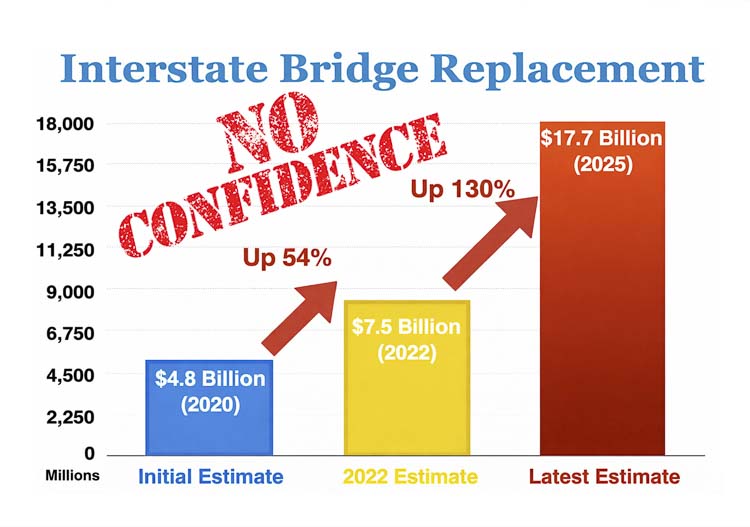
Recent revelations by Portland economist Joe Cortright and Willamette Week about a $17.7 billion cost estimate for the I-5 Interstate Bridge Replacement Program (IBR) spell the doom of the project. Legislators and the public have lost confidence in almost every aspect of the project, including the General Engineering Consultant firm, WSP. The program hides information and doesn’t appear to be truthful nor forthright when asked direct questions.
After two years of waiting, the program didn’t reveal cost numbers they had for at least four months, but Cortright’s Public Records Request unmasked the ugly truth. The $7.5 billion high end cost estimate jumped to $17.7 billion for a fixed span bridge. This leaves a funding gap of at least $10 billion. Neither state has the money to fill this huge hole.
Interim IBR Project Manager Carley Francis had told legislators in December they would not have updated costs in January. The IBR would wait for the Coast Guard decision, hoping for a fixed span bridge to be approved. Yet nearly three years ago, the Coast Guard rejected the idea of a fixed span bridge providing only 116 feet of clearance for marine vessels on the Columbia River.
At the Dec. 15 meeting of legislators tasked with oversight of the project, Rep. Thuy Tran (Democrat, Oregon’s 45th District) was told information she sought would need to be requested via a Public Records Request. “I would say your group is not doing its work,” she responded.
Sen. Jeff Wilson (Republican, Washington’s 19th District) was told there would not be an option to cut the $2 billion TriMet light rail component to save money. He wanted to prioritize the various components of the project.
Rep. Shelly Boshart Davis (Republican, Oregon’s 15th District) was told the federal government would make the decision on one versus two auxiliary lanes for the bridge. She then unloaded on the staff. “We can’t definitively say one or two auxiliary lanes, yet we definitively say yes to light rail,” she exclaimed in frustration.
Legislators were told the cost difference between a fixed span bridge and one with a lift span was $500 million. Yet Cortright revealed an IBR document showing only a $200 million difference.
In a separate part of the column, Cortright says “If IBR chooses to build a moveable span bridge because the Coast Guard will not vacate its earlier decision requiring a 178′ navigation clearance, the total cost of the project would be an estimated $14.6 billion, and could range as high as $19 billion.” That would leave a $12 billion funding shortfall.
Construction is now estimated to take 20 years, according to IBR construction contract timelines. Cortright notes:
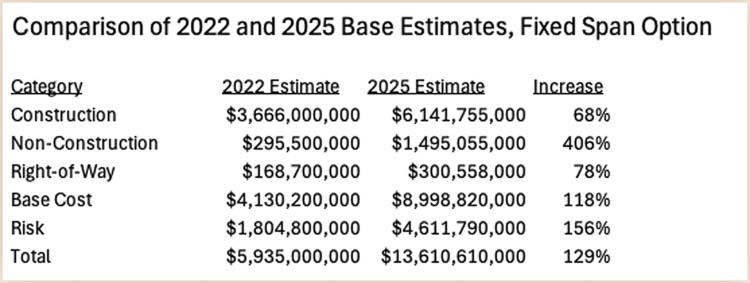
“Construction costs are predicted to rise by about 68 percent over the earlier estimate. ‘Non-construction’ costs – which are chiefly the costs for engineering consultants and staff time – are predicted to increase six times faster than actual construction costs, by 406 percent, compared to just 68 percent for construction. Higher non-construction costs constitute a $1.2 billion increase in total project costs.
“The report confirms that the $1.2 billion increase is for staff and consultant expense and in part reflects the long duration of the project, which is now expected to continue for nearly 20 years, to 2045.’’
Available funding
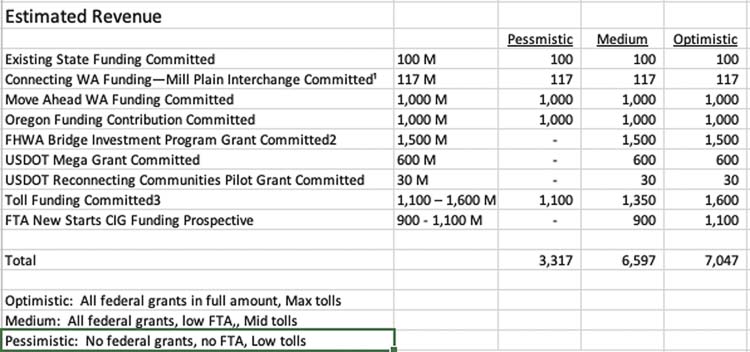
In 2023, the IBR’s finance plan listed federal, state, and tolling dollars providing between $6.3 billion and $7 billion in funds to build the project. This included between $1.1 billion and $1.6 billion in toll related funds. Rep. Jake Fey (Democrat, Washington’s 27th District) passed a bill allowing WSDOT to borrow up to $2.5 billion tied to IBR tolling revenues in 2025.
The IBR is relying on $2.1 billion in federal DOT funds, plus another $1 billion from the Federal Transit Administration for the transit component. However if the project doesn’t get a Record of Decision (ROD) and “shovels in the ground” by the end of September 2026, the federal money could be moved to other projects around the nation.
While each state has committed $1 billion, Oregon has been on a “pay as you go” plan, having only funded $500 million so far. They owe an additional $500 million in the next five years according to the IBR’s finance plan.
Yet Oregon’s Gov. Tina Kotek has recently called for her legislature to rescind their $4.3 billion transportation tax package, just passed in an October emergency session. Could this add another $500 million hole to the IBR’s financial troubles?
Cortright estimates the IBR could have as little as $3.3 billion in funds available, and an “optimistic” $7 billion. Nonetheless, that is $10.7 billion short of the high IBR cost estimate of $17.7 billion. If the IBR chooses the lift span bridge, the funding shortfall could be $12 billion.
The federal government is not likely to bail out the troubled program. DOT Secretary Sean Duffy recently pulled back $400 million from Oregon’s I-5 Rose Quarter project that began with a cost estimate of $450 million and is now projected at $2 billion. Last year, he also killed $4 billion for California’s high speed rail project.
Both states face additional challenges for their transportation dollars. The December flooding caused significant damage, especially in Washington. No cost estimates are available, but Gov. Bob Ferguson has proposed an additional $3 billion transportation package for road and bridge maintenance and the state ferry system. None of it goes to the IBR.
With a $10 billion funding hole, the financial burden on each state would be an additional $5-$6 billion that neither state has available. Oregon just put on “hold” the $4.3 billion statewide transportation package, and the governor is now seeking to rescind it.
Other challenges
Last fall, the IBR team slashed transit ridership projections by roughly 84 percent. They had failed to use a federally required STOPS model for their projections. There is no longer a need for “high capacity” transit as part of the bridge. Many citizens question how WSP and the IBR team could not know about the requirement. It appears they were also hiding this from legislators and the people.
TriMet is facing its own financial nightmare. Following a decade of nearly $6 billion in operating losses including $850 million last year, the transit agency is now talking about cutting $300 million in service, including MAX light rail. This does not include $847 million in unfunded employee pension and benefit obligations. Will TriMet even be around in a decade?
The IBR is at least two years behind schedule in submitting its final Supplemental Environmental Impact Statement (SEIS) to the federal government. The program needs to provide “answers” to the 10,000 citizen comments submitted over 14 months ago. The federal government will require extensive time to review the questions and IBR team responses.
That in turn has delayed consideration of a Record of Decision. Many believe it is now near impossible for the project to obtain the ROD in 2026. During the failed Columbia River Crossing (CRC), it took three years for a ROD to be issued.
Presently, the WSDOT contract with consultant WSP allows them to spend up to $293.5 million on the IBR. As of June 30, 2025 the IBR had spent $235 million. That cost should be updated soon to reflect end of year spending, likely to approach $260 million.
Oregon and Washington legislators should stop the financial bleeding on this out of control project. The lack of truthfulness by IBR officials warrants a vote of no confidence in the program. The money’s not there and citizens are feeling over-taxed in both states.
Also read:
- VIDEO: WA diesel hits record $6.53, crushing truckers and school budgets
 With diesel nearing $6.53 per gallon in Washington, trucking businesses and school districts now confront sharply higher fuel expenses affecting budgets and workers.
 - Opinion: In plain sight – yielding to pedestrians
 Drivers often fail to see pedestrians due to inattentional blindness, which highlights the need for more focused awareness at intersections and stronger safety practices.
 - Expect delays on SR 14 in Vancouver for guardrail repairs Wednesday
 State Route 14 travelers in Vancouver should plan for morning delays as WSDOT will close two eastbound lanes for guardrail repairs, affecting mileposts 6.0 to 7.0.
 - Overnight closure planned on westbound SR 14 Camas Slough Bridge Tuesday
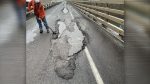 WSDOT crews will close westbound SR 14 at Exit 14 in Camas to collect bridge deck samples and plan future repairs; detours will be in effect.
 - Opinion: Stay in your lane – seriously, it’s the law
 Drivers must choose the nearest lane when turning in Washington, and left turns bring added risk. Even with signals, every driver must help prevent crashes by following law.
