


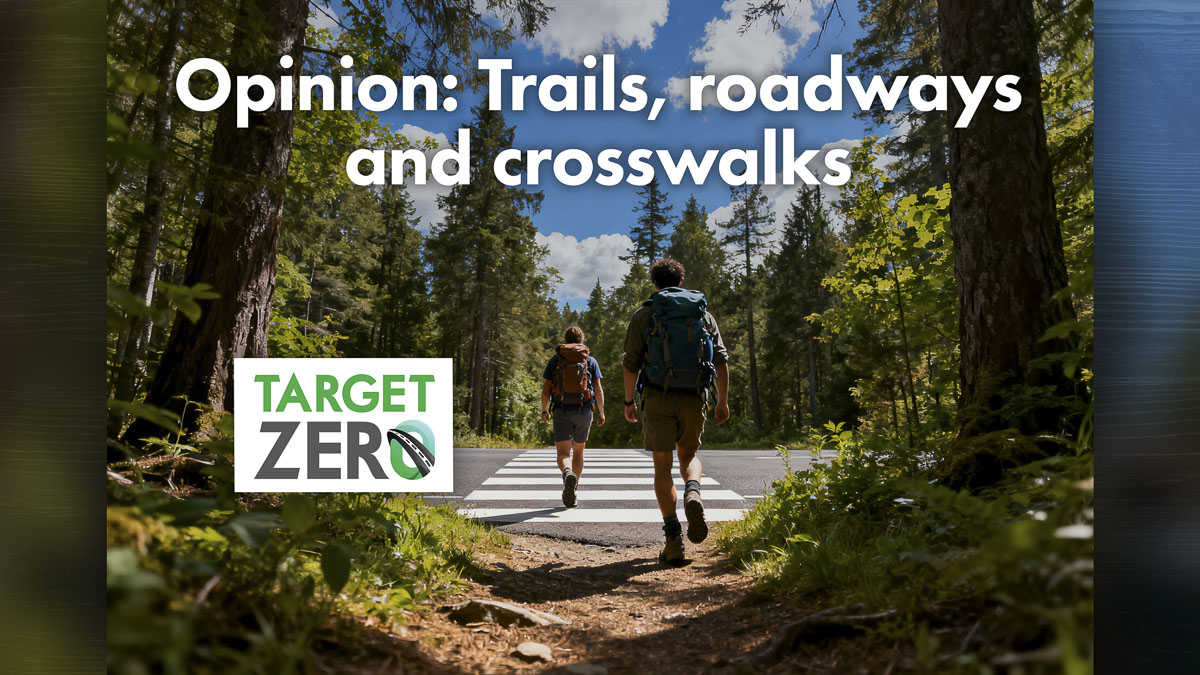
Doug Dahl addresses a question of hiking trails that cross a road and marked as a crosswalk
Q: Many places where hiking trails cross a road are marked as a crosswalk. Are those crossings which aren’t marked considered implied crosswalks in which pedestrians have the right-of-way? In a related question, sometimes there are stop signs on the trails. What is the impact of those signs, and do they have any legal meaning for walkers?
A: It seems a bit silly to put up stop signs for walkers, doesn’t it? I mean, if you’re travelling at around three miles per hour, you’re almost stopped already. For all the trail users traveling on foot, those stop signs weren’t put there for you. But since they are there, well, I’ll get to that in a minute.
Let’s start by clarifying some terms, starting with ‘crosswalk.’ The definition in the law is not reader friendly, so let’s go with this: Crosswalks exist at every intersection of roadways. They extend across the roadways from each of the corners of the intersection. When there’s paint on the road, like zebra stripes or a ladder, that’s a marked crosswalk. But the law is clear that paint or no paint, if there’s an intersection, there are crosswalks.

What, then, is an intersection? Where roads intersect, that’s an intersection. Too obvious, right? It’s there in the description. But to answer our question we need to know, when a trail crosses a road, does the trail count as a road?
The RCW defines a roadway, in part, as “ordinarily used for vehicular travel.” While bicycles are considered vehicles, it’d be hard to argue that a trail or shared-use path fits the definition, especially since the law goes on to say that sidewalks and shoulders are not part of the roadway even though they can be used by cyclists. Plus, the law doesn’t even consider a junction between an alley and a street to be an intersection.
No intersection means no automatic crosswalks. If you’re a hiker on a trail that crosses a roadway, unless there’s a marked crosswalk, you’re required to yield the right-of-way to traffic on the road. It’s also a good survival skill.
Getting back to those stop signs on trails, they’re put there for the cyclists. Or, at least, mostly for cyclists. The Manual on Uniform Traffic Control Devices includes the regulation of low-speed human or electric-powered transportation devices as well.
At a walking pace, if a densely wooded trail suddenly opened up to a roadway, you could easily stop if needed to yield to traffic. At cycling speeds, you’d need a warning. Depending on vehicle speeds, traffic volume, and visibility, traffic engineers may install either yield or stop signs on bicycle facilities (which include shared paths) that cross roadways.
Do walkers have to stop at those stop signs? The law states that drivers, cyclists, and pedestrians shall obey “any official traffic control device applicable to thereto,” and I can’t find anything that exempts pedestrians from those stop signs. Now, here’s a twist: a few years ago Washington passed a law that allows cyclists to treat stop signs as yield signs, when safe to do so. Does that mean that walkers are required to stop, while cyclists may not have to?
However you interpret the law, if you’re a trail user, it’s still you versus a multi-ton projectile that doesn’t have a stop sign. Drivers, please remember that imbalance of power and be vigilant – if you’re the biggest and fastest, you have a responsibility to be the safest too. Trail users, please remember that even a painted crosswalk isn’t a free pass and you’re putting your safety in the hands of a stranger.
Also read:
- Opinion: Portland’s War on Cars Part 4 – A smarter automobile strategy to end gridlock
 O’Toole argues fuel wasted in Portland-area congestion has sextupled since 1982, generating 250,000 tons of extra greenhouse gases annually.
 - Opinion: Transit ridership trends are dismal but regional plans are oblivious
 Puget Sound transit passenger-miles fell 31% from 2015 to 2024 despite a half-million-resident population increase.
 - Interstate Bridge Replacement Program seeks qualified firms for bridge replacement contract
 The CRBR project is backed by $5.7 billion from state funds, federal grants, and future tolling.
 - Opinion: Bankrupt – A $3.5 billion Rose Quarter Freeway widening project
 Joe Cortright argues ODOT’s Rose Quarter project has grown from a $450M approval to a $3.5B estimate, with a $2B funding gap.
 - Opinion: Portland’s War on Cars 3 – Ending the war on automobiles
 O’Toole argues Portland should add toll lanes, fix safety hazards, and redesign TriMet routes to end its anti-auto policies.
 wpDiscuz