



IBR Administrator Greg Johnson: “We want to accommodate folks who do not drive”
John Ley
for Clark County Today
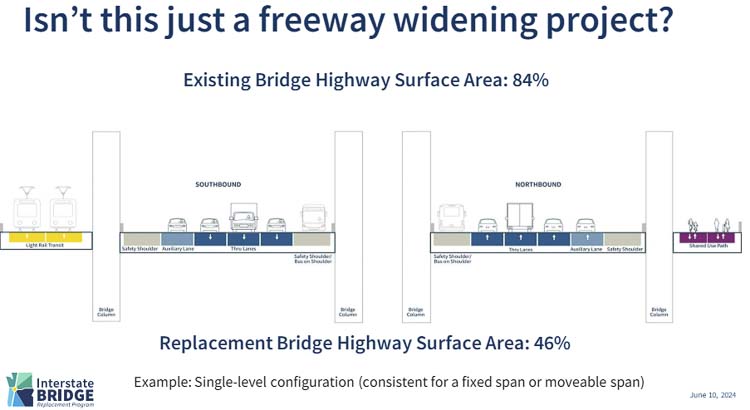
The Interstate Bridge Replacement Program (IBR) is proposing that over half the new Interstate Bridge be dedicated to anything but cars and freight haulers. IBR officials revealed to the 16 members of the Bi-state Bridge Committee on Monday that only 46 percent of the surface of their single-level bridge will be highway lanes for cars and freight haulers. They want to replace an over congested three-lane bridge with another three-lane bridge, plus a single auxiliary lane for merging.
The overall width of the single-lane structure would have 208 feet of usable surface, according to Administrator Greg Johnson. The three through lanes plus the one auxiliary lane planned for the replacement bridge would use 46 percent of that surface. The current two Interstate Bridge structures have 84 percent of their surface for vehicles according to an IBR graphic.
“It’s a huge bridge,” Johnson said, speaking of the view from Hayden Island. He indicated the single-level design the program is considering is 270 feet wide.
“Building more through lanes does nothing,” he told the committee. “We want to accommodate folks who do not drive.”
Sen. Lynda Wilson noted the significant reduction in space allocated for vehicles compared to active transportation. “I have a concern that we’re paying more attention to multimodal transportation,” she said. She told Johnson we should be focusing on the needs of cars and freight haulers.
“We are not ignoring the needs of the highway traffic,” Johnson responded. But he laid out all the problems for bicyclists and pedestrians, including the noise levels and their effort to keep only a 4 percent grade. But how many interstate freeways have pedestrian and bike facilities on them?
“We’re not ignoring any mode,” Johnson said. “We’re making sure that we’re building something that, if you choose not to be in a car, you can safely have an enjoyable trip across this bridge.”
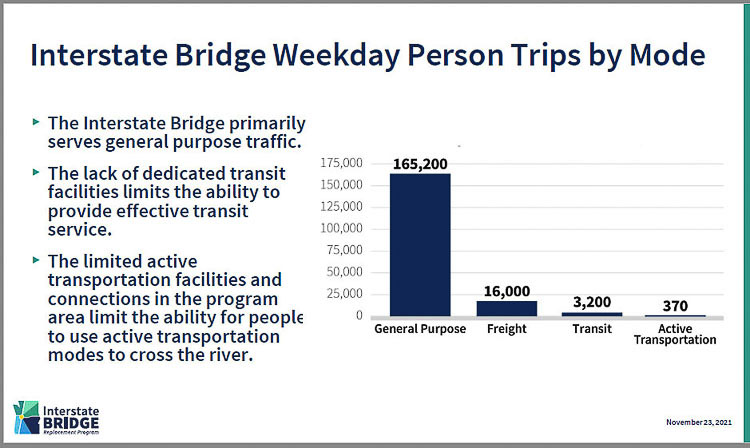
Over two years ago the IBR program shared that there were 370 active transportation trips a day over the bridge versus 184,400 with all other modes.
Legislators pushed questions of cost-sharing equity. The fact that less than half the new proposal was for cars and trucks brought appropriate questions about who will pay for those portions, not for cars and trucks.
“Would there be tolls for pedestrians and bicyclists,” Oregon Rep. Shelly Boshart Davis asked. Johnson said that’s not under consideration.
With a $7.5 billion price tag, Davis noted truckers are already paying more than their fair share of state transportation taxes. The Oregon Trucking Association is currently suing the state alleging they are paying 34 percent more than is appropriate.
Rep. Ed Orcutt asked if they don’t get all the money expected or if bids come in higher, would they consider scaling back the project? He noted the current plan remains $1.5 billion below the high estimate. Economist Joe Cortight has estimated the revised price tag to be $9 billion.
Ray Maybe, assistant program administrator, said they remain committed to delivering the project build within the current ($6 billion) budget. Yet, it was admitted inflation and cost estimates are a concern. Last December, program officials told legislators they would have an updated cost estimate sometime this year.
Frank Green, assistant program administrator, reported they hope to have an announcement next month on their request for $1.5 billion from the DOT’s Bridge Improvement Program. Earlier this year they received $600 million from the “mega grant” program. They also expect to apply to the Federal Transit Administration for between $900 million and $1.1 billion next year in transit funding.
Tolling remains part of the planned funding of the project. A subcommittee of the Washington and Oregon Transportation Commissions has been meeting since February. They will determine toll rates, and whether or not there will be a low income toll relief program.
Johnson noted the Draft Supplemental Environmental Impact Statement (DSEIS) is delayed, but expected to be released by the end of the year. One reason is the Federal Highway Administration (FHWA) and Federal Transit Administration (FTA) have changed requirements for both traffic and transit projections on projects seeking funding. “Some models are over-projecting ridership,” he said.
That brought pushback from Cortright. “Traffic modeling is foundational to the entire project,” he told legislators during public comment. He said current IBR modeling is wrong and is “a mark of the incompetence of staff.’’ Cortright estimated the change in modeling will delay the project six to 18 months. He’s been saying the modeling was bad for quite some time.
Legislators were told the existing bridge costs $1.2 million per year to operate and maintain. The IBR said it will require an estimated $270 million in capital maintenance by 2040, not including the cost of seismic retrofits, as a reason for not repurposing the existing bridges. But the $1.2 million annual cost is only $19.2 million by 2040. It was not explained what the other $250 million in costs were attributable to.
Oregon Rep. Khahn Pham asked if there was any resolution on transit funding. TriMet is demanding “new revenues” (taxes) from both states to pay for operations and maintenance of the three-mile light rail extension into Clark County. She noted C-TRAN’s position is they will not pay for any of the costs of light rail. There was no answer from Johnson or the IBR staff.
Transit projections have been questioned for years. Almost nobody believes the IBR projections that I-5 transit ridership will be 26,000 to 33,000 boardings a day, by 2045. C-TRAN reported that they picked up just two more daily boardings on their I-5 express buses in 2023. They carried just 525 people over the Interstate Bridge and less than 1,000 total when including the I-205 Glenn Jackson Bridge.
The program is designing wide safety shoulders to allow C-TRAN Express buses to speed past vehicles stuck in congested traffic, with their Bus on Shoulder program. The IBR’s current traffic projections indicate travel times in the morning will double to 60 minutes, when traveling from Salmon Creek to the Fremont Bridge. Additionally half of rush hour traffic will be stuck going zero to 20 mph by 2045.
The “active transportation” component of the bridge will be expanded from the current four-foot-wide sidewalk to an unknown larger-sized pathway. The light rail extension would be on the west side of the bridge, with bikes and pedestrians on the east side.
Questions were asked about when people may lose their homes to eminent domain to the project and their ability to make input. Johnson referenced the release of the DSEIS later in the year, but also said eminent domain was the last tool they use in their tool box. There are 40 Vancouver single family homes in IBR crosshairs plus 35 floating homes on Hayden Island.
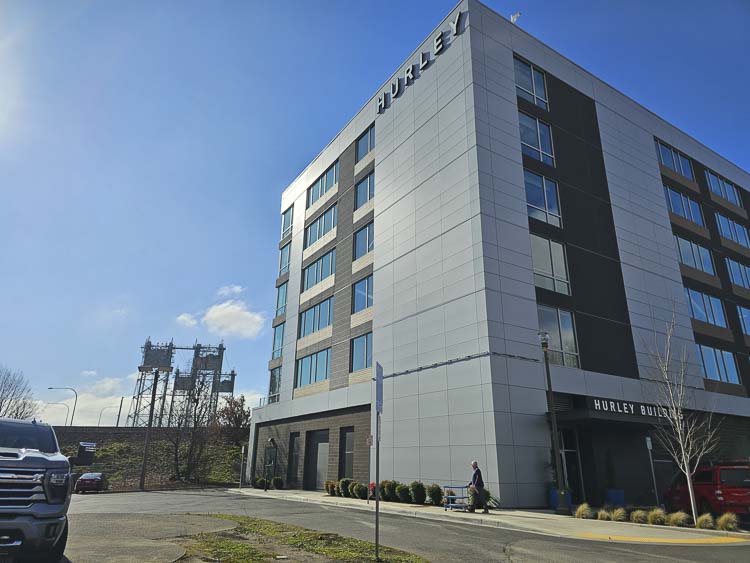
Rep. Paul Harris asked about the loss of the Hurley Building and impacts on upriver businesses. The Hurley building is only 5 years old, and is the sight of the proposed waterfront MAX station about 75 feet above ground level. The responses indicated no final list of negatively impacted properties will be produced until they receive a Record of Decision from the EPA.
The Coast Guard remains an obstacle to the project. They are demanding a bridge with at least the current 178 feet of clearance for marine traffic provided by the current bridge. They would prefer “unlimited” clearance offered by either a bascule or swing span bridge, or a tunnel. It’s been over two years since they made that demand, with no resolution.
The Regional Transportation Council (RTC) reported last month there is a “new normal”, which included more people working from home and 68 percent lower transit ridership to work, that would seem to confirm the FTA’s requirement that agencies stop over-projecting transit ridership in their funding requests.
Clark County has added 39,000 new people in the past four years, but only two more people are riding the I-5 C-Tran Express buses on an average day. That should scream “don’t waste money on high-capacity transit right now.”
The majority of people want traffic congestion relief as their top transportation priority. That appears to be the one thing the project fails to deliver, when evaluating their “Purpose and Need” statement. Several community surveys indicate 78 percent of Washington residents and 70 percent of regional residents list traffic congestion and lost time as their top priority for the project.
Also read:
- Letter: Vancouver Mayor Anne McEnerny-Ogle makes several serious and incorrect engineering statements
 Bob Ortblad critiques engineering claims by Vancouver Mayor Anne McEnerny-Ogle, highlighting cost and safety advantages of an immersed tunnel for the I-5 crossing.
 - Washington’s studded tire deadline is March 31
 Drivers must remove studded tires by March 31 or face a $137 fine, with WSDOT urging early action due to busy service centers and no planned deadline extension.
 - VIDEO: WA diesel hits record $6.53, crushing truckers and school budgets
 With diesel nearing $6.53 per gallon in Washington, trucking businesses and school districts now confront sharply higher fuel expenses affecting budgets and workers.
 - Opinion: In plain sight – yielding to pedestrians
 Drivers often fail to see pedestrians due to inattentional blindness, which highlights the need for more focused awareness at intersections and stronger safety practices.
 - Expect delays on SR 14 in Vancouver for guardrail repairs Wednesday
 State Route 14 travelers in Vancouver should plan for morning delays as WSDOT will close two eastbound lanes for guardrail repairs, affecting mileposts 6.0 to 7.0.
 wpDiscuz
