



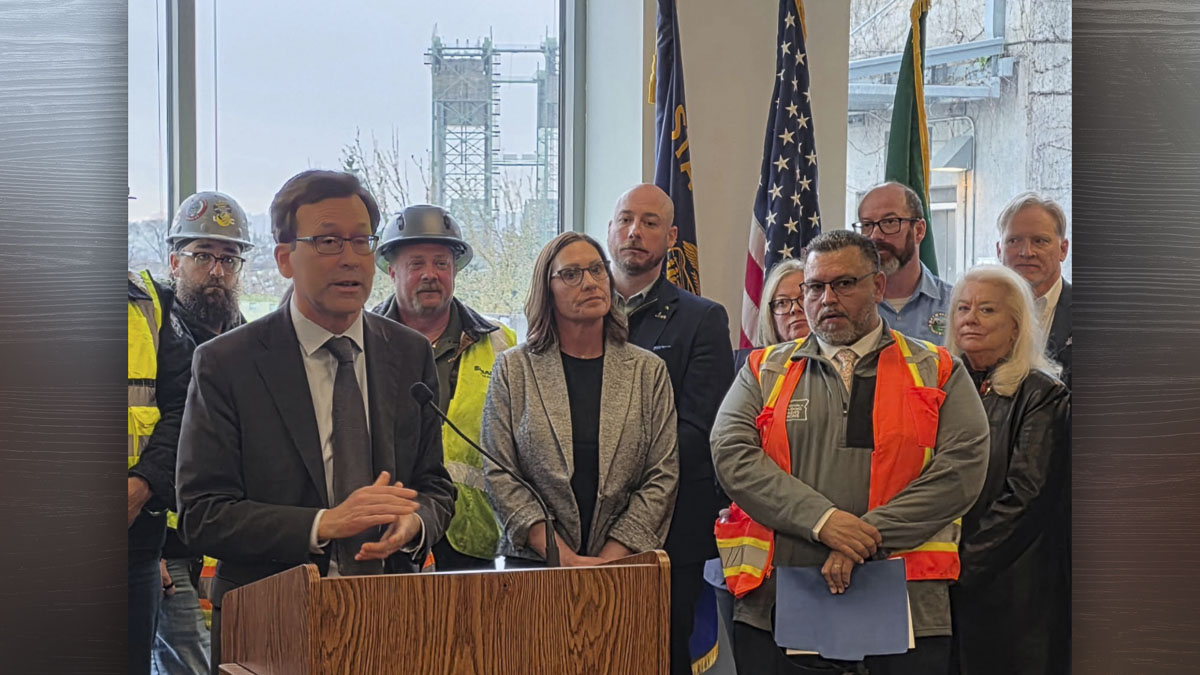
Clark County Today Editor Ken Vance says that in spite of all the pomp and circumstance and sleight of hand used by the governor, mayor of Vancouver, and IBR officials today, you need to remember what we really need is a more cost-efficient project that does not include light rail
Ken Vance, editor
Clark County Today
Tuesday’s press conference with Gov. Bob Ferguson and others to announce the updated cost of the proposed I-5 Bridge replacement project was as nauseating as I expected it to be. While trying to spin it to ease the harsh reality of the announcement that the current cost estimate for the project is $14.4 billion, the elected officials and others confirmed a massive increase doubling the previous cost estimate.

Thanks to Oregon Journalism Project reporter Nigel Jaquiss, we learned specifics of the massive cost increases earlier this year. At that time, members of the Interstate Bridge Replacement Program (IBR) refused to confirm. They wanted to wrap the announcement up in pretty paper and ribbons and parade out the heavy hitters to have their own celebrated announcement. Today’s news conference was a farce. It was a setup. Serious questions weren’t welcomed, nor were they answered. It was a pep rally for those in the overwhelming minority who support the current project.
I hate it when folks like me in the media “fact-check” press conferences or speeches. Not that they don’t need to be fact-checked, but the fact-checkers are usually biased and therefore need to be fact-checked themselves. That said, I’m going to play a little point/counterpoint with the main points made in today’s gathering and I will do so with receipts of links to previous Clark County Today stories that prove the transportation folks and elected officials wrong. They’re not telling the truth nor presenting facts. And now, they’ve got this disaster so far down the road, they don’t even feel the need to fake it anymore.
Governor Bob Ferguson’s main points
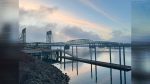
Ferguson said replacing the 109-year-old bridge is essential for public safety, the economy, and jobs. It’s the same thing Gov. Jay Inslee told us seven years ago when they relaunched the Columbia River Crossing 2.0. Ferguson emphasized that more than 140,000 vehicles cross the bridge each day and said the current bridge is vulnerable in an earthquake because of timber piles in loose sand.
He highlighted recent good news from the U.S. Coast Guard, which approved a fixed-span replacement bridge instead of a movable span. He said that decision was important because a movable span would have caused continued traffic backups and would have added about $1.7 billion to the cost.
In this previous CCT report, Erin Wirth, with the US Geological Survey and the M9 Project at the University of Washington, said she believes there is approximately a 14 percent chance of a magnitude 9 earthquake happening in the next 50 years. The bridge is not falling down tomorrow as Inslee and Ferguson have tried to tell us. We have time to revise this current proposed project in order to create one that is more cost effective and efficient, one that better reflects the will of Southwest Washington residents.
Ferguson also acknowledged that project costs have risen. He said the updated estimate for the core project is now $7.65 billion. He and the others did everything they could to avoid using the $14.4 billion price tag because they know how that is being received. IBR officials won’t even confirm how much the light rail portion of the project will cost. Previously, we were told it was $2.1 billion for the 1.83-mile extension. I’m willing to bet that number has risen significantly.
Ferguson made clear that light rail remains part of the project and said the bridge will be built with light rail included. When asked why light rail had to stay in the project, he said that agreement is already in place and that the project is moving forward on that basis.
Ferguson said the program currently has $5.5 billion in state and federal funding available and is pursuing another $1 billion through the Federal Transit Administration’s Capital Investment Grant program. He said construction is expected to start in 2028. Wait just a minute. You currently have $5.5 billion in hand but in months you will begin a project that costs $14.4 billion?
It’s what they call the “phased approach.’’ Sure, the full five-mile corridor project will not be completed all at once. They say additional corridor improvements would be tackled later in phases as more funding becomes available. The reason they use the “phased approach’’ is because there are essentially no alternatives to robbing more of the taxpayers’ money once the project is underway. There is no turning back at that point.
On tolling, Ferguson said it is too soon to say whether tolls will be higher than earlier estimates, adding that Oregon and Washington treasurers are still analyzing the numbers. That’s an outright lie. Just like the overall project cost estimates, they know that it will be impossible to fund a $14.4 billion project, when only $5.5 billion is in hand, without raising tolls high enough to make it hurt those 70,000-plus Southwest Washington drivers who commute to work in Oregon and the trucks that carry goods over the bridge.
Legislative support
State Rep. Jake Fey, chair of the House Transportation Committee, called the bridge replacement the state’s highest transportation priority and said Washington lawmakers have already committed $1 billion, matching Oregon’s $1 billion.
Let’s remember, Oregon hasn’t come up with its $1 billion yet. Last time I checked, they had only come up with 50 percent of that and promised to come up with the rest. Oregon has been a bad partner from the very beginning of this project. The state has more and more failing transportation projects than we can count. Not to mention TriMet, soon to be our newest partner, that is billions in debt.
We need to support an extension of C-TRAN’s Bus Rapid Transit system, at a fraction of the price, instead of TriMet’s Yellow Line light rail extension.
No relief for traffic congestion
Another fact that has been buried for years now is that the current $14.4-billion project will do virtually nothing to reduce traffic congestion, which is the No. 1 issue in the minds of taxpayers as we have reported on many prior occasions.
So, in spite of all the pomp and circumstance and sleight of hand used by the governor, mayor of Vancouver, and IBR officials today, you need to remember this is not the best and most efficient use of the taxpayers’ funds. We need a more cost-efficient project that does not include light rail and it needs to be part of a larger project that addresses a third or fourth crossing that provides congestion relief. There is time to pause and get this right!
Also read:
- Final Supplemental Environmental Impact Statement published for Interstate Bridge Replacement Program
 Federal agencies published the final environmental impact statement for the Interstate Bridge replacement project.
 - Speed cameras designed to bring added safety to work zones
 WSP issued 65,000 infractions in first year, with 59,000 being penalty-free first offenses as program expands statewide.
 - Marie Gluesenkamp Perez seeks federal assistance in combating sea lion predation of salmon & steelhead fishing stock
 Congresswoman pushes for expanded lethal removal authority as sea lions devour Columbia River fish stocks.
 - Opinion: The high cost of hiding – Why IBR’s delayed revenue study is a $15 billion warning sign
 IBR delays critical toll revenue analysis until June 2027, hiding financial details until after project approval.
 - Opinion: The high cost of hiding – Why IBR’s delayed revenue study is a $15 billion warning sign
 IBR delays critical toll revenue analysis until June 2027, hiding financial details until after project approval.
 wpDiscuz
