
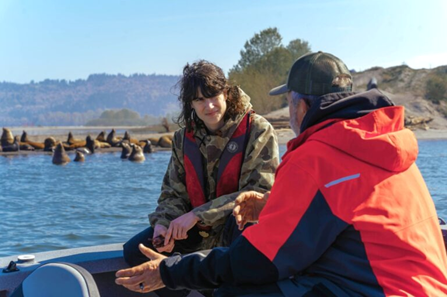
Rep. Marie Gluesenkamp Perez is upping the ante in her effort to address the predation of salmon and steelhead by California and Steller sea lions in the Columbia River and its tributaries.
The Congresswoman wrote to U.S. Secretary of Commerce Howard Lutnick, who oversees the National Oceanic and Atmospheric Administration (NOAA) and its fish management activities, to partner on new removal strategies to curb sea lion populations.
“Sea lions have eaten four times as many salmon as our fishermen and Tribes have harvested in the Columbia River in a year. During the 2025 spring season, nearly one-fourth of fish at Bonneville Dam show wounds from sea lion bites,” Rep. Gluesenkamp Perez wrote in her letter. “We need NOAA, in close partnership with states and Tribes, to examine what strategies yield the best results for pinniped removals—including direct, lethal removal.”
She continued, “when grocery prices are at record highs, it is insulting to my community to waste taxpayer dollars while fishermen continue to be denied their ability to put food on the table for their families.”
Sea lions have learned that they can find an abundance of fish without any effort by swimming out of the ocean and into choice points on the river. In many cases they only take a bite of the belly before discarding the remainder of the fish.
Sea lions are protected under an outdated federal law known as the Marine Mammal Protection Act (MMPA). While similar to the Endangered Species Act, this law sets a blanket protection on all marine mammals, meaning that even when a species’ population has recovered and become invasive, they cannot be taken except under extreme circumstances. In 2018, Congress gave expanded removal authority to states and Tribal managers in the Columbia River, but only with burdensome removal processes and at the price tag of $38,000 per sea lion or $203 per salmon recovered.
Rep. Gluesenkamp Perez argues that salmon and steelhead – and fishermen – across Southwest Washington would be better off if removal authorities were extended from River Mile 112 of the Columbia River to River Mile 66, where the water is no longer salty enough to replicate traditional sea lion habitat.
Using her position on the House Appropriations Committee, Rep. Gluesenkamp Perez has previously drawn attention to the diminished salmon and steelhead stocks and the shortcomings of current sea lion removal strategies. She successfully included language in the Fiscal Year 2026 Commerce, Science, and Justice spending bill directing NOAA to study which pinniped removal strategies are most cost-effective and humane.
She also attended the December 2025 House Natural Resources Subcommittee on Water, Wildlife, and Fisheries hearing on “Sea Lion Predation in the Pacific Northwest,” to bring attention to the urgent need for creative, targeted solutions to control sea lion populations to save salmon.
Comments
Loading comments…