


🎧 TriMet’s $850M Loss Raises Questions About Light Rail Funding
Rep. John Ley discusses the IBR team putting light rail first in contracting plans
Rep. John Ley
18th Legislative District
Underlying the turmoil and significant debate regarding the I-5 Interstate Bridge Replacement Program (IBR) are two key issues for Southwest Washington citizens. At the top of the list is a $2 billion, 1.83-mile extension of TriMet’s MAX light rail into Vancouver, and tolling. Those two issues have been a lightning rod for close to two decades, killing the earlier Columbia River Crossing (CRC) effort in 2013.
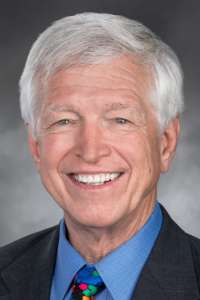
Rep. John Ley
Six of the eight planned 2026 construction packages are for light rail components. One is for “pre completion tolling signage,” and the other for “Columbia River Bridge.” Light rail components are at the front of IBR contracting priorities, but likely dead last on the people’s priorities.
As part of the IBR proposal, Portland’s TriMet has demanded Washington taxpayers (initially in Clark County) pay for a portion of the yearly operations and maintenance (O&M) costs of the MAX light rail. This flies in the face of C-TRAN providing bus service into Portland for decades and Portland (TriMet) having never paid a penny towards the bus service.
The city of Vancouver, where the light rail will touch down, does not want to pay that cost. This resulted in an extended, year-long battle at the C-TRAN Board where County Councilor Michelle Belkot was removed by Chair Sue Marshall and the other three county councilors.
Underlying the political battles, is a critical question. Why would Clark County taxpayers want to be financially tied to Portland’s TriMet? What are the potential risks and rewards of a permanent financial tie to TriMet? What is their current financial situation?
Poor TriMet management
Everything about TriMet screams “poor management!” The agency had an $850 million operating loss last year. It is currently discussing cutting $300 million in costs, as if a $550 million operating loss is acceptable. The failure of the Oregon legislature to pass a transportation package triggered these cuts, including Green Line MAX service by eliminating half the length of the line.
TriMet ridership peaked in 2012 and has been declining ever since. It fell off a cliff in the pandemic and today it remains roughly 30 percent below prepandemic ridership. By comparison, C-TRAN ridership has recovered to near 2019 prepandemic levels but remains well below its 1999 peak.
In the past four months, headlines like “Portland: Dire Transit Service Cuts Planned” abound as TriMet finally begins to address decades of operating losses and increased taxpayer subsidies.
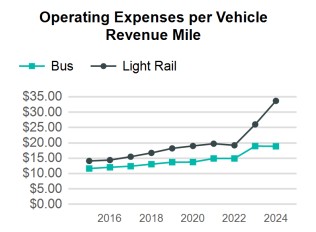
The Federal Transit Administration (FTA) requires mass transit agencies to report critical information annually. The most recent (2024) report shows TriMet’s MAX operating costs have jumped 75 percent in just two years. This compares to bus operating costs going up 26 percent.
Each mile of TriMet light rail costs $34 to operate versus $19 for its bus service. If the light rail vehicles were full most of the time, the higher cost might make sense. But transit ridership in general, and in Portland in particular, is significantly down. People constantly comment about empty buses and empty light rail vehicles.
Passenger fare revenues have plummeted as well. In 2013, fares covered 46 percent of operating costs. In 2024, fares paid for just 7.9 percent of operating costs. Taxpayers not only buy the buses and light rail vehicles, but they are now paying about 92 percent of operating costs.
IBR’s light rail platform
In the failed Columbia River Crossing (CRC) project, an Oregon Supreme Court Justice wrote that the CRC was nothing more than “a light rail project in search of a bridge.” Furthermore, the Federal Highway Administrator for Oregon said the CRC was “a platform for light rail.”
The present IBR proposal, the $2 billion transit component, was over one quarter of the $7.5 billion total project cost. Now that the cost has doubled to potentially $15 billion, the IBR has not updated the specifics, including light rail component costs.
But the IBR’s “Contract Packages” information on the website shows 28 separate construction packages for different components of the project. Surprisingly, this “bridge” project shows six of eight construction bid packages to be advertised in 2026 are for light rail. Only one is for bridge construction. The other for tolling signage.
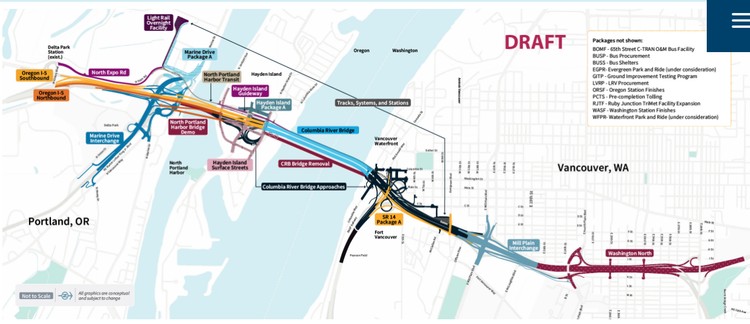
Yet, the IBR reports they won’t apply to the FTA for up to $1 billion in transit funding until 2027. It doesn’t expect a response until 2028. It makes no sense to sign potentially $565 million in light rail transit contracts in 2026 if the IBR team members don’t expect federal funding approval until 2028.
Taxpayers should note the federal government will only cover half the capital costs of a high capacity transit project. This means the two states will have to cover an estimated $1 billion in light rail and bus rapid transit costs. But if the federal funding fails to materialize, then they would be obligated to cover the full $2 billion transit cost.
Hopefully, DOT Secretary Sean Duffy and FTA Administrator Marc Molinaro are taking a very close look at the sketchy details regarding all aspects of the IBR proposal, including the recent plan to “phase” the project.
The recent revelation that the planned light rail extension would stop at the Vancouver Waterfront, roughly 70-80 feet in the air, should add to their curiosity. It certainly is not what people were allowed to comment on in the Environmental Impact Statement, recently submitted to the federal authorities in March.
Clark County citizens already oppose bringing light rail into Vancouver. Having the end of the line 70 to 80 feet in the air will likely only add to their opposition.
Finally, with TriMet having burned through $6 billion in cash over the past decade, Clark County voters will surely be opposed to any demands to cover TriMet’s financial mismanagement.

Also read:
- Opinion: Were Republican voters just sleeping during the August primary election?
 CCRP Chairman Matt Bumala says 60% of primary no-shows in the 17th and 18th districts were Republicans.
 - Opinion: WA Cares’ launch showcased care WA Cares did not provide
 Gov. Ferguson showcased a caregiving arrangement at the WA Cares launch that the program had not paid for a single day of.
 - Opinion: Portland’s War on Cars Part 4 – A smarter automobile strategy to end gridlock
 O’Toole argues fuel wasted in Portland-area congestion has sextupled since 1982, generating 250,000 tons of extra greenhouse gases annually.
 - Opinion: The Tooth Fairy’s secrets to making brushing & flossing magical
 Delta Dental of Washington’s Tooth Fairy Experience offers free resources to help children build lifelong brushing and flossing habits.
 - Opinion: Transit ridership trends are dismal but regional plans are oblivious
 Puget Sound transit passenger-miles fell 31% from 2015 to 2024 despite a half-million-resident population increase.
 wpDiscuz