



$44 million contract explodes to $293.4 million with ‘extra work’
Rep. John Ley
for Clark County Today
As the Oregon Department of Transportation (ODOT) and Washington Department of Transportation (WSDOT) cope with being billions of taxpayer dollars short to maintain roads and bridges, and to complete new projects on the books for the next decade, there’s one firm smiling all the way to the bank. WSP is an international, multi-billion consulting firm advising the two agencies on transportation projects, large and small.
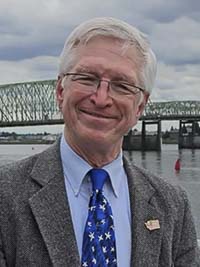
Interstate Bridge Replacement Program (IBR) Administrator Greg Johnson is a former WSP senior vice president. He hired his former employer to act as the General Engineering Consultant (GEC) for the current effort to replace the bridge. WSDOT and ODOT agreed and signed a lucrative contract.
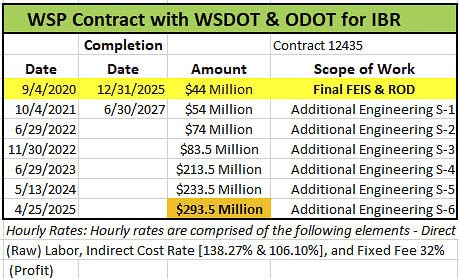
The Sept. 2020 WSP contract indicated they would be paid $44 million in a 5-year contract. They agreed to the following:
The GEC will provide the IBRP with the resources needed to advance the program through NEPA completion (Record of Decision) and pre-construction. This will include providing a Program Manager, in addition to discipline-specific resources and personnel to develop and deliver a program of this complexity.
Five years later, the program has not received approval of the 116-foot bridge height from the Coast Guard. It has not answered the 10,000 citizen comments submitted to the Supplemental Environmental Impact Statement (SDEIS) two years ago. The time frame to achieve a Record of Decision (ROD) from the federal Department of Transportation is in doubt, perhaps late 2026 or 2027 according to some.
But WSP has successfully negotiated multiple amendments to the contract allowing them to spend $293.5 million. The contract was extended 18 months to June 30, 2027.
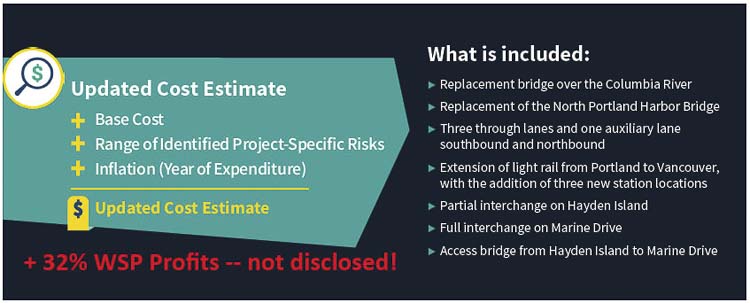
Buried in the details is a stunning revelation – WSP is contractually guaranteed a 32 percent “profit.”
The initial contract allows for “extra work.’’ It’s that extra work that the two DOT’s have approved which allowed the contract to explode over six-fold.
Economist Joe Cortright recently revealed WSP has received $116 million in contracts, of the $273 million the program has contracted for through the end of September 2025. He notes Johnson told legislators two years ago: “Here we are $3 billion later, and basically building the same project,” the failed Columbia River Crossing.
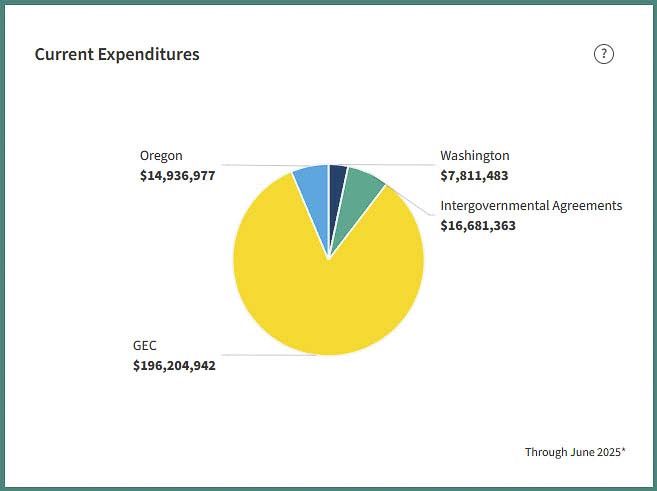
Separately, the IBR website “accountability” page shows the GEC has received $196.2 million of $235 million spent through June 30. That would mean WSP received about $47 million in profit with the other consultants and subcontractors receiving about $148 million for services.
The 44-page WSP contract contains an exhibit listing roughly 30 hourly pay rates, with a 138.27 percent indirect cost additive, plus a 32 percent profit. All told WSP hires a low-wage employee for $23.32 per hour, then adds $32.24 for overhead; and finally adds $7.46 in profit. Taxpayers are billed $63.02 for work paying $23.32 per hour.
High end hourly rates shown are $224 per hour. The additives are $309.72 for overhead, and another $71.63 in profit for WSP. The total taxpayer bill per hour worked – $605.40.
The six contract amendments were for “extra work” and “engineering.” But how much engineering is required for a project that may not receive Coast Guard approval? How much engineering was done to design and engineer the MAX light rail station roughly 90 feet above the Vancouver waterfront? How much engineering was done to create a bridge allocating 54 percent of bridge surface to bikes, pedestrians, and transit vehicles?
Johnson’s team recently cut transit ridership projections by 84 percent. He admitted in June that they had not used the federally required STOPs program to estimate transit ridership when seeking federal funding for projects. ”We guessed, and we guessed low,” Johnson told the C-TRAN Board. How could WSP have not known about a federal requirement created in 2015?
Cortright notes WSP is two years behind schedule on delivering the project to that record of decision. They are late in delivering updated construction costs, which some estimate could be $10 billion. We still don’t know how much Johnson and his team have agreed to pay four up river firms in “mitigation,” if the Coast Guard were to approve the “bridge too low.”
There’s a hard deadline rapidly approaching the program – September 30, 2026. If there is no ROD allowing for construction to begin by then, at least one of the two federal grants disappears. The Trump administration has already been removing multiple federal transportation grants from projects around the nation, including $1.8 billion for Chicago light rail and $4 billion from the California high speed rail.
Johnson recently announced he was stepping away from the project at the end of December. Was he pushed out the door by the two DOTs? Who will be his replacement, given the critically short time frame for a make or break completion of multiple tasks?
But the revelation of the DOTs paying Johnson’s former employer a 32 percent profit margin won’t sit well with taxpayers. When added to the expected updated cost of the project in December to perhaps $9 billion or $10 billion, both DOT’s don’t have the money to pay the increasing IBR costs.
Taxpayers in Oregon are preparing a revolt by collecting signatures to repeal $4.3 billion in new transportation taxes (NoTaxOR.com). Washington citizens are very unhappy with having the first or second highest gas prices in the nation, due to the recent gas tax increase and the impacts of the Climate Commitment Act (CCA). WSDOT says it needs $8 billion just to maintain transportation infrastructure.
Paying a multibillion dollar multinational consulting firm a 32 percent profit margin could be the straw that breaks the camel’s back.
Also read:
- Opinion: Too deep to drive – flooded roads
 Doug Dahl explains why even shallow water on roadways can be dangerous for drivers and outlines the risks of hydroplaning and driving through floodwaters.
 - C-TRAN takes no action on Board Composition Review Committee’s directive
 After a long executive session, the C‑TRAN board took no action on a 4‑3‑2 board composition proposal that has divided Vancouver, Clark County and the small cities.
 - Opinion: Sound Transit – No cause for celebration
 Charles Prestrud argues Sound Transit’s costly light rail expansions have failed to boost overall ridership or ease Puget Sound congestion.
 - Opinion: Simultaneous left turns
 Doug Dahl explains how Washington law directs drivers to make simultaneous left turns by passing to the left of each other in an intersection.
 - Judge grants C-TRAN injunction against WSDOT
 A judge ruled that WSDOT cannot withhold grants from C-TRAN while the agency’s board composition review process continues.

Breathtaking revelation of waste, fraud, and abuse. Thank you Rep Ley for a remarkable look into the grift that is the IBR, and the fleecing of taxpayers that make this Canadian Corporation WSP rich beyond belief.
I hope soon you will expose the depth of this company’s tentacles across SW Washington. I know they corrupted the City Council of Camas years ago with proposed pool bonds, roundabouts, and a $300M Northshore Development that nobody wants. I challenge readers to look no further than their own municipal contracts to discover how much YOUR City or County Government is spending on “planning” with WSP or its numerous subsidiaries.
A majority of voters REJECTED the CTRAN ballot proposition to extend TRIMET MAX light rail over I-5 bridge in November 2012, and also opposed light rail at the ballot box in November 2013. Why spend $BILLIONS to construct light rail, and $MILLIONS to operate & maintain it every year when most residents, don’t want to pay for it, and won’t use it? CTRAN bus ridership over I-5 today is lower than 20 years ago, there is zero justification for high capacity light rail! WSP did a terrible job on outreach for the 90 day comment period and ignored asking for input on social media platforms that WSDOT and ODOT routinely use for traffic alerts. The IBR website has a search function that works poorly. The Director advised residents NOT to comment about safety concerns at an RTC meeting during the public comment period. Residents and businesses on the chopping block to make way for light rail in downtown Vancouver and Hayden Island said they were not fully informed of their upcoming demise during the comment period. The 10.000 comments will likely be meticulously discounted by WSP and affiliates as irrelevant, at an inflated cost. Funds needed to maintain existing roads and bridges are being squandered on WSP profiteering and marketing.