



Program refuses to provide updated costs adding to project perils
Rep. John Ley
for Clark County Today
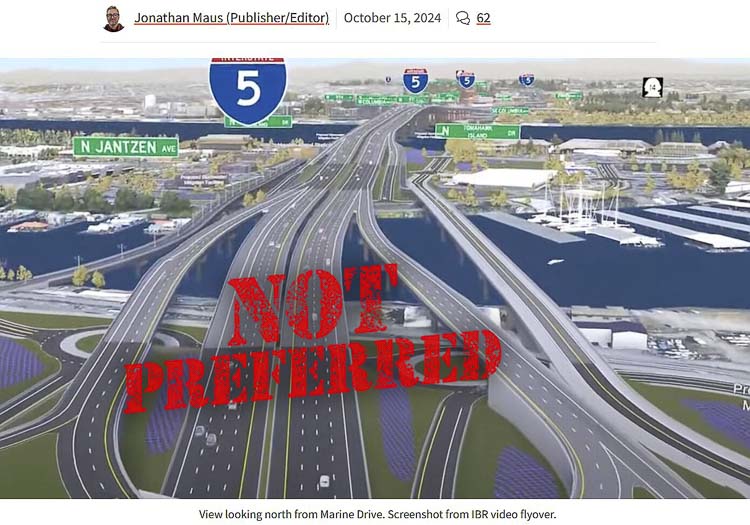
The Interstate Bridge Replacement Program (IBR) is a bridge over troubled waters. It’s too low for the Coast Guard, it doesn’t reduce traffic congestion or save people time, and it costs way too much. Tolling and light rail are troubling components of the proposal.
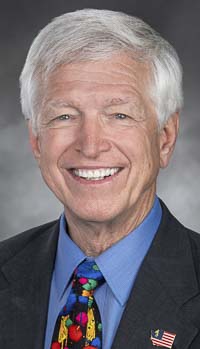
Legislators were extremely unhappy on Monday when 3-year old cost projections were not updated. Representatives on both sides of the river expressed their displeasure as both states have significant challenges in funding transportation. With no cost updates, it’s hard for legislators to deal with the “modified locally preferred alternative” with a $7.5 billion price tag that may be going to $10 billion or more.
The current locally preferred alternative pushed by the IBR is actually preferred by very few of the people we serve. The number one priority people have by an overwhelming margin, is to reduce traffic congestion and save people time.
Yet the unpreferred alternative guarantees travel times and traffic congestion will get worse. According to the IBR’s own data, 46 percent of vehicles currently travel at freeway speeds of 50 mph or greater. Yet in 2045, only 27 percent of traffic will travel at freeway speeds.
Currently, 28 percent of rush hour vehicles travel at zero to 20 MPH. By 2045 fully half of rush hour traffic will be in stop and go congestion, traveling zero to 20 MPH.
The cause of this is replacing an over congested 3-lane bridge with another 3 through lane bridge. Another cause is allocating 54 percent of bridge surface to transit, bikes and pedestrians, while cars and freight haulers only get 46 percent. An additional cause is the failure to use a “collector distributor” as required by federal law when you have freeway interchanges spaced closer than one mile apart.
The Coast Guard does NOT prefer the 116 foot clearance for marine vessels. They told us that over two years ago, and yet the IBR continues pushing that as the “preferred” choice. The program ignored the Coast Guard’s request for the 178 feet height and its preference for “unlimited” clearance for maritime vessels that could be provided by an Immersed Tube Tunnel (ITT) or a bascule bridge.
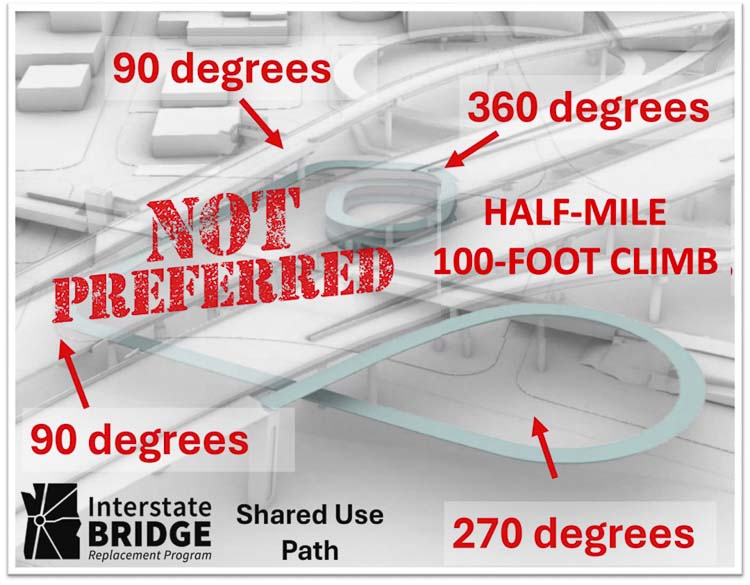
Our active transportation community does not prefer the half mile long ramp to get from the Vancouver Waterfront MAX station down to the ground. Pedestrians and bicyclists won’t use this, when they can easily ride transit one more stop 2,500 feet north, and exit there.
The No More Freeways group does not prefer the current proposal, which is not truly “green.” It will take decades to supposedly save construction related CO2 emissions.
The Hayden Island community does not prefer the current proposal. The footprint of the proposed bridge will ruin the quality of life in the community. And six bridges over the north Portland Harbor will wipe out too many floating homes.
Citizens on both sides of the river do not prefer the tolling. We know this because the Oregon legislature and governor just eliminated the ability of ODOT to toll Oregon roads and bridges. Citizens do not prefer the 55,000 vehicle diversions which will divert to the free I-205 Glenn Jackson Bridge. The ensuing gridlock will be a nightmare for both states.

The citizens of Clark County do not prefer expanding TriMet’s light rail into Vancouver. They definitely oppose paying taxes to fund TriMet’s Operations and Maintenance costs. Almost nobody wants to travel 14 mph on the MAX Yellow Line, when C-TRAN express buses go twice as fast.
The Federal Transit Administration did not prefer the unorthodox method the IBR staff projected transit ridership for 2045. They demanded the use of their STOPS model, which slashed potential ridership by 83 percent to just 4,600 to 5,400 daily boardings. There is no need for any “high capacity” transit.
Clark County’s C-TRAN used to have seven separate express bus lines over the river into Portland. Today they have three; with ridership flat at around 525 daily boardings for the past few years. And that includes I-205 service. Our Delta Park bus service has about 900 daily boardings.
Let’s talk about the $2 billion transit component that is overwhelmingly light rail costs. TriMet lost $850 million last year. Their “solution” is to cut $300 million, but they implemented about $18 million of cost cuts so far. The patient will bleed to death, just a little slower with this strategy.
Will TriMet even be around, given the Oregon citizens’ rejection of the recent transportation tax package? It was going to provide TriMet $45-$48 million annually to slow but not stop the losses.
I believe taxpayers expect legislators to make a thorough evaluation of the project and the proposal. Having no updated cost projection is another huge red flag about the unpreferred nature of the project. Legislators need to prioritize the spending, within existing financial means.
When the Coast Guard stands by its earlier position requiring 178 feet of clearance, the program will blame the Coast Guard for an added $500 million (or more) cost of the supposed “alternative” of a lift span. The good news, is that would save the $140 million in mitigation costs the IBR wants to pay four up river firms for the ‘bridge too low’ alternative.
My suggestion is that Oregon and Washington legislators should hit the pause button now. The program spent $235 million in the first four and one half years. That’s roughly $50 million per year that could and should be used by both states to maintain their current roads.
The people don’t want a bridge too low that doesn’t reduce traffic congestion and save them time. They don’t prefer the expensive and slow, TriMet light rail. In fact they are not preferring any form of mass transit. They definitely don’t prefer tolling.
We don’t need to guarantee WSP as the General Engineering Consultant a 32 percent profit on the continued failure to promote an unpreferred alternative. We need to stop the waste of people’s money.
The current project was opposed over a decade ago. It definitely remains an unpreferred alternative, once again today.
Also read:
- A sub-district vote could be a way to go to pay O&M costs associated with light rail
 Clark County Council members heard details on how a voter-approved C-TRAN sub-district could be created to fund long-term operations and maintenance costs for light rail tied to a new Interstate Bridge.
 - Letter: British Columbia’s new immersed tunnel can solve Interstate Bridge Replacement Program’s $17.7 billion problem
 Bob Ortblad argues that an immersed tunnel similar to a project underway in British Columbia could significantly reduce costs and impacts associated with the Interstate Bridge Replacement Program.
 - C-TRAN offering free service on Transit Equity Day, Feb. 4
 C-TRAN will offer free service across its entire system on February 4 in observance of Transit Equity Day, honoring the legacy of Rosa Parks.
 - Opinion: The many reminders not to speed
 Doug Dahl examines the many technological and policy-based reminders aimed at reducing speeding and explains why most drivers still choose not to use them voluntarily.
 - Rep. John Ley’s new bill calls for an independent audit of Interstate 5 Bridge Replacement Project
 Rep. John Ley introduced legislation requiring an independent audit of the Interstate 5 Bridge Replacement Project to review costs, management, and oversight.

Providing gainful employment for the CRC. IBR and in the future ??? committee. Government happily at work?
The “preferred” design is preferred by a some buffoons who believe that making driving so miserable that drivers will resort to filling those empty buses and light railcars or even biking. When was the last time you saw a biker crossing the existing bridge during the rainy season or any other time?
Yes 2 different bicyclists in the pouring rain on Monday. Many of us have ridden across the bridges for years. There are several bicycle clubs as well as daily commuters. You can easily take your bike on the bus or light rail if you have a longer commute The baffoons making driving so miserable are the drivers themselves, driving too fast, tailgaiting, distracted, on their phones, no concern for safety for others, too many with no passengers. Traffic has only getting worse and there needs to be efficient alternatives. It is ridiculous that there is no efficient way on public transportation to get to PDX from Vancouver. It is nearly 2026 and we ned to gear up for the future.
Thank You for your attention to this matter.
Interesting how John Ley leaves out the reason for the lateness of the latest financials being connected to the government shutdown by republicans to receive info needed from shutdown departments.
Gold plated light rail has never been preferred by Clark County voters. Elevated tracks and stations add to the outrageous cost, difficulty to use, and safety concerns. Public bus ridership across the I-5 Bridge is lower than 20 years ago! Cost effective transportation solutions for all vs. light rail for 1-2% of commuters are needed. Any plan must better accomodate freight and roads for all. A third crossing deserves consideration.