
Rep. John Ley for Clark County Today
Washington and Oregon state legislators overseeing the long-troubled I-5 Interstate Bridge Replacement Program (IBR) are signaling growing frustration with the project's current cost and direction. They particularly zeroed in on its decision to build only a single auxiliary lane and the continued commitment to light rail.

Rep. John Ley
In a lively oversight meeting on Friday, June 12, eight legislators from each state pressed program staff on funding risks, tolling impacts, traffic diversion, and overall costs. The tone was occasionally pointed, with several lawmakers openly questioning key design choices that appear increasingly out of step with practical traffic needs and fiscal reality.
Lane capacity emerges as flashpoint
A central issue was the bridge's auxiliary lane configuration. Program staff presented options for a new Columbia River Bridge, with costs for that segment alone ranging from $3.3 billion to $3.9 billion. Yet when Rep. Shelly Boshart Davis (R-OR) asked about the price difference between one versus two auxiliary lanes, the answer was staggering: an additional $600 million to $1 billion.
Davis repeatedly asked “who” and “when” a decision was made to eliminate the two auxiliary lane option. No clear explanation emerged for why the program had settled on just one auxiliary lane.
Rep. Jake Fey (D-WA) and others voiced support for the extra capacity. Public commenter Doug Tweet pointed to IBR's own data showing that a single auxiliary lane would do little to relieve congestion or save drivers time — while two lanes would deliver measurable improvements.
(Two Bridge Options.png)
Bridge design slides revealed another telling detail: the wider Extradosed option offers 272 feet of width compared to 232 feet for a girder design. The 40-foot difference could easily accommodate more than three additional 12-foot traffic lanes. Staff said that a second auxiliary lane would add just 8 feet to each side of the bridge. The decision to forgo the space allocation to vehicles feels shortsighted to many observers, especially given the project's massive $15 billion price tag.
Tolling, diversion and data skepticism
Tolling remains deeply contentious. Rep. Thuy Tran (D-OR) raised alarms about traffic diversion negatively impacting her east Multnomah County community. Economist Joe Cortright emphasized that up to 50,000 vehicles could avoid a tolled I-5 and shift to I-205 instead. Local advocates including Zachary Lauritzen of Oregon Walks, warned of safety and quality-of-life impacts on northeast Portland neighborhoods.
Program staff downplayed the risks, claiming diversion would be minimal — less than 3 percent of traffic, (roughly 4,200 vehicles). That reassurance rang hollow for some, especially given the program’s history of overly optimistic projections, including questionable light rail ridership forecasts used to justify transit elements.
Skyrocketing costs and uncertain funding
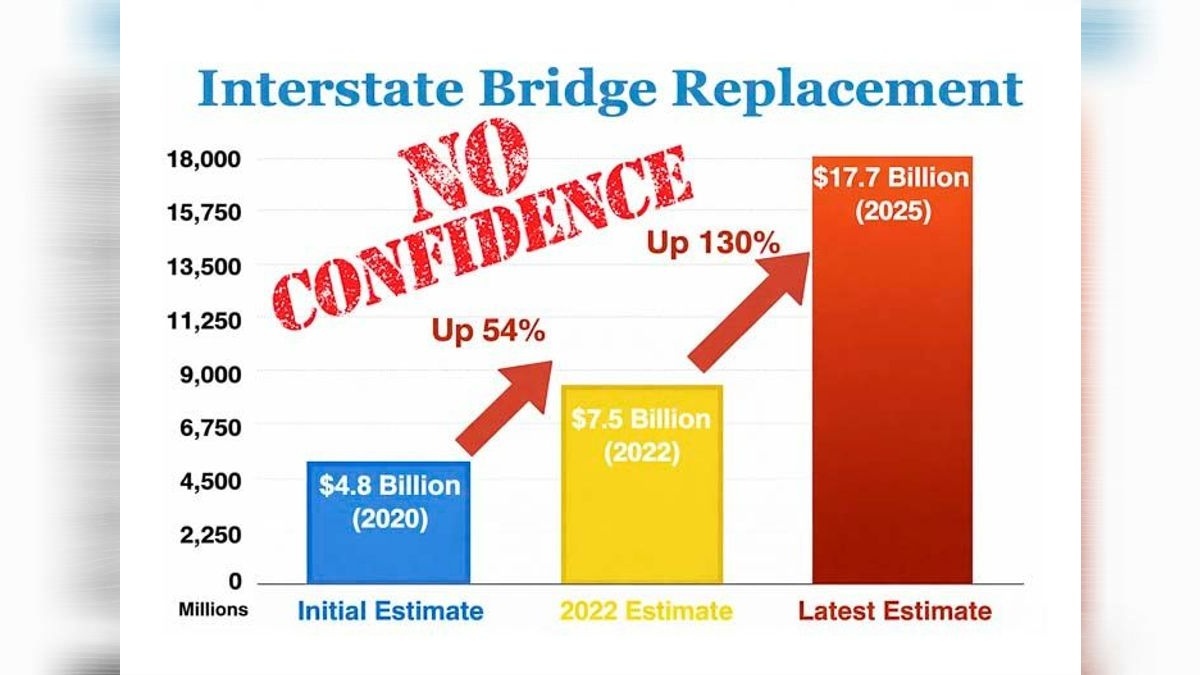
The project’s timeline has slipped dramatically. Phase one construction is now expected to stretch 8–10 years once it begins, with the overall schedule extended by 11 years to the late 2040’s. Critics will recall past statements from former administrator Greg Johnson that delays would cost $1 million per day — putting the price of those 11 years at roughly $4 billion in added costs.
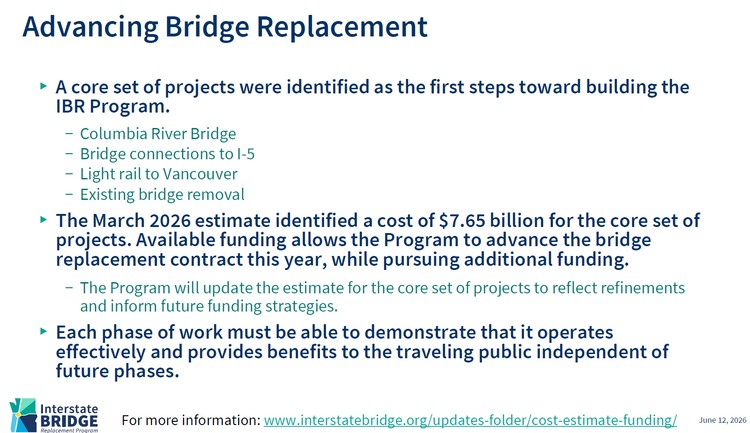
The latest cost estimate for the core project stands at $7.65 billion as of March 2026. The program has $5.69 billion in committed funding but still faces significant gaps, including Oregon’s remaining $500 million commitment and hopes for more federal dollars. The transit (light rail) component alone is pegged at $3.5 billion, meaning the two states would need to find $2.5 billion to cover the balance of transit costs if the Federal Transit Administration approves a $1 billion contribution in 2030.
Staff pointed to contingency funding of $4.2 billion in “risk” and $2.4 billion for “escalation,” but with costs reportedly doubling every couple of years, skepticism abounds. As Cortright has noted, the project’s price has already ballooned over 300 percent — and groundbreaking remains two years away. Oregon voters’ recent 83 percent rejection of new transportation taxes only underscores the political difficulty of filling these gaps.
Light rail future in doubt
The current plan reserves space on the bridge deck for light rail in a potential second phase, but several legislators pushed back. At the meeting’s close, Sen. Chris Gorsek (D-OR) stated plainly that light rail could come later. Rep. Kevin Mannix (R-OR) noted Washington’s prior concession on light rail during the failed Columbia River Crossing project and questioned whether it remains necessary or desired today.
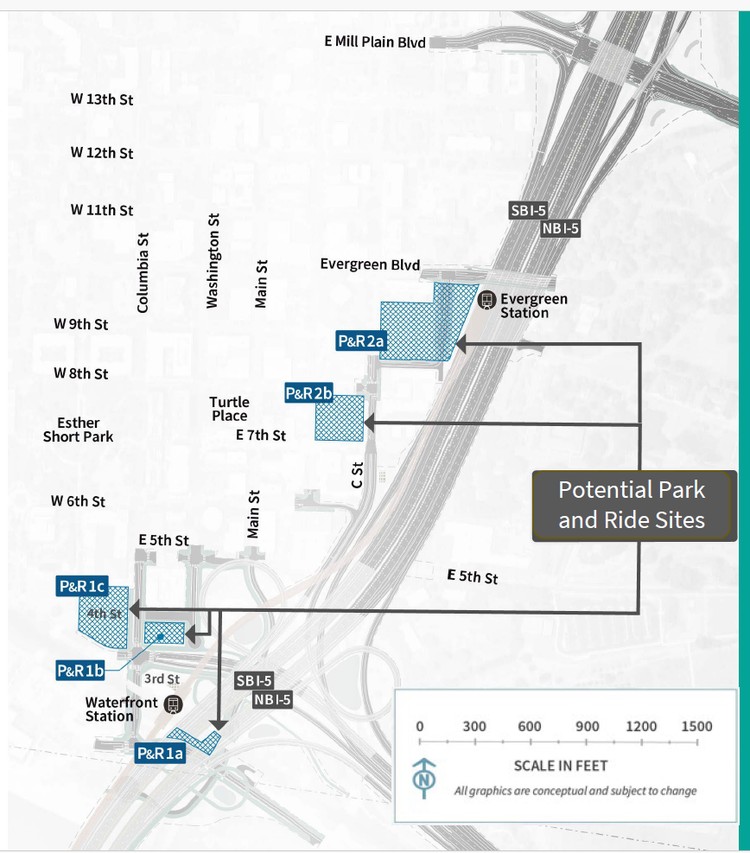
The program showed five potential park and ride sites, two near Library Square and three near the Vancouver waterfront. A total of up to 1,270 spaces were studied. No cost was mentioned.
(Vancouver Park n Ride locations.png)
Pre-completion tolling and equity measures
Tolling is slated to begin in July 2028 with the start of construction, with full post-completion tolling starting in 2035. Four toll scenarios range from $1.55 to $4.70 (in 2026 dollars), with congestion pricing pushing rates higher and annual escalators of 2.15 percent in most cases. Freight operators would face 1.5 to 4 times standard rates.
A proposed Low Income Toll Program (LITP) would offer 50 percent discounts to households at or below 200 percent of the federal poverty level. Native Americans could be exempt. Only 4-6 percent of users are expected to qualify, they said.
Staff was asked how much the LITP would reduce revenue, and therefore how much tolls would need to rise to compensate. They did not know, but said it was a small amount. They indicated they expected the cost of toll collection to be “on par” with the rest of WSDOT’s five toll programs, which ranges from 20 percent to over 40 percent.
What comes next
My concluding remarks to the committee.
“My biggest concern is cost and cost containment. If I track the numbers correctly for phase one, we are still a little short of all the money needed to finish phase 1. The history of this project has been about every 2 to 2 1/2 years, we get a new cost update and it seems to double.
We are 2 years away from the beginning of construction. Therefore, if between now and 2028 costs go up 50 to 100 percent, we won't have enough money. That is an unbelievable, huge concern.”
I thanked legislators who echoed the desire for a face-to-face conversation because I want to hear what each and every one of them have to say. I desire a priority setting meeting – what can we afford? What can we not afford? How do we best move forward, given the reality of the money at hand and what we really need to have versus what we'd like to have.
The meeting concluded with broad agreement to hold the next session in person for better engagement, tentatively scheduled for September 17. A Record of Decision is expected around July 1, with over half a billion in federal funding at risk of expiring by September’s end if milestones slip.
This latest oversight meeting makes one thing clear: patience is wearing thin among legislators on both sides of the river. With costs exploding and core traffic relief seemingly under-prioritized in favor of ambitious transit goals, many citizens are rightly asking whether the IBR Program is truly delivering the practical, cost-effective bridge replacement the region wants — or simply repeating the mistakes of its failed predecessor on a much larger scale.
Comments
Loading comments…