



Joe Cortright says the I-5 Bridge replacement is more than two years behind schedule, with the Record of Decision now unlikely before April 2026, raising costs and taxpayer concerns
Joe Cortright
The City Observatory
The Interstate Bridge replacement project continues to fall behind schedule.
In 2020, Interstate Bridge Replacement Program (IBR) officials told legislators they’d have a record of decision in the summer of 2023.
It now appears that the earliest a record of decision will be released is April of 2026, more than two and a half years late.
These delays contribute to driving up project costs – and creating more billable hours for consultants.
State transportation officials routinely miss their own deadlines, provide vague and misleading claims about being “on schedule”– never acknowledging that they’ve failed to execute their own plans, and that this is the reason for higher costs.
Like all major federal projects, the IBR has to have an environmental impact statement. When the project was revived five years ago, officials promised that the environmental review would be finished in about two and a half years, by the summer of 2023.
The IBR has missed that deadline, and has repeatedly delayed the schedule for completing the environmental review and producing the legally required Record of Decision (ROD). IBR officials aren’t forthcoming about the status of the project; we’ve only been able to obtain copies of the detailed project schedule through state public records laws.
Tracking the changing deadlines for the IBR
While they won’t tell us exactly where they are currently, we can deduce their progress by tracking a critical step in the environmental review process: the release of an “administrative review draft” of the final document to cooperating agencies. As we’ll see, it takes more than six months from the time the partner agencies see this draft and a record of decision is issued.
We recently filed a public records request with Metro — one of the partner agencies on this project — for a copy of the administrative review draft of the FEIS. Metro is the federally designated metropolitan planning organization and is therefore a “cooperating agency” on the IBR project. On September 8, 2025, Metro reported that it had no documents on hand that constituted the administrative draft of the FEIS.
That fact tells us that the IBR hasn’t circulated the administrative draft, meaning that it is now almost nine months behind its January 2024 schedule.
The February 2025 schedule claimed that a Record of Decision would be issued on Jan. 9, 2026 – about six and a half months after the provision of administrative draft #2 to cooperating agencies, but with the three month delay already experienced, that would push the ROD to approximately early April 2026.
IBR: Vague promises of a Record of Decision sometime in 2026
At the most recent public discussion of the project, an Aug. 11 Portland City Council committee meeting, Assistant Director Ray Mabey said that they now expected to finish the environmental review process in early 2026:
“We are nearing the end of that. We’re seeing light at the end of the tunnel, and expect a final supplemental environmental impact statement and a record of decision early next year,” Mabey said.
A slideshow presented contained no markings indicating the exact dates, and showed only values for entire years. It also contained the blanket disclaimer that “Schedule will be updated as needed to reflect Program changes and timeline.” As we’ve noted before, ODOT routinely moves the goalposts, changing its schedule, and consigning all previous schedules to the memory hole, and asserting that they are “on track” with the current schedule.
The IBR is now more than two years behind the schedule it offered when it began work in 2020. For comparison, here is the schedule that IBR presented to the joint Oregon and Washington legislative committee overseeing the project in December 2020. As you can see, the earlier schedule was more detailed (quarterly), more precise (with descriptions and milestones) and called for the NEPA process to be complete by Summer of 2023 (the green dot in the fourth row).
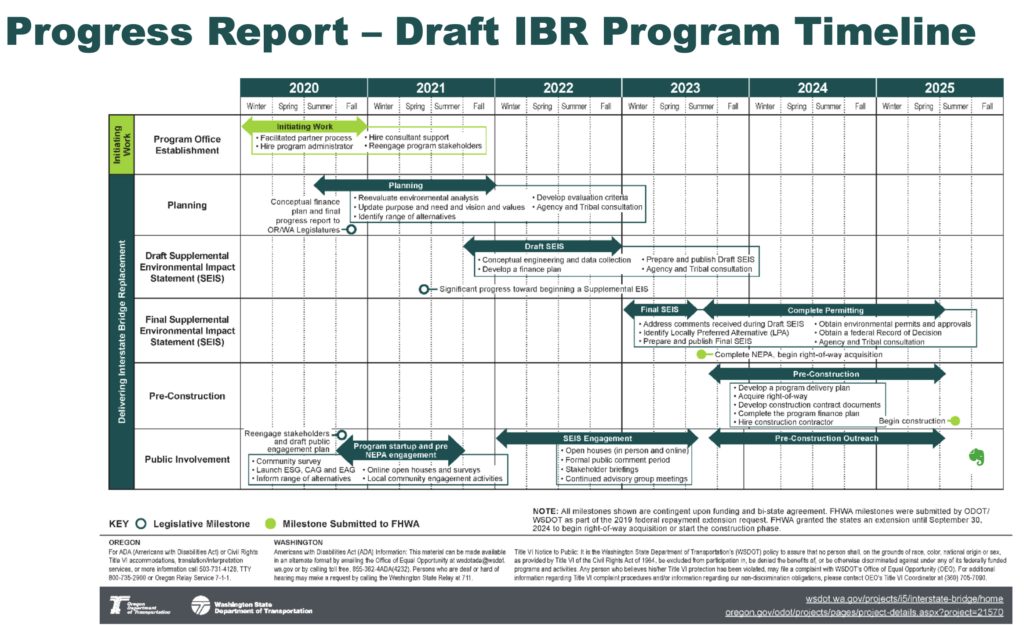
What this means is the I-5 Bridge replacement project is now certain to be at least two and a half years behind its original schedule: the Record of Decision should have been completed two years ago, in the summer of 2023; it now appears that the ROD will not be released for at least another six months, until April of 2026.
These delays, as IBR officials regularly tells us, are playing a key role in driving up costs. While that’s a problem for taxpayers, it actually means more billable hours for the consultants working on IBR: the fact that the environmental review process has taken more than two years longer than anticipated means that they’ve billed even more.
Repeated delays of the administrative draft #2
These progressive postponements of the final environmental impact statement show up in the form of repeated delays to the release of new drafts of the FEIS. In January 0f 2024, IBR officials said they would circulate the administrative draft #2 of the FEIS to cooperating agencies on November 20, 2024.
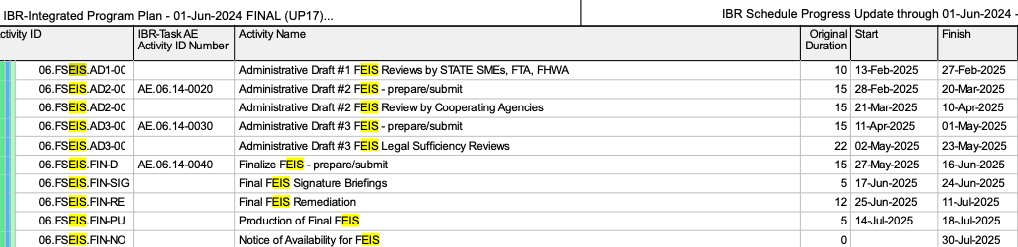
In June 2024, the IBR said it would circulate administrative draft #2 of the FEIS to cooperating agencies on March 21, 2025 – about four months later – in order to meet a July 2025 deadline for publishing the FEIS.
In February of 2025, the project schedule was changed to show that the administrative draft #2 of the FEIS would be circulated starting June 16, 2025 – a further delay of three months.
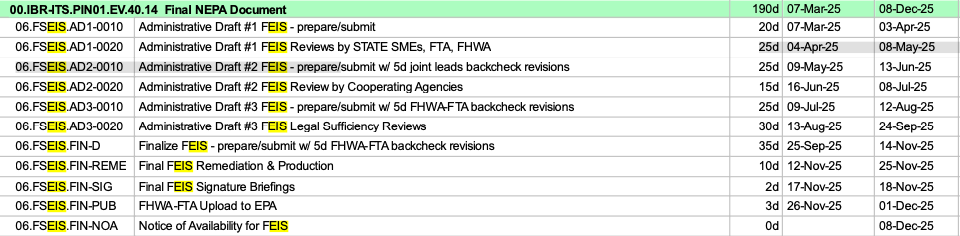
As Metro’s negative response to our public records request shows, the IBR is now at least three months behind this schedule.
A history of vague assurances about schedule
This is nothing new. IBR officials have always offered misleadingly vague statements claiming to be on schedule, even as the project fails to meet its own deadlines. For example, asked at a June 10, 2024 legislative hearing whether the project would start construction in 2025 — something that plainly isn’t going to happen — Administrator Greg Johnson seemed to answer in the affirmative, but really said nothing “we are on a good path to get this project underway:”
REP. MCLAIN: Okay, so this is normal stuff. We’re still on . . . basically we’re one or two months slowed down, but we’re still on line to get construction started in 2025 with all of the things that you’ve presented today, as far as getting our work done on our permits, etc, correct?
GREG JOHNSON: Yes, we are still on track to uhhh . . . we’re moving some things around, and you’ll see a presentation later about our proposed delivery process that we put forward to the industry to get input on. We are, we are on a good path to get this project underway.
In reality, even 15 months ago, it was apparent that construction would not start in 2025, and with these delays, it is almost certain that construction cannot start in 2026, either. But Greg Johnson always says he is on schedule, even when announcing delays. It is something he has been saying for years. For example, in October, 2023, The Columbian reported that Johnson claimed the project was “on schedule:”
I-5 bridge environmental impact statement delayed, again — this time until 2024
Administrator: ‘We’re still on time and on schedule at this point’
The goalposts are in a nearly constant state of movement. As long as you keep producing a new schedule — and conveniently forgetting about the previous one — you can always claim that you are “on schedule at this point.” This practice is essentially built-in to the scheduling documents, which have this footnote:
“The IBR Program Plan is a PLANNING TOOL and represents the current plan to progress the work. This plan is subject to frequent change and adjustment. No dates are concrete until they have been actualized.”
In practice, what this means is, nothing in the schedule is actually “scheduled” until it has been completed. It’s a meaningless and circular definition that allows them to assert that they’re always on schedule.
Using and abusing deadlines is a standard DOT practice
Any discussion of project schedules by transportation officials is going to be a combination of vague and evasive language and Orwellian double-speak. As former Metro President David Bragdon wrote of his experience with the failed Columbia River Crossing — the earlier attempt to build the I-5 Bridge replacement — highway agencies used the deadlines as a cudgel to manipulate decisions, while routinely blowing through deadlines themselves:
In short, ODOT leadership’s claims that “federal deadlines” are urgently impending are usually fabrications, created by ODOT PR staff (who dominate the agency) to force other parties like local governments to go along with whatever ODOT staff is proposing without scrutiny. (Ironically, ODOT itself rarely meets any real deadlines, and has a terrible track record of doing anything on time. Yet ODOT management insists that everybody else adhere to deadlines that don’t exist.)
Also read:
- Overnight closure planned on westbound SR 14 Camas Slough Bridge Tuesday
 WSDOT crews will close westbound SR 14 at Exit 14 in Camas to collect bridge deck samples and plan future repairs; detours will be in effect.
 - Opinion: Stay in your lane – seriously, it’s the law
 Drivers must choose the nearest lane when turning in Washington, and left turns bring added risk. Even with signals, every driver must help prevent crashes by following law.
 - POLL: After hearing state leaders describe the I-5 Bridge as vulnerable in an earthquake, what is your reaction?
 State and local leaders describe the I-5 Bridge as structurally at risk but recommend drivers continue crossing it while complex replacement plans unfold.
 - WA and OR scale back I-5 Bridge ambitions as cost balloons
 A $14.4 billion price tag prompts Washington and Oregon leaders to delay portions of the I-5 bridge project and prioritize just the main spans.
 - Letter: ‘Now we have Engineer Bob telling us the I-5 Bridge needs replacing because it is built on shifting sand with wooden structures’
 Amboy resident Thomas Schenk critiques Democrat leadership, tax policies, and the addition of light rail to the I-5 Bridge, while urging Republican voters to participate more in midterm elections.
 wpDiscuz
