


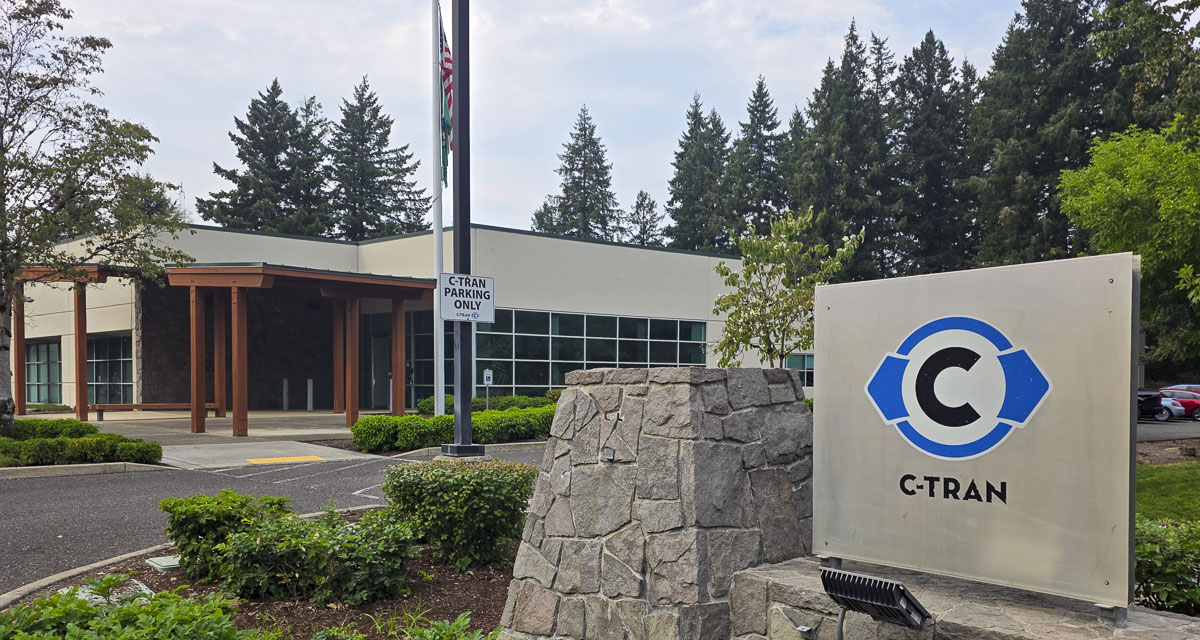
The Supplemental Environmental Impact Statement is a key component toward getting approval for a new bridge over the Columbia River on Interstate 5, and the C-TRAN Board of Directors OK’s it on Tuesday night, with the cities of Camas and Washougal voting no
Paul Valencia
Clark County Today
The Interstate Bridge Replacement Program (IBR) presented the Final Supplemental Environmental Impact Statement (SEIS) to the C-TRAN Board of Directors on Tuesday, and that board gave its approval for the C-TRAN CEO to sign it.
What does that mean?
That the C-TRAN Board generally agrees with the analysis, impacts, and mitigation outlined in the SEIS.
That includes the Modified Locally Preferred Alternative and its language that C-TRAN “may participate” in the funding of operations and maintenance costs associated with light rail’s extension from Oregon into downtown Vancouver.
The city of Camas and the city of Washougal voted no.
Tim Hein, representing Camas on the C-TRAN board, said there are a number of problems with the SEIS, including the light rail component.
“Ridership is not increasing. Costs are increasing. There is no established budget,” Hein said. “There really is no focus to reduce costs. This project, the scope, needs to be revised, reduced … and completely revisited.”
Hein was referring to the current ridership on C-TRAN buses that move passengers to Portland over the Interstate Bridge. With ridership that is still not up to pre-pandemic numbers, and no evidence that it will increase, he is not convinced that the cost of light rail justifies the investment.
Tia Robertson, representing Washougal, also was uneasy with the potential costs for a component of the project that does not benefit her city.
“From the Washougal standpoint … the O&M costs are something we don’t want to cover. I didn’t feel comfortable voting yes,” Robertson said.
Interestingly, after this vote was taken, the C-TRAN Board of Directors heard a presentation on the possibility of creating a sub-district in the C-TRAN boundary that would vote to pay for O&M costs for light rail. That potential sub-district would be asked to foot the bill instead of the entire C-TRAN boundary. The theory would be that such a sub-district could be Vancouver only or even just a part of Vancouver, say downtown.
Scott Patterson, deputy chief executive for C-TRAN, gave a similar presentation to the Clark County Council last week. That story can be read here: https://www.clarkcountytoday.com/news/a-sub-district-vote-could-be-a-way-to-go-to-pay-om-costs-associated-with-light-rail/
Earlier in Tuesday’s meeting before the vote on the SEIS, Patterson clarified to the board that agreeing to OK the SEIS does not commit C-TRAN to funding of any specific component. That work would continue.
IBR officials gave the SEIS presentation to the C-TRAN board.
There are eight agencies involved in the bridge replacement that must sign off on the SEIS before it is presented to the federal government. C-TRAN is one of the eight.
Then, the hope is to have a Record of Decision by the spring of 2026 which could lead to the start of construction.
The IBR team received thousands of comments when it released the SEIS in 2024, and this final SEIS was adjusted after receiving that input.
Hein inquired about that feedback.
“The reason I ask is we get a lot of feedback, too,” Hein said, adding, “95 percent, 100 percent, all in favor of the bridge.”
However … “90 percent don’t want light rail. If they do want light rail, it’s very focused and concentrated. It’s generally downtown Vancouver.”
After the presentation, Patterson pointed out the action that was needed next.
“We are seeking direction from the C-TRAN board to allow the C-TRAN’s CEO to sign the final SEIS,” Patterson said.
Vancouver Mayor Anne McEnerny-Ogle, who has a seat on the C-TRAN board, moved to sign the SEIS. Clark County Chair Sue Marshall, who has a seat on the C-TRAN board, seconded.
Bart Hansen of the city of Vancouver and the chair of the C-TRAN board, then asked for the vote. This vote did not ask for individuals to state their vote separately. Several voices said aye, but this reporter could not specifically identify those who said aye.
Hein and Robertson, representing Camas and Washougal, said no.
There are nine voting members on the C-TRAN board.
“The argument that we have to start now because costs are only going up … that’s a poor, one-sided argument with an agenda,” Hein said after the meeting. “Costs are always going to go up. The way to reduce costs is to reduce your spending.”
Also read:
- Opinion: Portland’s War on Cars Part 4 – A smarter automobile strategy to end gridlock
 O’Toole argues fuel wasted in Portland-area congestion has sextupled since 1982, generating 250,000 tons of extra greenhouse gases annually.
 - Opinion: Transit ridership trends are dismal but regional plans are oblivious
 Puget Sound transit passenger-miles fell 31% from 2015 to 2024 despite a half-million-resident population increase.
 - Interstate Bridge Replacement Program seeks qualified firms for bridge replacement contract
 The CRBR project is backed by $5.7 billion from state funds, federal grants, and future tolling.
 - Opinion: Bankrupt – A $3.5 billion Rose Quarter Freeway widening project
 Joe Cortright argues ODOT’s Rose Quarter project has grown from a $450M approval to a $3.5B estimate, with a $2B funding gap.
 - Opinion: Portland’s War on Cars 3 – Ending the war on automobiles
 O’Toole argues Portland should add toll lanes, fix safety hazards, and redesign TriMet routes to end its anti-auto policies.
 wpDiscuz