


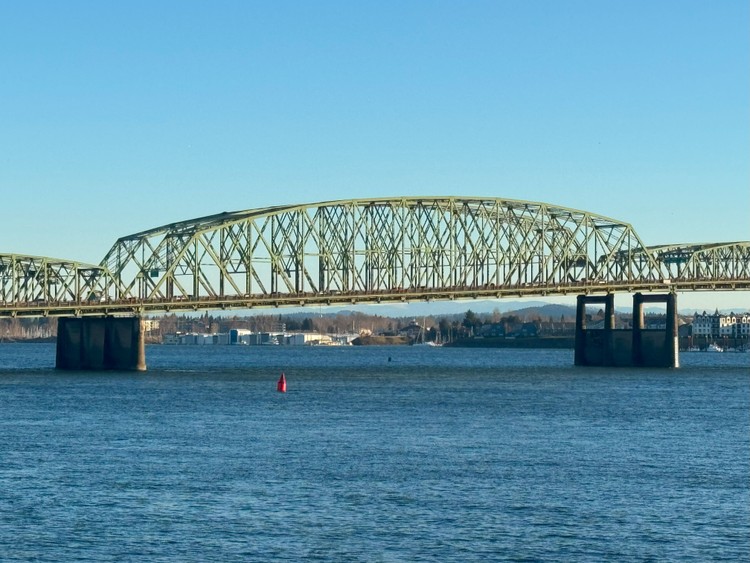
🎧 I-5 Bridge: A $10B Funding Gap and a Risky Bet
Clark County Today Editor Ken Vance discusses the issue of the phased approach of replacing the I-5 Bridge and the light rail extension into Vancouver
Ken Vance, editor
Clark County Today
I would think one of the most important fundamental life principles is don’t spend money that you don’t have. I wish someone would teach that principle to the transportation and elected officials who are jamming the $14.4 billion I-5 Bridge replacement project down the throats of taxpayers.

Ken Vance
If you’ve been reading the content offered by Clark County Today on the I-5 Bridge project, you are aware of how transportation officials justify their “phasing’’ approach to large projects in the region and beyond. Essentially, they don’t have all of the funding needed for a major project so they slice it up into “phases.’’ They will claim it’s a fiscally responsible approach to a mega project, but it’s not. I will counter that it’s more a “gun-to-your head’’ approach.
Let me explain.
Interstate Bridge Replacement Program (IBR) officials trotted out Washington Gov. Bob Ferguson for a press conference in March in an attempt to spin the announcement that the I-5 Bridge replacement would likely cost $14.4 billion. Keep in mind, only about $5 billion has been secured to this point for the project. Not to worry, they say. The project will be divided up in “phases’’ to allow it to begin and then continue as more money is allocated.
I would argue it’s a blatant sleight-of-hand tactic. They know once they start construction on a $14.4 billion mega project, opponents will have no success standing in the way of future funding that would jeopardize the original funding investment to be wasted and a project to be left standing partially completed. So elected officials will then do what they do best, forcefully reach into the taxpayers’ wallets and take more of their hard-earned money.
Earlier today, Clark County Today republished a well-reported story written by reporter Jerry Cornfield of the Washington State Standard. Much of the information was already known to our readers from our own reporting here at Clark County Today. However, it provided considerable context and insight into this “phasing’’ dynamic.
The report said Vancouver Mayor Anne McEnerny-Ogle isn’t happy that the first phase of the I-5 Bridge replacement will only bring TriMet’s light rail extension to the Vancouver Waterfront, where prospective users will have to climb some 90-feet above ground to board it. We’ve reported on the mayor’s visit to the Regional Transportation Council and the C-TRAN board attempting to gain momentum for her fight to get the light rail extension advanced to the Library Square site near Evergreen Blvd. in phase I. She even leaned on the Vancouver City Council to approve a resolution asking IBR to extend light rail to Library Square.
More details were offered in today’s Washington State Standard report:
The current estimate for replacing the northbound and southbound spans, connecting them to the highway, removing the old bridge and extending light rail service to Vancouver is $7.65 billion, according to information presented to the Washington State Transportation Commission in mid-May.
Making room on the bridge for light rail, but not building it, drops the overall cost to $5.68 billion. That’s the current approach. Ferguson said a bridge construction contract will be issued next year. Cars could be driving across the new span by 2035, roughly two years later than previously announced.
If the two states secure the $1 billion federal transit grant they seek, light rail could be added in a later phase. A final decision on the application is not expected before 2030 and service is not anticipated before 2036.
Now, most people likely agree with Vancouver’s mayor that it makes no sense to extend the light rail only to the waterfront and suspend it 90-feet in the air. However, I will counter – and always have – that it makes no sense to have light rail on the project at all. The majority of Clark County residents have repeatedly expressed opposition to light rail and its more than $2 billion cost to taxpayers, let alone the maintenance and operations expense that C-TRAN’s Board of Directors have committed Clark County residents to paying for.
Earlier this month, Oregon voters rejected new transportation taxes – ODOT has a huge funding problem. Oregon still owes the IBR $500 million for the promised $1 billion contribution. Tolling is not settled. The federal government could pull some or all of their $2.1 billion in grants. I would say phase 1 funding is anything but guaranteed.
So, when it comes to the “phasing’’ approach. I live in the real world. When it comes to mega projects like this, I accept the fact that not every dollar can be raised and accounted for to begin construction on a project like this. But, when there’s a $10 billion difference between the expected cost and the committed funds, a more responsible approach must be sought.

Also read:
- Opinion: Workers need their wages more than the state’s paid-leave program does
 Washington’s paid-leave payroll tax stands at 1.13% and is projected to hit its 1.2% cap by 2027, with some lawmakers eyeing a 2% rate.
 - Opinion: ‘It may be time for McCleary 2.0’
 Dick Rylander examines the Battle Ground School District’s proposed $116,830,000 three-year EP&O levy heading to the November 2026 ballot.
 - Washington Policy Center tax expert warns that new income tax will affect everyone
 Ryan Frost argues Washington’s new 9.9% income tax has a $1M deduction that a simple legislative majority could remove.
 - Opinion: Were Republican voters just sleeping during the August primary election?
 CCRP Chairman Matt Bumala says 60% of primary no-shows in the 17th and 18th districts were Republicans.
 - Opinion: WA Cares’ launch showcased care WA Cares did not provide
 Gov. Ferguson showcased a caregiving arrangement at the WA Cares launch that the program had not paid for a single day of.