



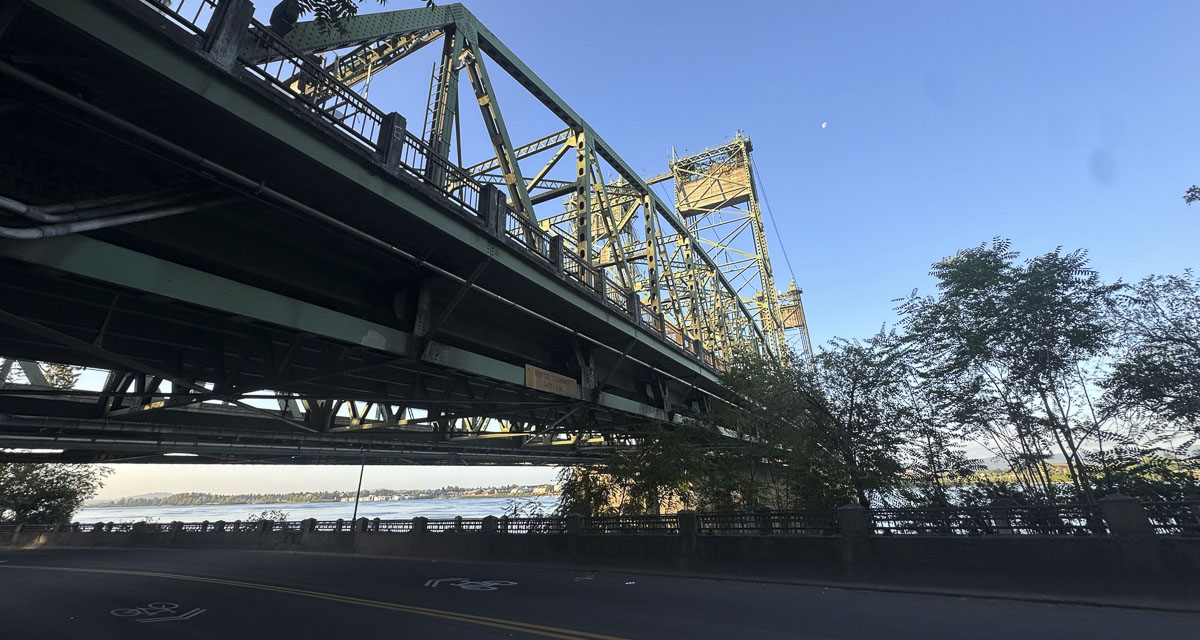
Economist Joe Cortright offers the reasons he believes the project is in deep trouble
Joe Cortright
The City Observatory
The Interstate Bridge Replacement Program (IBR) is two and a half years behind its own schedule, and its environmental review will take almost five years rather than about half that much time.
The Trump Administration is now slow-rolling environmental approvals.
The Coast Guard is likely to require a much more expensive crossing.
Billions in federal grants for the project could disappear.
Oh, and the cost is likely to reach $9-10 billion.
It is beginning to look like the perfect bureaucratic-political-financial storm is going to again engulf the Interstate Bridge replacement project, just as it did its earlier iteration, the Columbia River Crossing.
As we’ve noted before, the IBR is more than two and a half years behind the schedule it announced in 2020 in getting a federal “Record of Decision,” signalling the end of the environmental review process and the start of construction. That delay now poses a lethal threat to the project.
The Trump Administration seems hostile to major road projects in Blue States. It already rescinded more than $400 million in funding for the I-5 Rose Quarter freeway widening project, and is slow-rolling the processing of other awarded highway grants to “run out the clock,” and terminate the grants. In testimony to the joint legislative committees of the two states on September 15, project director Greg Johnson conceded that if they can’t start construction by September 15, 2026, they stand to lose some or all of the $2.1 billion in Biden-era federal funding for the project.
A second and separate problem is that the US Coast Guard has long fought with the Oregon and Washington highway departments over the minimum navigation clearance for the proposed bridge. Their objections produced an expensive two-year delay that helped lead to the demise of the Columbia River Crossing a decade ago. Three years ago, in 2022, the Coast Guard published a “Preliminary Navigation Clearance Determination” saying that they required a crossing with at least a 178-foot clearance over the Columbia River. But IBR has pushed ahead with its plans for a much lower, 116-foot fixed span, hoping to bully the Coast Guard into approving this design. That’s looking less and less likely: IBR is late in delivering a new navigation impact report to the Coast Guard, and the Trump Administration’s new interest in a “Maritime Industry” strategy means it is vastly less likely to agree to a lower fixed span.
Trump Administration delaying project
There are already ominous signs from Washington, D.C. that the federal government is intentionally delaying action on the IBR.
In a recent news report, Vancouver Mayor Anne McEnerny-Ogle acknowledged that the earliest that the Record of Decision would become available is April of next year. KGW-TV reported that in a phone interview from the US capital, the Mayor said the Trump Administration is delaying the IBR project:
The project is being handled here in Washington, DC with delays. Each time the project meets a deadline, the goalposts change a bit. . . . now it [the record of decision] may not be done until April.
The project was more than two years behind its stated 2020 schedule even before the Trump Administration took office, but there are good reasons to believe that the new administration will take its time dealing with this project. Already, in the case of another nationally significant bridge project–the replacement of Baltimore’s Francis Scott Key Bridge–there are signs that President Trump would like to renege on the federal pledge to pay for the project (the cost of which has roughly doubled from about $2 billion to $4 billion). The threat is fueled by political disputes between the President and Maryland’s democratic Governor. While the replacement funds were enacted by Congress under President Biden, it’s worth noting that the new Congress has already rescinded the funding for another Biden highway grant program (the Reconnecting Communities program).
More troubling for the IBR, there is evidence that the US Department of Transportation is slow-rolling the processing of some approved grants in a way that may cause them to expire. Transportation for America reports that if contracts are not soon signed for some FY 2022 grants they will lapse.
The Trump administration’s inaction at USDOT may lead to FY2022 grants expiring at the end of Fiscal Year 2025, potentially putting millions in community projects at risk. Unless funding is obligated by September 30, 2025, many grant awardees could see their hard-earned federal support disappear.
Program Administrator Greg Johnson testified to the Joint Oregon-Washington legislative oversight committee on the I-5 bridge project on September 15, 2025, and confirmed that federal grants for this project are in also in jeopardy unless the IBR can obtain a Record of Decision by 2026:
We have grants that have to be obligated and agreed to in 2026 or we have the potential of having those grants expire, so we have some hard deadlines that we are putting on the table for folks to keep our schedule of getting to a Record of Decision in 2026.
The federal funds at risk include both the $1.5 billion Bridge Investment Program grant and the $600 million MEGA grant. The funding for these grants to the IBR was part of the FY 2024 grant cycle (Bridge Investment Program) and FY 2023-24 grant cycle (MEGA). A follow-up interview with KGW television provides further details:
Johnson later explained to KGW that the specific deadline is a little over a year away. The IBR project’s largest single grant is a $1.5 billion award from the federal Bridge Investment Program; it comes with a statutory deadline of Sept. 30, 2026. As long as a portion of the grant funding is in use by then, the requirement will be satisfied — but the project needs to get into construction in order to start spending the money.
Based on Johnson’s testimony it appears that IBR needs to get its record of decision and obligate these funds not later than September 30, 2026 (the end of the FY 2026 fiscal year).
The trouble is that all of these federal approvals are ultimately discretionary. The Trump Administration USDOT controls action on the Environmental Impact Statement and Record of Decision. The Trump Administration Coast Guard decides, on its own timeline, how to evaluate the navigation clearance and whether to issue a legally required bridge permit. The Trump Administration USDOT also controls the process for contracting and obligating funds. Given a political backdrop of hostility to projects in blue states like Oregon and Washington, there are plenty of opportunities for this process to drag out long enough to kill the project.
And, while they want to blame the Trump Administration, this is in large part, a problem of IBR’s own making: they simply failed to complete the environmental review process by their original deadline of the Summer of 2023, as they promised the Oregon and Washington Legislatures in 2020.
Without federal funding, the entire cost of the IBR project would fall on the two states. That, coupled with a likely increase in the total cost of the project to as much as $10 billion, could doom the entire effort.
Also read:
- Letter: A call for competent Interstate Bridge project management
 Rick Vermeers argues that unchecked scope, rising costs, and missed timelines threaten the survival of the Interstate Bridge Replacement project unless light rail is removed.
 - Rep. John Ley introduces bill to balance representation on Washington transportation boards
 Legislation introduced by Rep. John Ley seeks to change how transportation board seats are allocated and prevent funding penalties tied to population-based representation rules.
 - Opinion: IBR administrator receives generous Christmas gift on his way out the door
 Ken Vance argues that IBR leadership avoided accountability on rising project costs as Administrator Greg Johnson announced his departure without providing updated estimates.
 - Update: Belkot’s legal team submits sheriff’s report to its case against Clark County Council
 Michelle Belkot’s legal challenge against the Clark County Council advanced after a sheriff’s report alleging rule violations was accepted into evidence.
 - Opinion: ‘If you tolerate lies and dishonesty from the government, you’re guaranteed more’
 Lars Larson criticizes state officials for refusing to disclose updated cost estimates for the Interstate Bridge Replacement project, arguing that a lack of transparency guarantees further government dishonesty.
 wpDiscuz
