


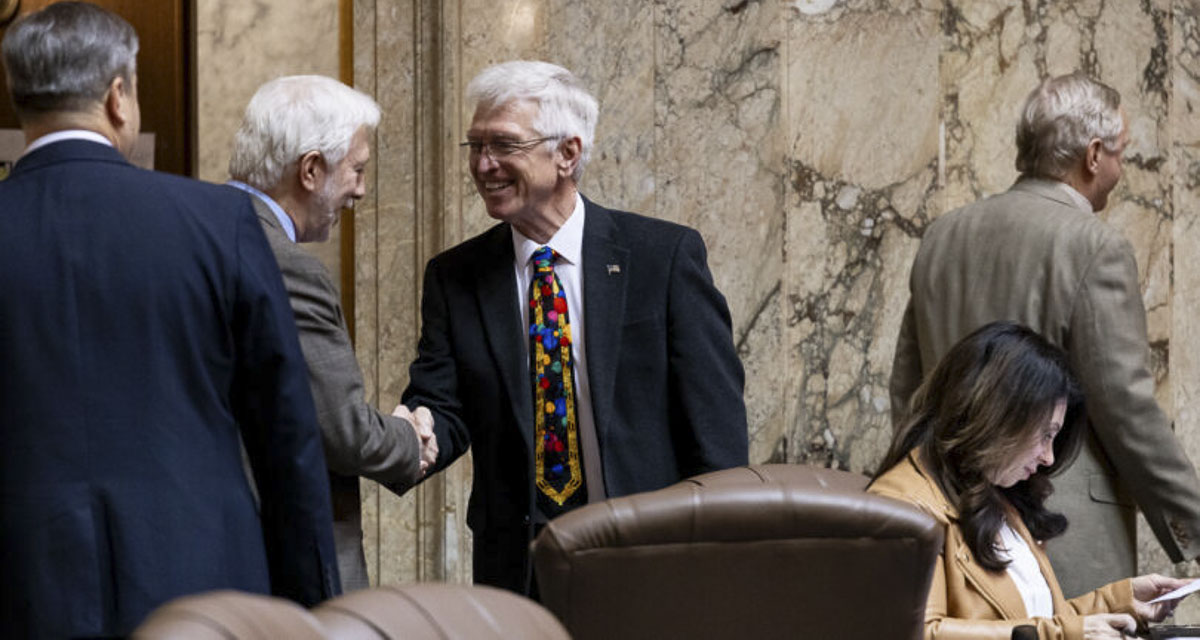
House Bill 2143 would repeal the provision allowing WSDOT to withhold funding when board membership is not allocated strictly by population
Rep. John Ley has introduced legislation aimed at resolving an ongoing dispute between the city of Vancouver and smaller Clark County cities over representation on the C-TRAN Board of Directors.
The conflict stems from a state requirement that transit agency boards be allocated proportionally by population, or risk having funding withheld by the Washington State Department of Transportation (WSDOT). State law also prohibits any single city from holding more than half of a board’s seats to prevent one jurisdiction from dominating decision-making.
“For most of C-TRAN’s history, the Board’s power was evenly divided, with three seats each for the small cities, Clark County, and the City of Vancouver,” said Ley, R-Vancouver. “That structure ensured smaller cities had an equal voice at the table.”
“However, recent changes to this balance have disrupted the community. That could force residents of smaller cities to help fund a light rail extension tied to the Interstate Bridge Replacement Program, which would primarily benefit a small number of people in downtown Vancouver.”
House Bill 2143 would repeal the provision allowing WSDOT to withhold funding when board membership is not allocated strictly by population. The bill would also cap representation for Clark County and the City of Vancouver at three seats each, preserving seats for smaller cities rather than assigning them solely by population.
“The elected leaders of our small cities have taken a firm stand on this issue at the C-TRAN Board level,” noted Ley. “My bill would protect their voice, ensuring those small communities are heard, and their influence remains at a level that has served the community well for nearly 40 years.”
The 2026 legislative session begins on Monday, Jan. 12.
Information provided by the Washington State House Republicans, houserepublicans.wa.gov
Also read:
- Opinion: Portland’s War on Cars Part 4 – A smarter automobile strategy to end gridlock
 O’Toole argues fuel wasted in Portland-area congestion has sextupled since 1982, generating 250,000 tons of extra greenhouse gases annually.
 - Opinion: Transit ridership trends are dismal but regional plans are oblivious
 Puget Sound transit passenger-miles fell 31% from 2015 to 2024 despite a half-million-resident population increase.
 - Interstate Bridge Replacement Program seeks qualified firms for bridge replacement contract
 The CRBR project is backed by $5.7 billion from state funds, federal grants, and future tolling.
 - Opinion: Bankrupt – A $3.5 billion Rose Quarter Freeway widening project
 Joe Cortright argues ODOT’s Rose Quarter project has grown from a $450M approval to a $3.5B estimate, with a $2B funding gap.
 - Opinion: Portland’s War on Cars 3 – Ending the war on automobiles
 O’Toole argues Portland should add toll lanes, fix safety hazards, and redesign TriMet routes to end its anti-auto policies.
 wpDiscuz