



Public comment period is open until Jan. 6, 2023
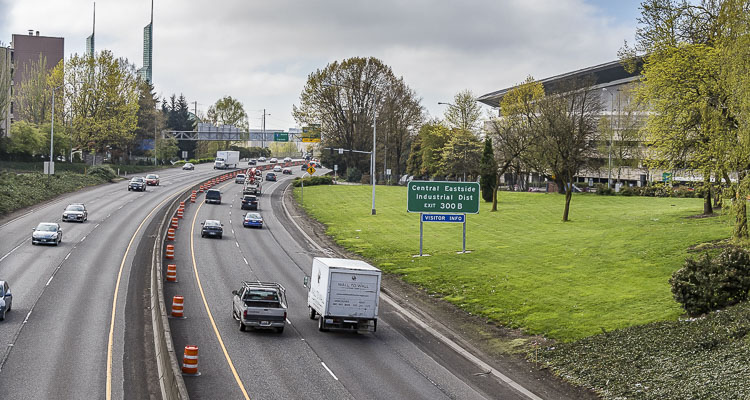
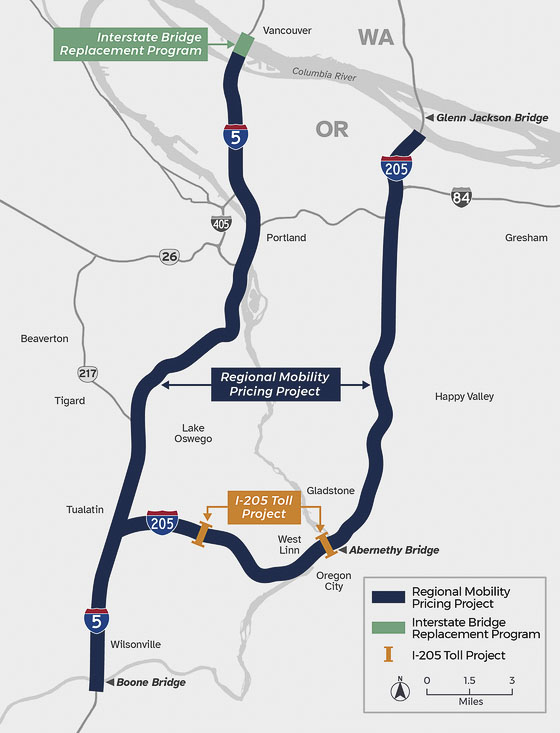
PORTLAND, Ore. – The Oregon Department of Transportation (ODOT) invites the public to comment on an upcoming study about tolling I-5 and I-205 to reduce traffic congestion and make travel times more predictable through the Portland metro area.
This effort, known as the Regional Mobility Pricing Project, will study variable rate tolls as part of ODOT’s urban mobility strategy to reduce traffic jams and provide safer trips for travelers.
The 50-day public comment period is now open.
Variable rate tolls are a type of congestion pricing, which improves mobility and provides more predictable travel times by charging a higher price during peak traffic periods and congested locations. In addition to these benefits, this type of tolling will:
- Increase safety as traffic jams shrink
- Improve the flow of goods to and from market
- Raise sustainable revenue to preserve and improve the transportation system
- Reduce carbon emissions to support reaching the state’s climate goals
This month, ODOT begins the federal National Environmental Policy Act (NEPA) process by identifying the project’s potential benefits and negative impacts. The start of the process is called “scoping,” a comment period to solicit input on the range or scope of community and environmental issues to study.
Our work to date has been informed by thousands of public comments from dozens of community conversations through briefings, workshops and discussion groups. In late 2023, ODOT will publish the Draft Environmental Assessment for public review and comment. Completing and publishing the results of the analysis in the Environmental Assessment is an important step to meet federal requirements and obtain a federal decision about tolling on I-5 and I-205. The earliest tolling could begin for the Regional Mobility Pricing Project is late 2025.
Other proposed tolls in the Portland area include the Abernethy and Tualatin River bridges on I-205 and the Interstate Bridge Replacement on the Columbia River. Each of these projects will have its own public comment period as well.
Join a webinar
We will share information and answer questions about the proposed concept for tolling I-5 and I-205. We will introduce considerations that will be studied, how to comment and next steps at two webinars.
- Webinar 1 – Tue., Nov. 29, 11 a.m.-12 p.m. Click this link to join the Zoom Webinar. Telephone dial in by phone: +1 346 248 7799 Webinar ID: 824 4095 7204
- Webinar 2 – Wed., Nov. 30, 4-5 p.m. Click this link to join the Zoom Webinar. Telephone dial in by phone: +1 719 359 4580 Webinar ID: 861 6446 4157
The webinars will take place on Zoom, and you can join online or by phone. Each webinar will present the same information. No RSVP is needed. These meetings will also be livestreamed on ODOT’s YouTube Channel.
Also read:
- Board authorizes C-TRAN to sign off on Interstate Bridge Replacement Program’s SEIS
 The C-TRAN Board approved the Final SEIS for the Interstate Bridge Replacement Program, with Camas and Washougal opposing the vote over light rail cost concerns.
 - C-TRAN ridership grows for fourth consecutive year
 C-TRAN ridership topped 5 million trips in 2025, marking the fourth straight year of growth.
 - Opinion: ‘If they want light rail, they should be the ones who pay for it’
 Clark County Today Editor Ken Vance argues that supporters of light rail tied to the I-5 Bridge replacement should bear the local cost of operating and maintaining the system through a narrowly drawn sub-district.
 - Opinion: IBR falsely blaming inflation
 Joe Cortright argues that inflation explains only a small portion of the IBR project’s cost increases and that rising consultant and staff expenses are the primary drivers.
 - Letter: The Interstate Bridge Replacement Program’s $141 million bribe can be better spent on sandwich steel-concrete tubes
 Bob Ortblad argues that an immersed tunnel using sandwich steel-concrete tubes would be a more cost-effective alternative to the current Interstate Bridge Replacement Program design.

TOLLING is not needed to raise money for ODOT. Oregon is expected to receive roughly $6 billion from the $1.2 trillion federal IIJA package.
Furthermore, TOLLING is hugely inefficient. The Washington state tolling system has had to be bailed out with other taxpayer dollars for the past 3 years.
In Seattle on the I-405/SR-167 tolling system, fully 68% of tolling dollars went to the cost of collection. That is an outrageous waste of people’s money. The gas tax has under a 1% cost of collection.
Finally, the 78,000+ Clark County residents who work in Oregon are already paying over $325 million (2020) in Oregon Income Taxes. They are paying more than their “fair share” to Oregon.
Time to revive the idea of a gasoline tax placed on all gasoline going from Wash. refineries to Oregon. Oh, wait, that’s right… we tried that and the world was thought to be coming to an end!
So how is this I-205 tax different? Isn’t this a tax on the individual driver who chooses to drive instead of walk/bike/bus/paddle a canoe?
So if Oregon can tax any/all drivers on its roads, why can’t Wash. tax any/all drivers who consume its gasoline?!?!
What is it I’m missing?
Susan —
Great point! The sad reality is that Washington state elected representatives REFUSED to speak out AGAINST the Oregon TOLLING program back when it was proposed in 2017.
I addressed the Regional Transportation Council (RTC) in June 2017. I mentioned the TOLLING on both I-5 & I-205 beginning “at the border” and I chastised them for not bringing it to the attention of the citizens. I encouraged them to IMMEDIATELY take a position AGAINST the Oregon proposal.
Sadly, the RTC did nothing.
Even more maddening, the Columbian did NOT write a news story about the proposed Oregon legislation until early July, just a couple days before the legislation (HB 2017) was passed by both the Oregon House and Senate.
Our Washington state elected representatives failed us. They didn’t issue press releases against the TOLLING. They didn’t speak out against what Oregon was discussing.
They did the exact opposite of what Oregon’s legislators did, when Washington state Senator Marko Liias led the effort to tax Oregon 6 cents on gas refined in our state.
As you noted, elected representatives In Oregon, Alaska, and Idaho immediately responded to the threat. There was even some pushback in California. Bottom line — the 6 cent tax of refined “exported” gas was removed from the $17 billion transportation package.
It’s our understanding that on the East Coast, and in particular in Chicago, toll profits went largely to the Super Wealthy. This included very high prices for merely parking your car. Because the costs were so exaggerated, Chicago, apparently, had to take the whole thing down, largely because the citizens stood up in anger against this injustice. Why would it be any different on the West Coast??
I-5 and I-205 have been operating for years without tolls. The problem is that Government never has enough money to do all the things they want. We don’t need more taxes (tolls are just a use tax), we need less Government…..
Amen
“I object, your honor!” Government never has enough money to do right by its people and resources. They woud rather spend it on war and other foolish causes!
There’s lots of reason why State Governments have no money. In fact, Washington State is $30 Billion in debt. Oregon is about $13 Billion in debt. Each State has lost immense of revenue for two basic reasons: The Financial Aristocrats decided back in the 70s to De-Industrialize the US. Multi-millions of jobs were sent overseas to China, etc. In so doing, where those workers used to pay taxes with full time work, all of that was eradicated. End result: the Financial Artists in The Fed, Wall Street, Money Markets became fabulously wealthy. The US has became a completely Financialized Nation with the top 10% wealthiest ending up with all the money, while average citizens today, are lucky if they can even find a part-time job. This latest story about “toll roads, bridges” is simply to siphon off even more $$ from the citizens.
You need to build additional bridges not replace an existing bridge. You also don’t need to further tax people using the bridges as an excuse to do so. You really don’t need to include light rail. That is hole in the ground people’s tax money gets thrown into. You want anything done right?? Take the government’s involvement out of it and chances are good it will be done right and at a reasonable cost.
ROAD TOLLS? Increase safety as traffic jams shrink?
Please explain how the money grabbers acquiring more $’s, is going to ‘Increase Safety?’ How is extracting more $ from citizens going to ‘Shrink Traffic Jams?’
Since our Local West Coast Ports were closed seruptiiously, and the public never understood the truth about why, (there is a whole story in and of itself) it forced ALL goods to be shipped down the I-5 Corridor via Truck! One day, as I traveled from The Interstate Bridge, to the Freemont Bridge I counted 128 SEMI-Trucks in the Northbound Lanes! Talk about congestion. How is $ going to fix that? Its NOT !
Sustainable Revenue? What does that even mean? OR and WA have so much surplus money now, in their ‘Rainy Day’ funds, they cant even spend or waste it all ! Is that sustainable? To preserve amd improve our transportation system? WA is very good at improving our roads, but OR? Oregon has NEVER improved ROADS OR SAFETY! I have renamed Portland, POTLAND!
* Reduce carbon emissions to support reaching the state’s climate goals ?
FIRST, you have to prove success of this proposal to reducing carbon emissions before you can say what it will accomplish! Minus the Chemtrails blocking out the sun, we have darn good air here in the NW. We are blessed with water and trees, exude tons of lovely Negative Ions. Minus their ability to manipulate and control the weather world wide we may actually get to enjoy our rightful benefits of NATURE!
The oligarchs and shady politicians portending WE need to reach the States Climate Goals, talk about science! This is an outright fallacy! The entire ‘CLIMATE Change’, alias ‘Global Warming’ alias, ‘Emminent Ice-Age’ concludes DECADES of faulty reasoning, misleading information and LIES! Haven’t we had enough MEDIA M-ind K-ontrol? They want US, to believe everything they say, when time and time again we have seen, that it always fizzles out into some other attempt at mass programming tactics, using differen terminology. When they dont lasso the public, they try and try again. LOL this must be from where the term History repeats itself, and something NEW hits our Tell-A-Visions again!. Kinda rings a few bells aye? From where our entire world has emerged this past 2 years! Again. I rest my case.
There are SO MANY stories within this comment, but no time to go into all of them. I guess the big take away needs to be. Become aware. Search for Truth. Teach your children to seek truth. Don’t make a habit of jumping on all the Band Wagons. More important is to understand this —> UNITED we STAND, DIVIDED we FALL. Those steering the WORLD Ship right now, WANT US DIVIDED. This way they can let the CITIZENS OF EARTH destroy themselves. Do not give that to them.
Toll bridges opens up a whole new can of worms. Next they will want a toll lane, then they will want tolls for every lane and every highway around the USA. It will never end. They will find something. Just keep our streets, highways and bridges in good condition. We don’t want toll anything, How many times to we have to tell you. We DON’T WANT to be little California!
A 50-day public comment period was open from November 18, 2022 to January 6, 2023. From the toll promoters, “The Scoping Comment Period for the Regional Mobility Pricing Project is now closed. We received over 4,000 comments from across the region. All comments on these materials will be reviewed and summarized and will inform the environmental analysis.
For the most up to date information about the project, please visit the project webpage. General questions and comments can still be submitted through the general comment form.”
WA residents can also contact legislators directly.