


Bob Ortblad shares the virtues of an immersed tunnel design over the current I-5 Bridge replacement project
Editor’s note: Opinions expressed in this letter to the editor are those of the author alone and may not reflect the editorial position of ClarkCountyToday.com
The Interstate Bridge Replacement Program (IBR) is bribing ($141 million) four upstream marine and metal fabrication firms for bridge clearance mitigation, reduced from 178 feet to 116 feet. Taxpayer money would be better spent on hiring these firms to fabricate seven 400-foot-long sandwich steel-concrete tubes for an immersed tunnel. Seven tubes could be fabricated for about $181 million and could span 2,800 feet across the Columbia River. Deduct IBR’s $141 bribe, and the net cost is $40 million.

The IBR’s “Tunnel Concept Assessment” (July 14, 2021), prepared by WSP engineers, fraudulently disqualified an immersed tunnel alternative. The report completely ignored a “Sandwich Steel-Concrete Immersed Tunnel” design alternative that can save hundreds of millions. Using existing shipyards, steel tubes can be fabricated by firms like Thompson Metal Fab, Greenberry Industrial, and Vigor Marine.
WSP engineers falsely claimed that the construction of a new casting basin costing hundreds of millions would be needed for the casting of concrete tunnel tubes. WSP also more than doubled the necessary cubic yards of excavation and dredging. WSP falsely claims a tunnel will be twice the cost of a bridge.
Public disclosure requests forced two revisions that cut the cubic yards estimate in half and added a professional engineer stamp that is required by law. The IBR never announced or circulated revised reports. Eight agencies approved IBR’s Modified Locally Preferred Alternative design based on the original incorrect report.
WSP is the IBR’s General Engineering Consultant (GEC) and has been paid over $90 million for poor design and management that has increased IBR’s consultant budget from $44 million to $295 million. WSP should be terminated.
Examples of Sandwich Steel-Concrete Immersed Tunnels:
- The Uminomori Tunnel in Tokyo Port was completed in 2020 using a steel-concrete sandwich design. It has four traffic lanes and was built with seven 440-foot tubes totaling 3,080.
- The Chinese Shenzhen – Zhongshan immersed tunnel was completed in 2024 using a steel-concrete sandwich design. It is nine miles long, with 32 tubes, and has eight traffic lanes.
A Nippon Steel report titled “Development of Sandwich-Structure Submerged Tunnel Tube Production Method” explains in detail the history of several Japanese immersed tunnels.
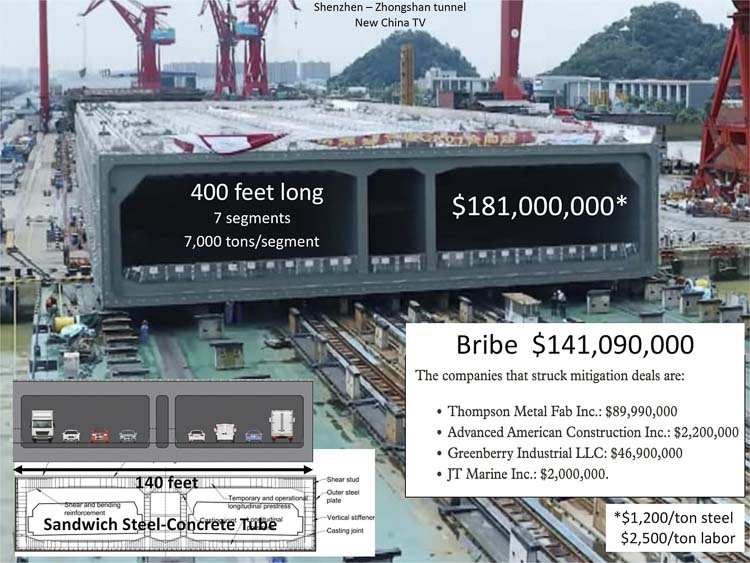
An I-5 immersed tunnel using a sandwich design with eight traffic lanes will need seven 400-foot tubes requiring about 50,000 tons of steel. These tubes can be fabricated by local companies with local labor for about $181 million. It will take a few $100 millions more to fill these tubes with concrete, transport them two miles, sink & connect in a dredged trench, connect to approaches, install ventilation and fire protection. The total cost of an immersed tunnel could be half the IBR’s $2,571,224,084 bridge.
The IBR estimates $2.8 billion for bridge approaches, $2.6 billion for a bridge, and $488 million to remove the current bridges. Building an immersed tunnel upstream of the current bridges and preserving the current bridges for local traffic and shared use path has the potential to cut a new I-5 crossing’s cost in half.
The IBR has also exaggerated the seismic risk of the current bridges.
Saving:
- No demolition of current bridges
- Preserve current approaches and bridges for local traffic & shared use path
- No drilled shafts (96) and temporary piles (1,775)
- No in river construction of bridge piers, columns, and truss spans
Bob Ortblad MSCE, MBA
Seattle
Also read:
- Opinion: Portland’s War on Cars Part 4 – A smarter automobile strategy to end gridlock
 O’Toole argues fuel wasted in Portland-area congestion has sextupled since 1982, generating 250,000 tons of extra greenhouse gases annually.
 - Opinion: Transit ridership trends are dismal but regional plans are oblivious
 Puget Sound transit passenger-miles fell 31% from 2015 to 2024 despite a half-million-resident population increase.
 - Interstate Bridge Replacement Program seeks qualified firms for bridge replacement contract
 The CRBR project is backed by $5.7 billion from state funds, federal grants, and future tolling.
 - Opinion: Bankrupt – A $3.5 billion Rose Quarter Freeway widening project
 Joe Cortright argues ODOT’s Rose Quarter project has grown from a $450M approval to a $3.5B estimate, with a $2B funding gap.
 - Opinion: Portland’s War on Cars 3 – Ending the war on automobiles
 O’Toole argues Portland should add toll lanes, fix safety hazards, and redesign TriMet routes to end its anti-auto policies.