



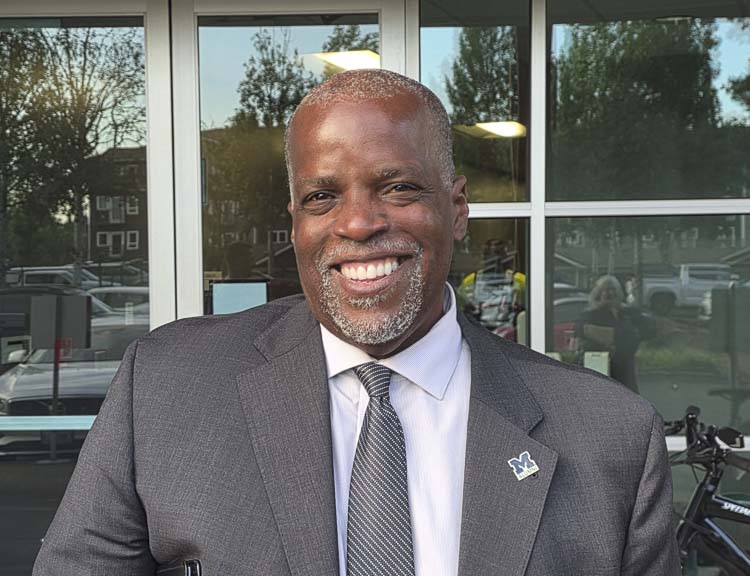
IBR officials gave an update to C-TRAN Board of Directors on Tuesday, and Program Administrator Greg Johnson said he has been given direction from Washington and Oregon leaders to move forward with light rail
Paul Valencia
Clark County Today
Interstate Bridge Replacement Program (IBR) officials gave an update to C-TRAN Board of Directors on Tuesday, and they are forging ahead with plans for light rail to be included on the new bridge, with details regarding how much and who will pay for operations and maintenance (O&M) to be determined at a later date.
In fact, the program administrator for the IBR, Greg Johnson, noted after the board meeting that there are alternatives to paying for O&M beyond C-TRAN funding.

Johnson was asked if the IBR team could still give the public a new bridge design if C-TRAN does not pay for O&M for light rail.
“The question is, If C-TRAN fails to support O&M costs, can we pivot away from light rail? My answer is that there are others who are interested in seeing light rail come across that bridge, on the Washington side,’’ Johnson said. “I think those folks will come together and they will find a solution to the O&M costs if C-TRAN doesn’t have the availability to do it.”
IBR officials gave a presentation that lasted longer than 35 minutes at Tuesday’s meeting, then took questions and comments from board members.
“The legislature in Washington, and the governor, and the legislature in Oregon, and the governor, have pledged a billion dollars, and they said, ‘Put light rail across this river,’” Johnson said.
This was part of an exchange between Johnson and Jennifer Senescu, the alternate to the C-TRAN board from the city of Camas, who wondered why light rail was being pushed despite the lack of support from so many in Southwest Washington. She reminded him that the city of Camas has voted not to support light rail on the proposed new bridge.
“It sounds like we’re just going forward despite public outcry to not go forward, despite the opposition,” Senescu said. “I’m just curious, are we ignoring the public and going forward?”
She also asked if there would be another vote, pointing out that in the previous votes, the people from Clark County have said no to light rail.
“Voting on infrastructure projects is not a thing,” Johnson said. “You want me to have folks down in California vote on what’s happening, because I-5 goes all the way down to California? Are you saying you just want folks here to vote on what happens on I-5, rather than all of the users who utilize I-5? Voting on an interstate project has never happened.”
Senescu countered that while she appreciated Johnson’s point of view on the entirety of the project, she specifically meant the Clark County component of paying for operations and maintenance for light rail.
Bart Hansen, a member of the Vancouver City Council and C-TRAN board member, also pointed out that a sticking point will be how to come up with operations and maintenance costs.
“Is California going to vote on this project? No. But when it comes to operations and maintenance of this project, that is going to come down to somewhat of a local conversation of how that’s done,” Hansen said.
Johnson acknowledged as much.
“I did not mean to diminish the local support or lack thereof,” Johnson said. “I’m talking about the overall program. We don’t vote on infrastructure improvements.”
The C-TRAN board has delayed a vote on language stating whether C-TRAN — and Clark County taxpayers — may pay for O&M or will not pay for O&M. Older language said C-TRAN will not pay for TriMet’s rail system expanding less than 2 miles into Vancouver. Newer language adopted last fall by the board said C-TRAN “may” pay for O&M.
Earlier this year, Clark County Councilor Michelle Belkot, and at the time a C-TRAN board member, tried to have a vote to revert to the older language, to protect Clark County taxpayers from this expense. When it appeared that vote would pass, the vote was delayed. The next day, the four other Clark County councilors voted to remove Belkot off the C-TRAN board.
At the next C-TRAN meeting, Tim Hein, the C-TRAN board member from Camas, asked to delay the language vote until the legal system could rule on Belkot’s lawsuit. Belkot is hoping to be reinstated to the C-TRAN board.
That vote on the language is scheduled to be addressed again in the July C-TRAN meeting.
Meanwhile, IBR officials said Tuesday that they will not have a final estimate of the costs until late summer.
Johnson opened his presentation to the board — as well as the couple dozen citizens in attendance — by saying he does not have horns, in effect letting people know he is not an enemy. He did not appreciate being called a “salesman” for the project by someone in public comment at the beginning of the board meeting.
“I am a transportation professional who has been doing this for 42 years,” he said.
As far as the project, he is confident that a new bridge will be completed.
“We’re going to get this done. This is an effort. Not an easy effort,” Johnson said. “But we’re going to get this done. And the reason we’re going to get it done is not because of ideology and not because of some secret cabal, we’re going to get it done because it needs to be done. If this (current) bridge fails, we will be in a world of hurt.”
Earlier, he had noted the risk of a major earthquake. The I-205 bridge carries roughly 170,000 vehicles daily, he said. The I-5 bridge carries 140,000.
“If I-5 goes down, this area will be in gridlock,” he said.
Johnson noted that the O&M costs go beyond light rail. It also will help pay for the express buses that will go directly from downtown Vancouver to downtown Portland. There are other elements of the project that fall under O&M as well.
“TriMet will pay for their portion of it. And the Washington side will make decisions on who pays for their side,” Johnson said.
Again, there is no definitive number just yet. Johnson said the IBR team should have those numbers by the end of the summer.
As far as the overall cost of the project, the estimate was between $5.5 billion and $7 billion. With inflation and other factors, the costs will change.
“This is one of the largest transportation megaprojects in the country,” Johnson said. “We will keep refining numbers and bringing things back to this board as we get better information.”
The goal is to break ground on some of the elements of the megaproject in 2026.
Among the details of the project presented to the C-TRAN board Tuesday included three new light rail stations — one on Hayden Island in Oregon and two in Vancouver. There would also be park-and-rides to build in Vancouver. Johnson noted that pedestrians and bicyclists also need room on the new bridge. This is not a bridge just for cars and trucks.
“The multimodal options expand choice,” Johnson said. “If you want to take light rail, guess what? You’ll be able to. If you want to get on an express bus, you will be able to. If you want to walk, bike? You will be able to. That’s what a good transportation system offers. It does not offer only one choice.”
For those who want more lanes of traffic, Johnson said that will not work in this corridor.
“You cannot build your way out of congestion,” he said.
He said he and his team are always available to talk, to “correct disinformation” about the project. He and Vancouver Mayor Anne McEnerny-Ogle will be at Esther Short Park on Saturday from 8-10 a.m. to discuss the plan.
“I’m passionate about this project,” Johnson said. “Please come talk to us.”
Public comment was heard by the board before the IBR presentation. Among those who spoke was John Ley, state representative from Washington’s 18th Legislative District who is on the transportation committee. He is not a fan of having Washington taxpayers help pay for Oregon’s transportation system.
Citing his own investigation, TriMet had 19 percent more employees in 2024 than in 2015. TriMet’s MAX light rail carries 36 percent fewer passengers than a decade ago. And TriMet’s costs are 84 percent higher than in 2015.
Proposing to spend $2 billion on less than 1.9 miles of track into Vancouver does not make financial sense to him.
“The takeaway is C-TRAN should avoid any financial entanglements with this project,” Ley said.
Also read:
- Letter: ‘This is the worst thing that ever happened to the region’
 A Hayden Island resident Sam Churchill is criticized in a letter calling the $14 billion Interstate Bridge Replacement project a “boondoggle” that destroys local businesses.
 - Opinion: Half the road, full stop – Understanding pedestrian right-of-way
 Doug Dahl explains how Washington’s law requires drivers to stop when a pedestrian is within one lane of their half of the road, not just when directly in front.
 - Opinion: What is the cost of a bridge?
 John Ley argues the I-5 Bridge replacement’s soaring cost stems from costly extras like light rail, noting other states deliver larger, toll-free bridges for much less.
 - Letter: Vancouver Mayor Anne McEnerny-Ogle makes several serious and incorrect engineering statements
 Bob Ortblad critiques engineering claims by Vancouver Mayor Anne McEnerny-Ogle, highlighting cost and safety advantages of an immersed tunnel for the I-5 crossing.
 - Washington’s studded tire deadline is March 31
 Drivers must remove studded tires by March 31 or face a $137 fine, with WSDOT urging early action due to busy service centers and no planned deadline extension.
 wpDiscuz
