



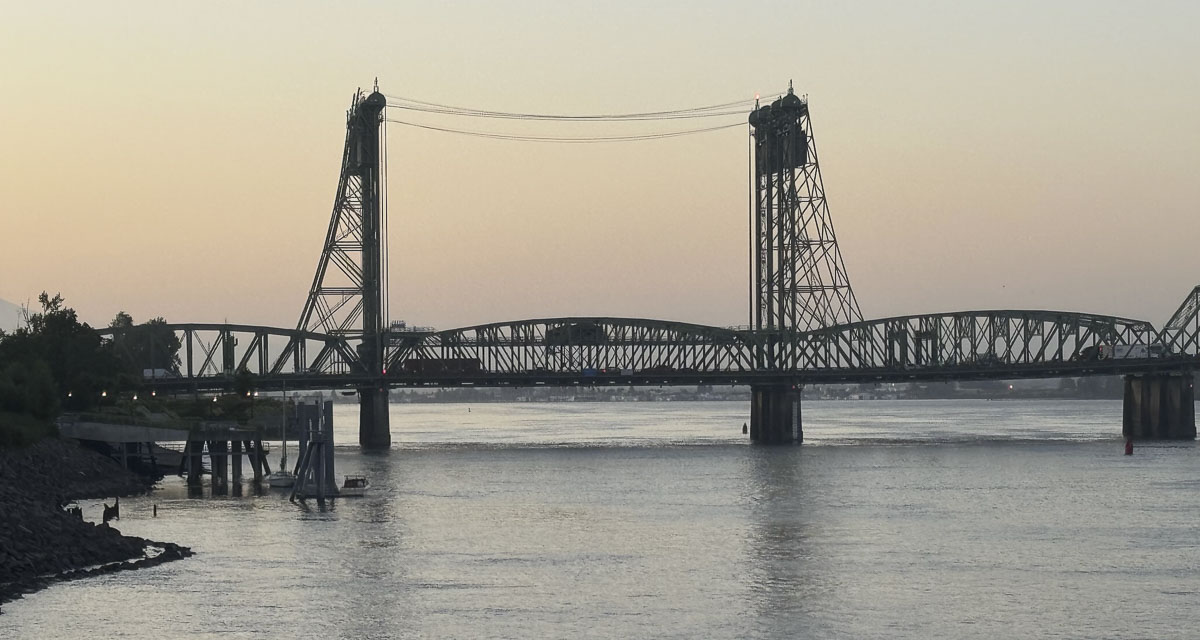
Joe Cortright says area residents can count on traffic disruptions on I-5 for the next two decades if the I-5 Bridge replacement project is finalized
Joe Cortright
City Observatory
Construction on the Interstate Bridge Project is expected to take until at least 2045, which means area residents can count on traffic disruptions on I-5 for the next two decades.

Construction will likely take even longer as packages are “sequenced” and delayed because adequate funding for the full $17.7 billion cost hasn’t been identified.
The biggest single transportation project in the Pacific Northwest, the proposed Interstate Bridge Replacement Project, which would replace the I-5 bridges over the Columbia River and widen the freeway between Portland and Vancouver has gotten a lot bigger – and will take a lot longer – than officials have been promising. As City Observatory reported last month, the cost of the project has exploded from an estimated maximum of $7.5 billion to a new estimated maximum of $17.7 billion. But that’s just one dimension of change: the same materials show that the project which was vaguely promised to be finished in a decade or less, will likely drag on through the mid-2040s. Welcome to the forever project!
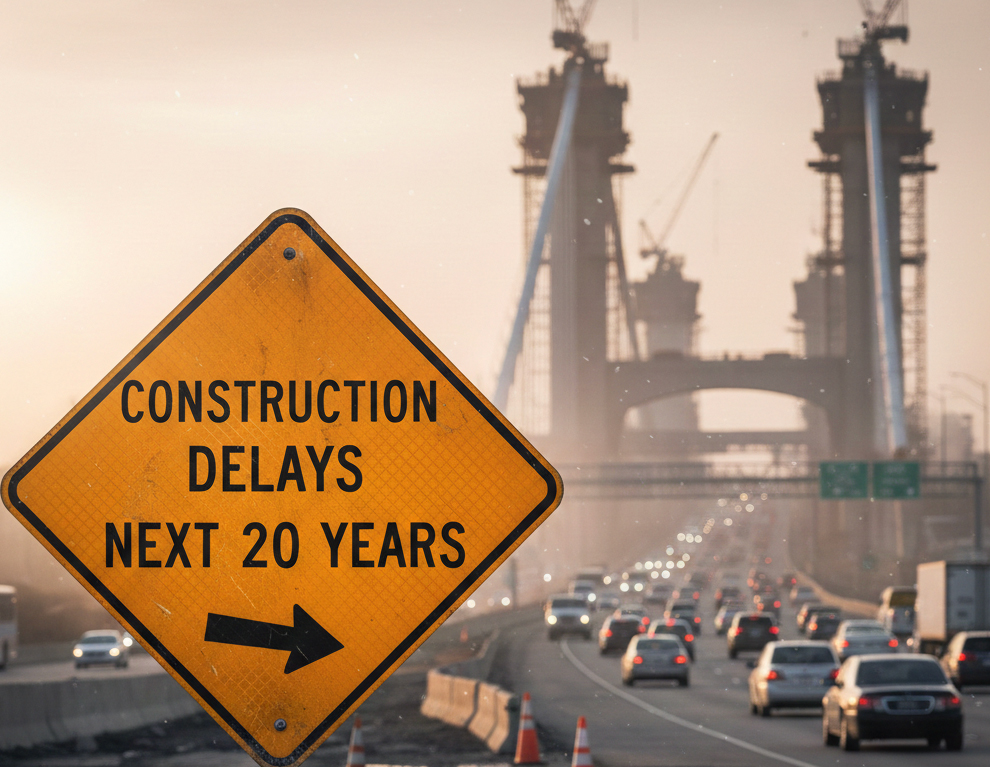
The Oregon and Washington highway departments started in earnest planning for – and spending money on – a replacement for the I-5 bridges over the Columbia River in 2005. They’ve already spent two decades and close to half a billion dollars on the effort, mostly on consultants. And by all indications, this process is going to drag on for at least a couple of more decades – and saddle the region with billions and billions in costs and debt, as well as extended disruption due to ongoing construction.
The good news, if you’re a consultant, is that this is going to mean lots and lots of employment. Going forward, contractors and staff expect to bill $558 million — about $2.4 million per month for the next 231 months (more than 19 years), according to internal documents obtained by City Observatory. This will be to oversee construction, and comes on top of about $273 million already spent on staff and consultants, plus more than $200 million spent on the earlier, failed Columbia River Crossing project. Here’s a table showing planned spending for “management” for the next two decades.

“GEC” is the “General Engineering Consultant.” These estimates include no provision for labor cost escalation over that 20-year period, so the actual figure could be much higher.
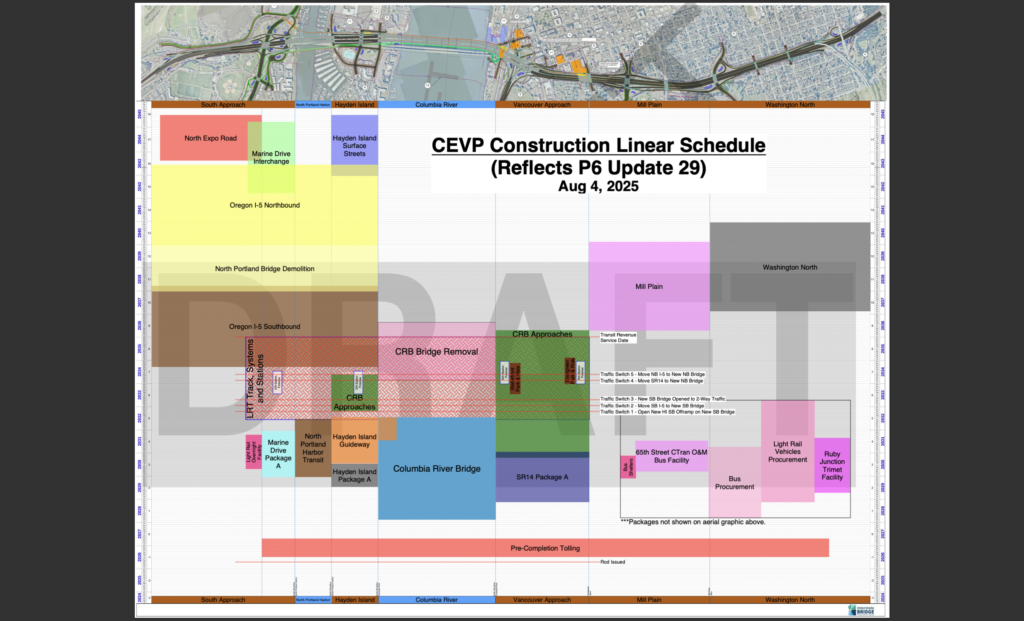
Construction on the river crossing itself won’t start, according to this schedule until 2028, but WSDOT will start charging tolls in 2026, in what is called “pre-completion tolling.” The pre-completion period, to be clear, lasts for a full two decades.
The Interstate Bridge Replacement Program (IBR) has produced an elaborate schedule, which combined with a project map, shows when and how long major tasks will take. The project will start with “pre-completion” tolling and then construction on the bridge crossing. Wider freeway segments and re-built intersections further from the Columbia River (Marine Drive in Oregon and Mill Plain in Washington) will be completed much later (in the 2040s).
Neither ODOT nor WSDOT has enough money to actually build the project, so their plan is to start spending the money they do have on some parts of the project, and then when that runs out, come back and ask for more. Their plan calls for them to do some parts of the project earlier than others, what they call “sequencing.” As it turns out, sequencing favors some program aspects over others. For example, Tri-Met will get an expanded Ruby Junction maintenance facility – estimated to cost $440 million starting in 2029 even though no light rail trains are expected to carry passengers until late in 2035. Similarly, a separate $94 million light rail overnight facility will be built starting in 2030 – almost five years before trains run. And, of course, the entire point of this financial strategy and “sequencing” is to make it all but impossible to give the two state DOTs all the money they need to finish the project: Once you’ve built the new, higher bridge, you’ll have to build new higher approaches and intersections to access it; once you build the maintenance facility and overnight rail yard, you’ll have to buy the trains to run on them. It’s a calculated strategy to extract the $17.7 billion (and quite probably a good deal more).
So what promises to be a perpetual payday for consultants is going to be a pricey and painful problem for people traveling between Portland and Vancouver for the next two decades. Motorists will have to start paying tolls (likely ranging between $3 and $4 at the peak hour) to cross the I-5 bridges as soon as the project gets a go ahead. Then, for the next two decades of construction, people crossing the river or using nearby roads will likely see regular disruptions as roads are closed, re-routed, and rebuilt. For example, between 2032 and 2034, after one new bridge is built, all traffic will be diverted to that bridge as an old bridge is torn down and a second bridge is built. In all, freeway traffic will be re-routed five times before the bridge is finished. Only after the bridge is built will several connecting freeways and interchanges be rebuilt, with additional disruptions.
As a post-script, it’s worth noting that in many respects, this may be the best-case scenario. Right now, the Oregon and Washington Transportation departments don’t have anywhere near enough money to actually build the whole project. Their plan is to get started, and then hold the two state’s legislators — and Portland/Vancouver travelers – hostage to come up with the money to pay for all of the other pieces of their elaborate plan. As we’ve pointed out, just the federal environmental review has already taken more than two years longer than their schedule. If their track record is any indication, we can expect even more delays, as well as cost overruns, throughout this entire period. Given that they’ve been working on “basically the same project” for the past twenty years, it’s a good bet that the disruption – and the consultant paychecks – will go on well past the mid 2040s.
Also read:
- Opinion: Interstate Bridge replacement – the forever project
 Joe Cortright argues the Interstate Bridge Replacement Project could bring tolling and traffic disruptions on I-5 through the mid-2040s.
 - Opinion: Oversized tires and the frequency illusion
 Doug Dahl explains why tires that extend beyond fenders are illegal and how frequency illusion shapes perceptions about traffic safety.
 - Opinion: IBR’s systematic disinformation campaign, its demise
 Neighbors for a Better Crossing challenges IBR’s seismic claims and promotes a reuse-and-tunnel alternative they say would save billions at the I-5 crossing.
 - Opinion: Is a state income tax coming, and the latest on the I-5 Bridge project
 Rep. John Ley shares a legislative update on a proposed state income tax, the I-5 Bridge project, the Brockmann Campus and House Bill 2605.
 - Board authorizes C-TRAN to sign off on Interstate Bridge Replacement Program’s SEIS
 The C-TRAN Board approved the Final SEIS for the Interstate Bridge Replacement Program, with Camas and Washougal opposing the vote over light rail cost concerns.
