



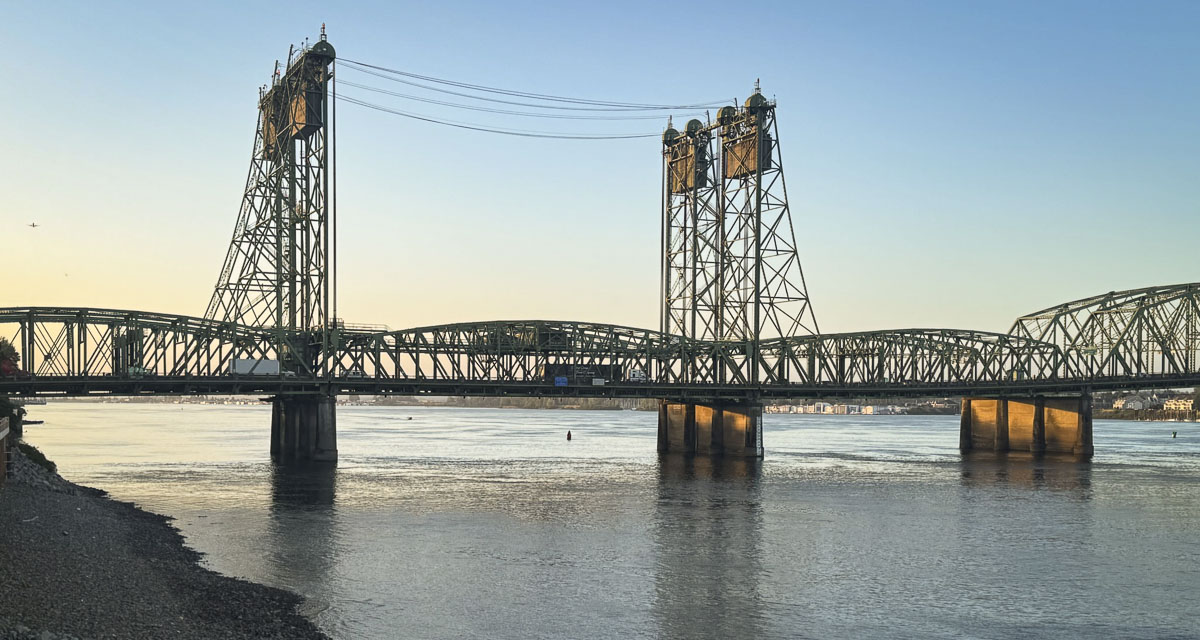
Joe Cortright provides a history of the IBR program’s communication about rising costs of the I-5 Bridge replacement project
Joe Cortright
City Observatory
In denial about rising costs. Two weeks ago, City Observatory and Willamette Week reported that the Interstate Bridge Replacement Program (IBR) had concealed from legislators and the public alarming new estimates showing the cost of the I-5 Bridge replacement project had doubled to as much as $17.7 billion. In the wake of this very bad news, the project and the two state departments of transportation have been in full spin mode trying to downplay the magnitude of the problem, claiming that the figures are “just a draft.”

IBR’s “draft” estimate dodge: What they’re not telling you
It’s not “just a draft” — it’s a comprehensive, near-complete technical analysis
- Two 90+ page “Basis of Estimate” reports (fixed span and movable span options)
- Detailed Excel spreadsheets covering 29 separate construction packages
- This is the kind of extensive documentation that represents real, defensible numbers
Estimates are always ranges — and this range just doubled
- IBR claims there’s no “final number” — technically true, but misleading
- Previous estimate (2022): $5-7.5 billion
- New estimate range: $12.2-17.7 billion
- The issue isn’t whether it’s “final” — it’s that costs have more than doubled
A calculated non-denial denial
- IBR doesn’t actually dispute the $12.2-17.7 billion range
- Officials avoid questioning the accuracy or authenticity of the previously secret documents
- Classic p.r. technique: don’t confirm, don’t deny, just deflect
They hid updated estimates from legislators — twice
- September 15, 2025: Legislators asked for new estimates, got 2022 numbers instead
- December 15, 2025: Same script, same outdated figures
- IBR officials had the new estimates in hand both times but didn’t disclose them
Their own timeline proves they’re stalling
- IBR’s September 5 work plan scheduled final estimate delivery for October 31, 2025
- Document titled “Programmatic Estimate Update – Work Plan” explicitly states: “October 31 – Final Estimate Submittal”
- Purpose: “Deliver a transparent and defensible programmatic base estimate”
IBR controls the “draft” label — and uses it strategically
- Nothing prevents IBR from releasing these estimates
- The “draft” designation is a choice, not a constraint
- It’s a convenient excuse to keep taxpayers in the dark
Two years of broken promises, zero explanation
- January 2024: IBR Administrator Greg Johnson told OPB new estimate would come in six months
- Two years later: Still saying it’s “months away”
- No acknowledgment of the repeated delays
IBR can’t keep its story straight
- September 2025: Frank Green said they’d produce estimates before Coast Guard’s navigation clearance determination and had “enough information” for both bridge designs
- December 2025: Carley Francis testified they needed to wait until after the Coast Guard decision
The transparency double standard
- IBR routinely releases other draft documents
- Somehow cost estimates require special treatment
- IBR has one rule for information that looks good, another for information that doesn’t
The bottom line: IBR has comprehensive cost estimates showing the project will cost $12-18 billion, has had them for months, briefed legislators with stale numbers instead, and is hiding behind the word “draft” while offering contradictory explanations for the delay.
Analysis: What the IBR documents actually show
We take a careful look at the previously secret documents – which are extremely detailed, running to almost 100 pages – and which itemize the cost of 29 different construction packages and hundreds of different cost categories. The claim that these are drafts, are inaccurate don’t hold any water.
It isn’t “just a draft“ – it’s a comprehensive nearly complete extensively detailed technical report. The documents include two 90-plus page “Basis of Estimate” narrative reports (one each for the fixed span and moveable span options), and detailed Excel spreadsheets with separate sections for each of 29 different construction packages.
Estimates are always a range, not a single number. IBR says the estimate is not “the final number.” In fact, IBR estimates are never a single, final number: they are invariably expressed as a range of possible costs. The previous (2022) estimate said costs would range from $5 to $7.5 billion; the news here is not that there’s a specific final number (there isn’t). The news is that the IBR’s estimate of the range of costs now runs from $12.2 billion to $17.7 billion.
A non-denial denial. IBR doesn’t deny that the actual new cost is in the range of $12.2 to $17.7 billion. IBR statements are careful to not actually deny that these are the likely costs of the bridge. They don’t question the accuracy or veracity of the documents.
Why did they hide estimates from the Legislature? IBR has failed to explain why IBR officials repeated out-dated 2022 estimates when they already had these new estimates in hand. On September 15, 2025 and again on December 15, 2025, Oregon and Washington legislators were pressing for a new estimate, and IBR officials didn’t even disclose the range, instead citing numbers they knew were out-of-date and wrong.
The IBR’s own schedule called for the estimates to be finalized in October, 2025. The work plan for the project, dated September 5, says that final estimate was to be submitted on October 31, 2025. (Document: Programmatic Estimate Update – CEVP Model Sep 5.docx; created by Greg Brink).
Programmatic Estimate Update – Work Plan
Purpose
Deliver a transparent and defensible programmatic base estimate for WSDOT, ODOT, and TriMet that meets FHWA/FTA standards, supports the CEVP process, and establishes a reliable basis for the financial plan. This update plan will focus strictly on refining the current scope; any scope changes will be addressed separately.
October 31 – Final Estimate Submittal
Delivery of final base estimate with fully documented risk ranges.
Packaging of basis of estimate, SCC workbook, unit cost records, change/decision logs, and quality certifications for FHWA/FTA and financial planning use.
IBR controlled classifying these as draft. IBR has had complete control over whether to call these “draft,” and has exercised that discretion to keep the estimates secret.
No explanation for two years of delay. IBR hasn’t acknowledged or explained why it has repeatedly postponed issuing new estimates over the past two years. IBR Administrator Greg Johnson told OPB in January 2024 that they’ve had a new estimate in six months; it’s two years later now, and IBR is still saying an estimate is months away.
IBR has flatly contradicted itself on when and whether it could produce an estimate. In September 2025, Frank Green said they would produce an estimate before the Coast Guard issued a new PNCD, and that they “had enough information” on both a fixed movable span to do so. In December 2025, Carley Francis testified that they needed to wait until after the PNCD.
IBR routinely releases draft documents. Many of the documents that IBR discloses to the public, and which it presents to the Legislature are marked “draft.” Simply because it is a draft does not mean that it is not reliable or cannot be released. When it is convenient, IBR releases draft documents to convey the impression that the project is on track and going well. For example, all its project schedules are have disclaimers, like this:
“Schedule will be updated as needed to reflect Program changes and timeline.”
And also like this:
“The IBR Program Plan is a PLANNING TOOL and represents the current plan to progress the work. This plan is subject to frequent change and adjustment. No dates are concrete until they have been actualized.”
Columbian: No clarity, sticker shock, renders funding plans useless
The Vancouver Columbian, long an outspoken booster of the Interstate Bridge project (and its predecessor, the Columbia River Crossing), was plainly dismayed and angry about the new estimates – and the fact that they were concealed. The Columbian editorially disputed the project’s claims to have been “clear” about rising costs:
In response to media inquiries, Program Administrator Carley Francis said in a statement the IBR “has been clear with our partners and the public that the cost … is going to increase, but since the cost estimating process remains underway, we still do not have a final number to share.”
We disagree; there has not been clarity. And the sticker shock that accompanies the revelation threatens the entire process. A sharp increase in the cost would render funding plans nearly useless and call for reconsideration by the Washington and Oregon legislatures, as well as the federal government.
IBR’s “just a draft” and “not final number” claims
IBR’s talking point is that the cost estimates are “just a draft” and that this isn’t a final number. We quote, in full, statements that IBR and its director have made to the media.
Blair Best of KGW TV read this statement from IBR at the end of the broadcast version of the story:
The draft basis of estimate that you are noting is not a complete cost estimate. It was created as a starting point to begin discussions within the cost estimate validation process. We’ve been clear with our partners and the public that the cost of the IBR program is going to increase, but since the cost estimating process remains underway, we do not have a final number to share.
Acting IBR program director Carly Francis quoted in Willamette Week.
“The document you received is a draft basis of estimate, not a completed cost estimate validation process (CEVP). CEVP is a time-intensive process that involves several iterations,” she said. “The cost estimate is not complete, and this work is ongoing. The program is working through validation of risks and associated costs. We do not yet have a new cost estimate.”
Previously secret cost estimate documents
Here are the documents obtained by City Observatory via a public records request showing the August 15, 2025 cost estimate for the Interstate Bridge Replacement Project ranging from $12.2 billion to $17.7 billion.
Narrative Report: IBR_BOE_Fixed Span Bridge_08.15.2025
Excel Spreadsheet: IBR Program Estimate Fixed Span – 8.15.2025
Also read:
- Opinion: IBR’s evasive, misleading and dishonest excuses for higher cost
 Joe Cortright argues the Interstate Bridge Replacement Program has withheld detailed cost estimates while offering contradictory explanations for rising costs tied to the I-5 Bridge project.
 - Rep. David Stuebe sponsors bill to strengthen enforcement of auto insurance laws and protect Washington drivers
 Rep. David Stuebe has introduced HB 2308, a bill aimed at strengthening enforcement of Washington’s auto insurance laws and increasing accountability for repeat uninsured drivers.
 - Letter: Interstate Bridge Replacement’s Park & Ride insanity
 Bob Ortblad criticizes the Interstate Bridge Replacement Program’s proposed Park & Ride garages, arguing the costs are excessive and unlikely to receive federal funding.
 - Letter: Interstate Bridge Replacement $13.6 billion estimate is too low!
 Bob Ortblad argues the Interstate Bridge Replacement Program’s $13.6 billion cost estimate understates the true expense, citing comparable projects, construction challenges, and engineering assumptions.
 - Opinion: ‘The drama and the waste of taxpayer money continues’
 Rep. John Ley outlines his objections to the approved fixed-span I-5 Bridge design, citing cost concerns, engineering standards, funding uncertainty, and opposition to light rail and tolls.
 wpDiscuz
