


Bob Ortblad says new $13.6 billion I-5 Bridge replacement cost estimate is probably too low by billions
Editor’s note: Opinions expressed in this letter to the editor are those of the author alone and may not reflect the editorial position of ClarkCountyToday.com
The Willamette Week recently reported that for six months, the Interstate Bridge Replacement Program (IBR) hid an estimate that doubled the project cost from $6 billion to $13.6 billion. This shocking $13.6 billion estimate is probably too low by billions.

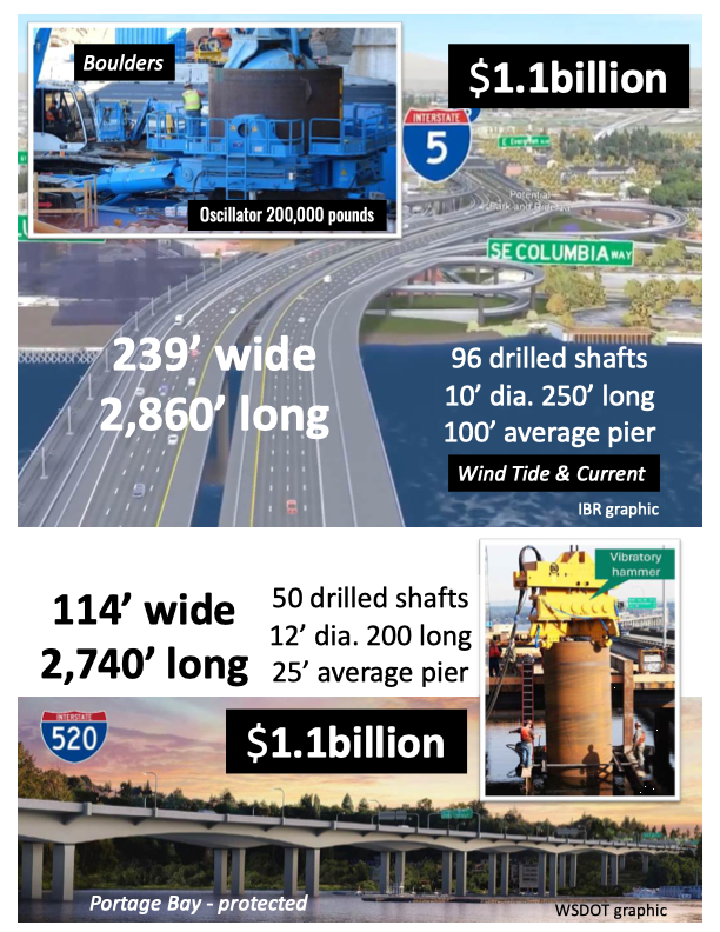
The SR 520 Portage Bay Bridge and Lid project was bid in November 2023 at $1.4 billion and was 70% above the engineers’ estimate. Skanska, the design-build contractor, attributes about 80% of this cost — approximately $1.1 billion — to the new bridge itself. Notably, the Portage Bay Bridge is nearly the same length as the proposed I-5 Bridge design and is supported by similar large-diameter drilled shafts. Furthermore, this bridge is being constructed in a shallow, weather-protected cove that is only 10 feet deep.
In contrast, the design for the I-5 Bridge is twice as large and situated in a more challenging location affected by tides, currents, and strong winds. The IBR bridge design is more than twice as wide (239’ vs. 114’), with piers four times higher. (100’ vs. 25’) The bridge also has twice the number of drilled shafts. (96 vs.50) The IBR shafts are also longer (250’ vs. 200’) and have a higher probability of hitting cobbles and boulders as they are drilled.
The IBR needs a 200,000 pound oscillator to drill 10-foot diameter shafts 250 feet through unpredictable Columbia River sand, cobbles, and boulders. Skanska is using a more mobile, less expensive vibratory hammer that is ten times lighter than IBR’s oscillator. The bottom of Portage Bay is a predictable soft sediment; over a hundred shafts have been completed just east in Montlake and Lake Washington.
In 2012, the Columbia River Crossing’s total estimated cost was $3.5 billion. The 250-foot, 10-foot diameter shafts were estimated to cost $1.25 million each, $5,000 per foot. A $4.2 million test shaft was drilled on Hayden Island by Malcolm Drilling, and it failed on the first attempt.
The current IBR estimated cost of $13.6 billion is a 288% increase from the CRC’s $3.5 billion, but the IBR estimated cost of drilled shafts ($129,586,650) has only increased 17% from $5,000 to $5,845 per foot. If a 288% increase is applied to drilled shafts, their cost will balloon from about $129 million to $632 million.
How many items in IBR’s current $13.6 estimate need to be doubled or tripled?
The SR 520 Portage Bay’s Bridge cost is $1.1 billion. By every measure, the IBR bridge design is twice as large and is a much more difficult construction site, therefore it should cost about twice as much, $2.2 billion. ($3.3 billion risk-adjusted). However, IBR’s base cost bridge estimate is only $1.1 billion. (not including approaches).
An Immersed Tunnel alternative was fraudulently disqualified by the IBR. An Immersed Tunnel needs no drilled shafts; it is supported by buoyancy. A tunnel could save about $600 million without shafts, $140 million by not bribing upstream businesses, and $300 million by not demolishing current bridges. The tunnel can also be built faster with less environmental impact.
Bob Ortblad MSCE, MBA
Seattle
Also read:
- Opinion: Portland’s War on Cars Part 4 – A smarter automobile strategy to end gridlock
 O’Toole argues fuel wasted in Portland-area congestion has sextupled since 1982, generating 250,000 tons of extra greenhouse gases annually.
 - Opinion: Transit ridership trends are dismal but regional plans are oblivious
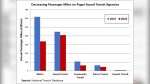 Puget Sound transit passenger-miles fell 31% from 2015 to 2024 despite a half-million-resident population increase.
 - Interstate Bridge Replacement Program seeks qualified firms for bridge replacement contract
 The CRBR project is backed by $5.7 billion from state funds, federal grants, and future tolling.
 - Opinion: Bankrupt – A $3.5 billion Rose Quarter Freeway widening project
 Joe Cortright argues ODOT’s Rose Quarter project has grown from a $450M approval to a $3.5B estimate, with a $2B funding gap.
 - Opinion: Portland’s War on Cars 3 – Ending the war on automobiles
 O’Toole argues Portland should add toll lanes, fix safety hazards, and redesign TriMet routes to end its anti-auto policies.
 wpDiscuz