


Leadership change and sharp drops in transit projections raise new questions about the future of the I-5 Bridge project
The Interstate Bridge Replacement (IBR) Program is facing renewed scrutiny after Administrator Greg Johnson announced he will step down at the end of the year and the project team slashed its transit ridership projections by 84 percent. The updated figures, along with major cuts to operations and maintenance estimates, have fueled public frustration and legislative concern over the accuracy of the project’s earlier claims. Critics argue that years of planning and hundreds of millions of taxpayer dollars have failed to produce credible answers about ridership demand or congestion relief. With confidence in the project waning, this week’s poll asks: what should happen next for the I-5 Bridge replacement effort?
More info:
Opinion: The IBR guts transit ridership projections by 84 percent and O&M costs by over half

John Ley writes that the Interstate Bridge Replacement Program has slashed its projected transit ridership by 84 percent, raising questions about accuracy, leadership, an...
Read more
Also read:
- Opinion: Portland’s War on Cars Part 4 – A smarter automobile strategy to end gridlock
 O’Toole argues fuel wasted in Portland-area congestion has sextupled since 1982, generating 250,000 tons of extra greenhouse gases annually.
 - Opinion: Transit ridership trends are dismal but regional plans are oblivious
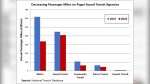 Puget Sound transit passenger-miles fell 31% from 2015 to 2024 despite a half-million-resident population increase.
 - Interstate Bridge Replacement Program seeks qualified firms for bridge replacement contract
 The CRBR project is backed by $5.7 billion from state funds, federal grants, and future tolling.
 - Opinion: Bankrupt – A $3.5 billion Rose Quarter Freeway widening project
 Joe Cortright argues ODOT’s Rose Quarter project has grown from a $450M approval to a $3.5B estimate, with a $2B funding gap.
 - Opinion: Portland’s War on Cars 3 – Ending the war on automobiles
 O’Toole argues Portland should add toll lanes, fix safety hazards, and redesign TriMet routes to end its anti-auto policies.
 wpDiscuz