



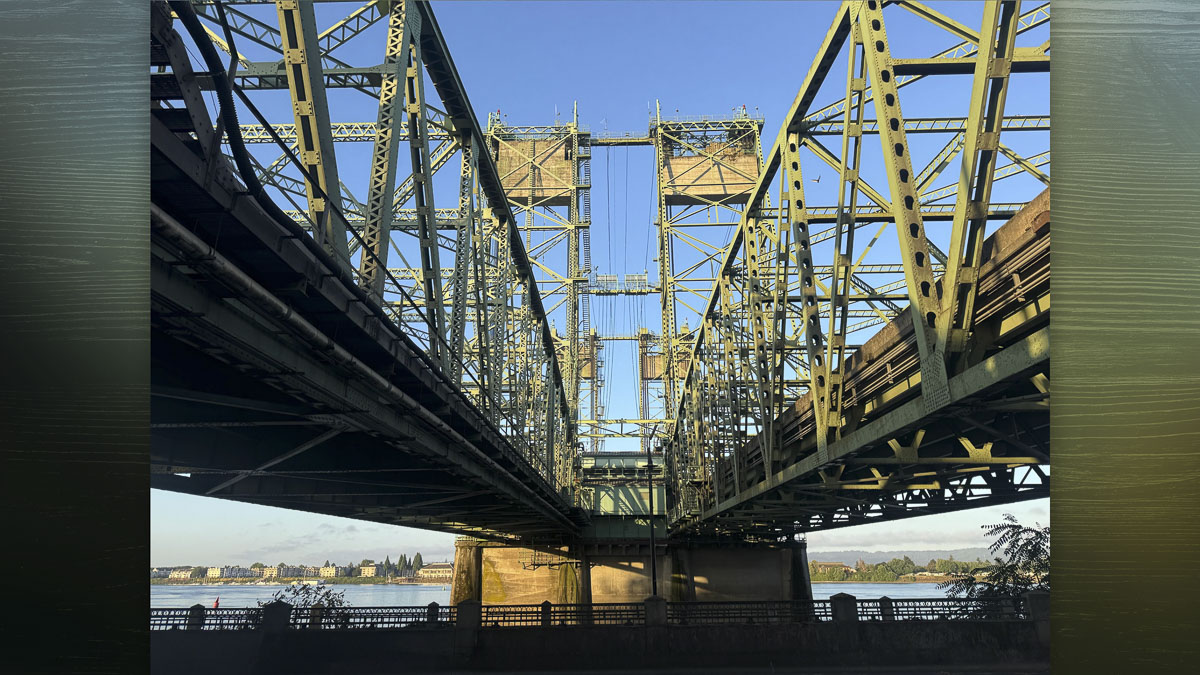
Rep. John Ley: “Those members of the (C-TRAN) board who rejected (Camas Councilor Tim) Hein’s motion are now on record supporting Clark County taxpayers paying new taxes to Portland’s TriMet
Rep. John Ley
for Clark County Today
“Who will pay?” is the question Clark County residents should be asking following the recent C-TRAN Board meeting. At stake is millions of dollars to pay for a 1.8-mile MAX light rail extension from north Portland into Vancouver. This battle and the underlying issue has been ongoing for a decade and a half, going back to the failed Columbia River Crossing.
At the Tuesday (Sept. 9) C-TRAN Board meeting, Camas Councilor Tim Hein made a motion to protect Clark County taxpayers from paying for Operations and maintenance (O&M) of Portland’s light rail, a position initially taken by the board roughly three years ago. That changed last November, when Vancouver Mayor Anne McEnerny-Ogle convinced the board they needed permission to “talk” with TriMet about the funding.
Those members of the board who rejected Hein’s motion are now on record supporting Clark County taxpayers paying new taxes to Portland’s TriMet. There was no discussion regarding “how much,” so perhaps it is open-ended support for picking the people’s pockets for light rail.
In December, the price tag was revealed by C-TRAN staff – $7.2 million allocated to Washington taxpayers, of which $6.8 million was for light rail. The board balked; so McEnerny-Ogle pivoted and asked the staff to approach the state legislature to cover the TriMet demand for payment. Democrat leaders in Olympia rejected the request.

An analysis prepared for Camas and small cities compared tax revenues paid to C-TRAN versus the services received. Vancouver residents paid 58 percent of the taxes, yet received 70 percent of the service and benefits from C-TRAN operations. It would owe an additional $4.2 million per year to cover the services its citizens receive.
Rural Clark County citizens paid $3 million more than the cost of the services they received. Each of the six small cities paid more in C-TRAN taxes than they received in service according to the report.
Questions are being asked about TriMet’s demands. Their assumption in December was that passenger fares would cover 25 percent of the cost. At the time, C-TRAN’s Scott Patterson said “the estimated farebox recovery of 25 percent is overly optimistic.”
Camas resident Margaret Tweet pointed out in public comments to the board, current systemwide farebox recovery for TriMet was 10 percent. If farebox recovery remains at 10 percent, taxpayers would need to come up with an additional $3.27 million. Clark County would be on the hook for 45 percent of that according to TriMet’s formula, or $1.47 million a year. That would make the total bill roughly $8.3 million a year.
Last December, the board was given two possible options to raise the money with a 0.1 or a 0.2 percent sales tax increase. The federal government “wants to make sure you’re not going to scavenge funds from other service you provide in order to pay for the high capacity transit,” said staff member Steve Witter. Will a sales tax increase now be put on the ballot by the C-TRAN Board? That was not addressed.
C-TRAN took in $3 million in passenger fare revenue in 2024. O&M costs were $61.8 million last year, so adding potentially $8.3 million for the 1.8 mile-light rail would increase C-TRAN O&M costs by over 13 percent. Sales tax revenues were $84.7 million.
“I am fighting for my constituents and more than my constituents. Clark County residents have voted down light rail three times,” Belkot said after the meeting. “I keep hearing, ‘How many times do we have to vote no? How many times do we have to say we don’t want light rail in Clark County?’”
Belkot was dismayed by Tuesday’s vote.
“I saw (some) board members … were tired of discussing it and would rather move on, and would rather put the price tag of O&M light rail expense on our Clark County taxpayers,” Belkot said.
It is often said history repeats itself. That is the case in the current battle over light rail. In October 2013, Marvin Case, Publisher Emeritus of The Reflector wrote the following.
“Despite a pledge to seek voter approval for any expenditures on light rail, the C-TRAN board of directors voted 5-4 Sept. 26 to pay the cost of operating light rail in Clark County out of existing revenues and to enter into an agreement with TriMet, the Portland-area transit agency, to operate a light rail system.
“Light rail continues to be part of the Columbia River Crossing (CRC) project as officials in Oregon consider building the project without Washington state involvement. The Washington state legislature declined to fund the CRC project, which was considered dead until resurrected as an Oregon-only project.
“C-TRAN had sought voter approval last year for a sales tax increase to pay for the operation and maintenance of light rail. That measure failed with a 56.5 percent ‘no’ vote.
“Instead of a new tax, C-TRAN planners now propose to use a combination of sources to pay for C-TRAN’s share of light rail operating costs, estimated at $2.3 million in 2019, the first year of operation, and rising to about $3.8 million by 2030.’’
One might wonder how the failed Columbia River Crossing estimate of C-TRAN’s share of light rail costs in 2030 would be $3.8 million; but the Interstate Bridge Replacement Program (IBR) now indicates it is $6.8 million? This would appear to be more games being played by financially troubled TriMet as they try to pick the pockets of anyone and everyone.
The December 2024 cost projections were based on TriMet promising nine light rail departures an hour on the Yellow Line. That’s up from four an hour presently, which is the maximum frequency in the entire MAX system. Those cost estimates now need to be adjusted.
In late July, TriMet announced it would be cutting service and $300 million in costs. One report: “The frequency of all MAX lines will also be reduced in some parts of the day. In total, the goal is to reach a 10 percent reduction across TriMet, including a record-breaking 18 percent reduction in MAX services and an 8 percent reduction in bus services, one of the largest seen in the agency’s history.”
This serves as a significant warning to all Portland metro area residents and especially Clark County taxpayers. The overarching question should be “is TriMet a financially viable organization?”
“How many times do you go into business with a partner that is failing? You don’t do it,” Camas Councilor Tim Hein said recently.
Since June, I have requested the Regional Transportation Council (RTC) Board to have a financial briefing on the health of TriMet. Chair McEnerny Ogle has failed to put that on the agenda. Coincidence?
The RTC Board does have a fiduciary obligation to make sure TriMet is viable if they continue to support the IBR’s Locally Preferred Alternative.
Also read:
- Letter: Vancouver Mayor Anne McEnerny-Ogle makes several serious and incorrect engineering statements
 Bob Ortblad critiques engineering claims by Vancouver Mayor Anne McEnerny-Ogle, highlighting cost and safety advantages of an immersed tunnel for the I-5 crossing.
 - Washington’s studded tire deadline is March 31
 Drivers must remove studded tires by March 31 or face a $137 fine, with WSDOT urging early action due to busy service centers and no planned deadline extension.
 - VIDEO: WA diesel hits record $6.53, crushing truckers and school budgets
 With diesel nearing $6.53 per gallon in Washington, trucking businesses and school districts now confront sharply higher fuel expenses affecting budgets and workers.
 - Opinion: In plain sight – yielding to pedestrians
 Drivers often fail to see pedestrians due to inattentional blindness, which highlights the need for more focused awareness at intersections and stronger safety practices.
 - Expect delays on SR 14 in Vancouver for guardrail repairs Wednesday
 State Route 14 travelers in Vancouver should plan for morning delays as WSDOT will close two eastbound lanes for guardrail repairs, affecting mileposts 6.0 to 7.0.
 wpDiscuz
