



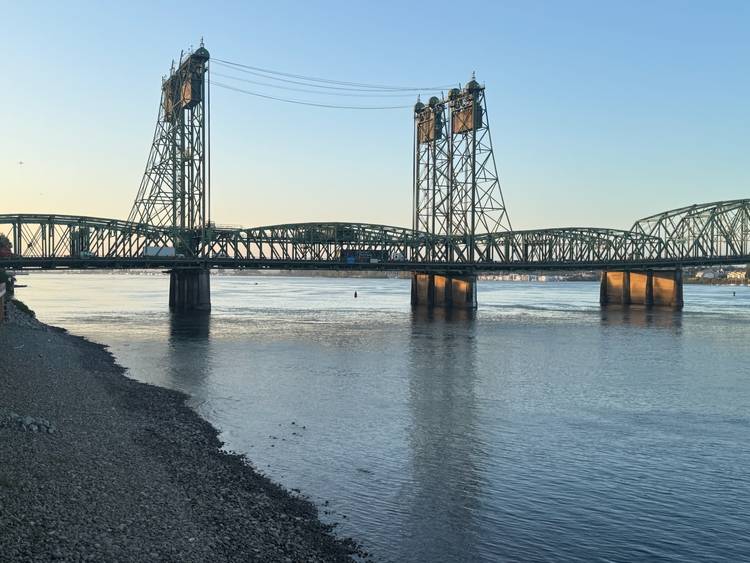
Clark County Today Editor Ken Vance shares his frustration with the IBR program’s long practice of withholding information about the I-5 Bridge replacement project
Ken Vance, editor
Clark County Today
Can anyone please tell me when we are going to get the full and complete details of the Interstate Bridge Replacement Program’s (IBR) I-5 Bridge replacement project? Sadly, I’m confident that the only people who could give us those full and complete details will never actually get around to doing just that.

Ken Vance
It’s been about six and a half years since then Governors Jay Inslee (Washington) and Kate Brown (Oregon) gathered in Vancouver to announce the signing of a Memorandum of Intent to rebuild the I-5 Bridge. And in that time since that fateful day in November 2019, folks like myself are still fighting tooth and nail to find out the complete details of the project, which we were recently told would cost as much as $15.2 billion.
The governors’ actions essentially created the IBR, which was a resurrection of the Columbia River Crossing project that failed by a narrow vote of the Washington State Senate in 2013. I challenge anyone to show me another news organization that has attempted to provide more insight, context and perspective of this current project than Clark County Today. I also challenge you to find me anyone who is more frustrated than I that we continue to be kept mostly in the dark by the IBR and those on the inner circle of the current project.
You see it was only a couple of weeks ago that the IBR team trotted out current Washington Gov. Bob Ferguson to give us the long awaited cost update for the current project. The governor even tried to lessen the blow of the new price, which was essentially double the previous estimate, by breaking out costs of the project. The governor talked about a $7.65 billion price tag of the bridge replacement, choosing not to refer to the estimated $15.2 billion of the entire project.
This week’s 48-second soundbite
This week, a strategic 48-second comment from Vancouver Mayor Anne McEnerny-Ogle at the Southwest Washington Regional Transportation Council meeting revealed something else the IBR team hid from us a couple of weeks ago.
According to CCT reporter Paul Valencia’s Thursday report:
In the new plan, with the $7.65 billion tag, light rail would end at the waterfront — or high above the waterfront, a stop that would require at least a 70-foot tall elevator and a long spiral walkway for commuters to go from the ground to the trains.
Next week, members of the Vancouver City Council will be voting on a resolution that concludes:
“The Vancouver City Council strongly recommends that LRT extend beyond the planned
Waterfront Station and connect with C-TRAN’s existing and planned bus system at a multimodal hub by Evergreen Boulevard near Library Square to achieve the stated purpose and needs of the IBR Program.”
The IBR did confirm with Clark County Today that a phasing plan is in the works now, with the hopes of completing the five-mile program in the future.
“These core projects must be completed first before we can build other elements in the corridor,” according to a statement from the IBR team.
Why did the IBR team bury this information two weeks ago? The answer is two-fold. First, because a second light rail stop (at a multimodal hub) would obviously increase the costs of the project, regardless if you wanted to break it out as part of the bridge replacement costs or the cost of the completion of the entire five-mile program in the future.
The second answer to my question is that the IBR team knows it is operating with a blank checkbook and precious little oversight. If a year from now, or five years from now, the IBR team members want to slip in more changes (and costs) to the project they know they will have no problem doing so. They have the governors of the two states on their side and the IBR team is taking its marching orders from the Washington State Department of Transportation (WSDOT) and the Oregon Department of Transportation (ODOT). There are no public votes planned in the future – advisory or otherwise. Both state’s legislatures have already approved their portions of the funding. Officials from the DOTs are protected from scrutiny from the public or the few brave lawmakers who are trying to hold them accountable.
A better solution
This $14.4 billion proposed project, which will continue to expand and increase in cost, does not need light rail. The majority of voters in Clark County have expressed that at the ballot box on three separate occasions. The IBR team has refused CCT’s request for an updated breakout of the costs of the current project. I am certain that the estimated $2 billion cost of the light rail element is going to increase dramatically in the future. We don’t need it, regardless if there is one stop or two on this side of the Columbia River.
Regardless of whether it’s TriMet’s light rail cars traveling over the new bridge or if it’s C-TRAN’s Bus Rapid Transit vehicles, either will be largely empty. So, why not save billions of dollars and just expand C-TRAN’s BRT program instead of the overpriced expansion of TriMet’s Yellow Line. Or better yet, let’s find someone at the federal level who will kill this project altogether.

Also read:
- Opinion: ‘When are we going to get the full and complete details of the Interstate Bridge Replacement Program’s I-5 Bridge replacement project?’
 IBR team buried key details about light rail ending at waterfront with massive elevator system required.
 - County seeks public comment on plans tied to CDBG and HOME funding
 Clark County proposes $2.4 million in federal funding for dental care, affordable housing, and sidewalk improvements.
 - Opinion: The path to real tax reform requires a spending limit
 Washington Policy Center director argues constitutional spending caps would force real budget tradeoffs instead of endless tax increases.
 - Court battle set to begin over WA’s new income tax
 Former AG Rob McKenna leads constitutional challenge against 9.9% tax on earnings above $1 million starting Thursday.
 - Vancouver mayor counters IBR’s proposal for the only light rail stop to be at the waterfront
 Vancouver’s mayor wants light rail extended beyond the waterfront to connect with C-TRAN buses at Library Square.
