



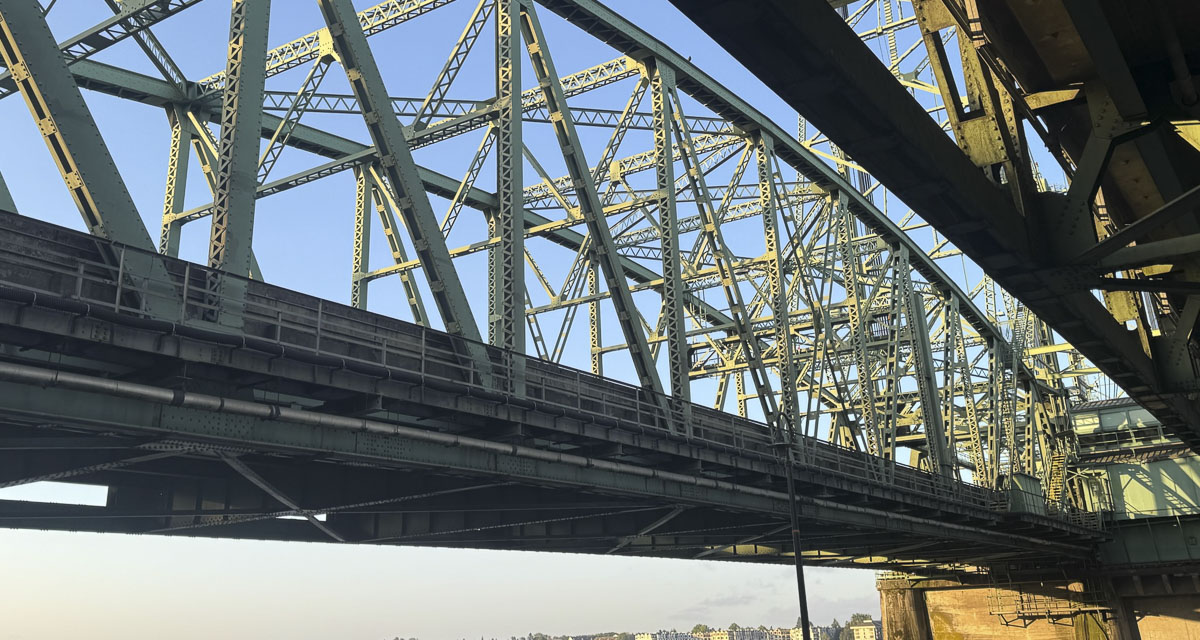
Clark County Today Editor Ken Vance recounts recent reports of troubles with the Interstate Bridge replacement project
Ken Vance, editor
Clark County Today
“Animal House’’ was an iconic movie of my childhood. I think I was a freshman in high school when it was released. One of my favorite memories of that movie was the final scene, also known as the parade scene.

The scene, filmed in Cottage Grove, Oregon, was a climactic event in the movie. The Delta Tau Chi boys sought their revenge on the Faber College administration for revoking their charter by sabotaging the parade with a series of shenanigans.
As complete chaos ensued, a character played by a young Kevin Bacon stood in the middle of the utter tumult trying to calm down the attendees who were stampeding around him as they were attempting to flee the scene. Bacon, a uniformed member of the college’s ROTC program, was part of the security for the parade. Bacon’s character stood in the middle of the street, repeatedly imploring the crazed crowd to “remain calm. All is well.’’
That scene is all I can think of when I hear proponents of the Interstate Bridge replacement program answer questions about the many problems, concerns and delays in their coveted project. And just like Bacon’s character in the iconic “Animal House’’ scene, their cries for calm about their precious program are getting more laughable by the day.
Let’s do a quick review of the latest news on the project:
• A Washington State Standard report earlier this week indicated “the torturously slow pace and increasingly expensive price to replace the Interstate 5 bridge across the Columbia River have some Oregon and Washington lawmakers growing uneasy and frustrated. After years of planning and lining up billions of dollars in state and federal funding, it continues to be an educated guess when construction will start, how much the project will cost and what the new bridge will look like when traffic finally drives over it.
“Project planners had estimated the price tag for replacing the bridge would range from $5 billion to $7.5 billion, with a likely figure of around $6 billion. But legislators said last week that they now expect the total could reach $10 billion as costs have escalated 30% on transportation projects in the Seattle and Portland regions in recent years.’’
The report also indicated that “one Washington lawmaker is even suggesting that the project may need to be ended or dramatically narrowed, and has contacted the Trump administration to suggest pulling back previously awarded federal funding.’’

Interstate Bridge Replacement Program (IBR) Administrator Greg Johnson acknowledged the timeline slipped, noting the environmental analysis must be finished before required federal permits can be obtained. He estimated it could be the middle of next year before initial work begins.
“There are complex issues we are dealing with. We cannot skip steps,” Johnson said.
Remain calm. All is well!
• Rep. John Ley was one of those lawmakers who were in attendance at the Sept. 15 meeting of the 16-member joint Washington and Oregon committee overseeing the I-5 Bridge replacement project that met for nearly three hours for an update from IBR Administrator Johnson and his team. This was the first meeting in 10 months and one of only two scheduled for this year.
Ley reported “the IBR was already the most expensive public works project in the region’s history with a top price tag of $7.5 billion, according to the program administrator. However, nearly two years ago, legislators were told the price was going up. There was no cost update provided on Monday, much to the chagrin of the legislators. Comments from citizens put the expected cost in the $8 to $10 billion range.’’
Ley added, “there were lots of questions and very few complete answers given. A cost update may be provided at the December meeting. The IBR ‘hopes’ to get approval from the Coast Guard, perhaps next April. The Record of Decision from the federal government might be coming in the summer of 2026, which would allow for construction to begin.
“The Federal Transit Administration requires the program to estimate transit ridership with current, more realistic projections. Apparently, the IBR team doesn’t have those projections yet. The Modified Locally Preferred Alternative (mLPA) is projected to be 26,000 to 33,000 daily transit riders on I-5, which none of the legislators in the past believed was accurate.
“There was only a brief mention of the IBR team working with the upriver firms that will be negatively impacted, but no mention of ‘how much’ they are seeking as ‘mitigation.’ In the failed Columbia River Crossing, three firms were going to be given $86 million. Today, there are four firms seeking mitigation.’’
Despite the rising concerns and questions from the members of the committee, Johnson is advancing two options: a single-deck bridge with 116 feet of clearance for marine traffic and a movable span option to provide the Coast Guard’s requested clearance of 178 feet.
Remain calm. All is well!
• Economist Joe Cortright joined in recently, sounding his own alarm of the struggles with the I-5 Bridge replacement project.
“The Interstate Bridge replacement project continues to fall behind schedule. In 2020, Interstate Bridge Replacement Program (IBR) officials told legislators they’d have a record of decision in the summer of 2023. It now appears that the earliest a record of decision will be released is April of 2026, more than two and a half years late. These delays contribute to driving up project costs – and creating more billable hours for consultants.
“State transportation officials routinely miss their own deadlines, provide vague and misleading claims about being ‘on schedule’ – never acknowledging that they’ve failed to execute their own plans, and that this is the reason for higher costs. Like all major federal projects, the IBR has to have an environmental impact statement. When the project was revived five years ago, officials promised that the environmental review would be finished in about two and a half years, by the summer of 2023.
“The IBR has missed that deadline, and has repeatedly delayed the schedule for completing the environmental review and producing the legally required Record of Decision (ROD). IBR officials aren’t forthcoming about the status of the project; we’ve only been able to obtain copies of the detailed project schedule through state public records laws.’’
Cortright shared a recent comment from IBR Assistant Director Ray Mabey.
“We’re seeing light at the end of the tunnel, and expect a final supplemental environmental impact statement and a record of decision early next year,” Mabey said.
Remain calm. All is well!
The bottom line
More than a decade ago, the Columbia River Crossing met its inevitable demise. Five years after it was defeated, the governors of Washington and Oregon resurrected that boondoggle with another just like it, an over-priced, unnecessary project that forces light rail down the throats of Southwest Washington taxpayers who have repeatedly said no to an extension of TriMet’s Yellow Line into Vancouver.
It’s no surprise to many of us that the current project appears to be headed down a similar path as the CRC.
All is definitely not well.
Also read:
- VIDEO: WA diesel hits record $6.53, crushing truckers and school budgets
 With diesel nearing $6.53 per gallon in Washington, trucking businesses and school districts now confront sharply higher fuel expenses affecting budgets and workers.
 - Opinion: In plain sight – yielding to pedestrians
 Drivers often fail to see pedestrians due to inattentional blindness, which highlights the need for more focused awareness at intersections and stronger safety practices.
 - Expect delays on SR 14 in Vancouver for guardrail repairs Wednesday
 State Route 14 travelers in Vancouver should plan for morning delays as WSDOT will close two eastbound lanes for guardrail repairs, affecting mileposts 6.0 to 7.0.
 - Overnight closure planned on westbound SR 14 Camas Slough Bridge Tuesday
 WSDOT crews will close westbound SR 14 at Exit 14 in Camas to collect bridge deck samples and plan future repairs; detours will be in effect.
 - Opinion: Stay in your lane – seriously, it’s the law
 Drivers must choose the nearest lane when turning in Washington, and left turns bring added risk. Even with signals, every driver must help prevent crashes by following law.
 wpDiscuz
