


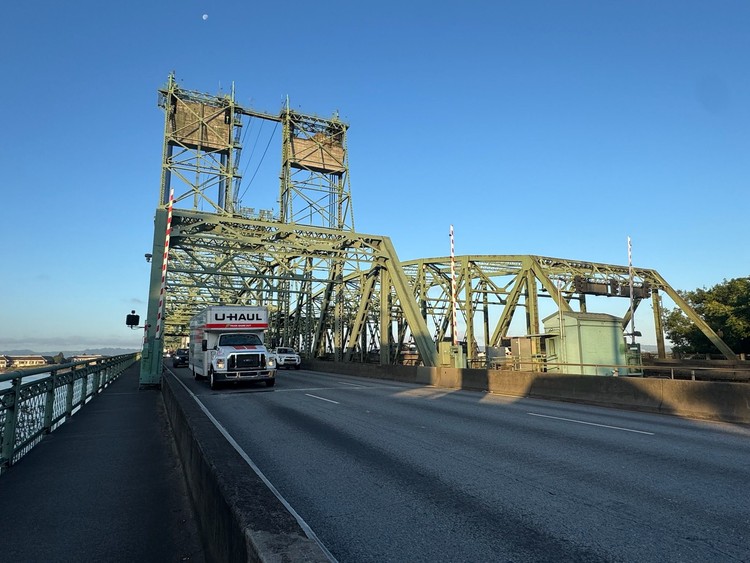
Joe Cortright offers some troubling research to the impact tolling I-5 to help pay for the I-5 Bridge replacement will have on the I-205 corridor
Joe Cortright
City Observatory
The proposed $15 billion Interstate Bridge replacement project will be paid for in part by $2.00 to $4.65 tolls. These tolls will cause tens of thousands of vehicles per day to stop crossing the I-5 Bridge; and most traffic will divert to the parallel I-205 bridge, producing gridlock, according to Interstate Bridge Replacement Program (IBR) consultant reports.
City Observatory obtained — via public records requests — “investment grade” toll revenue estimates prepared by IBR contractor Stantec. This “Level 3” study shows that tolling I-5 will reduce I-5 traffic from 127,000 vehicles per day to 77,000 vehicles per day. A majority of the cost of the project is widening the freeway and rebuilding interchanges to accommodate traffic that will . . . never arrive.
Tolling I-5 will permanently depress I-5 traffic to lower than current levels, and in all likelihood a majority of the diverted traffic will shift to the parallel Interstate 205 bridge, producing serious congestion.
The new toll revenue projections echo exactly the findings of studies of a 2023 “Level 2” forecast, as well as the 2013 Investment Grade Forecast prepared for the virtually identical Columbia River Crossing.
Highway agency claims that investment grade forecasts are unlikely “worst case scenarios” are untrue: Traffic levels routinely fall below levels predicted in investment grade forecasts, as happened with the Tacoma Narrows Bridge, and many other similar projects.
These projections call into question the entire rationale for this $15 billion project: What it means, as a practical matter, is that the newly widened I-5 will be used by fewer vehicles 20 and 30 years from now than use it today. We will have paid literally billions for added capacity for which there is virtually no demand because the people who might use it are unwilling to pay even a modest portion of its cost. Meanwhile, by charging $4.60 (peak) for using I-5, and nothing for using I-205, the project will produce substantial diversion, causing longer trips, more pollution, more congestion and less-reliable travel times on I-205, the route connecting much of the region of Portland International Airport, a time critical destination.
Tolling I-5 will divert 50,000 vehicles away from the I-5 bridge
Here’s the simple fact: soon, motorists will pay as much as $4.60 if they cross the Columbia River on I-5, while the parallel I-205 Glenn Jackson Bridge will remain free. There’s utterly no question that the addition of an expensive toll will prompt many people to either change their route to take I-205, change destinations, or forgo the trip entirely. The project’s Environmental Impact Statement improbably claims there will be almost no diversion due to tolls, but newer and more accurate studies prepared by the consulting firm, Stantec, show that tolls will cause traffic to fall dramatically on I-5, and that tens of thousands of vehicles will likely divert to I-205. Pursuant to a public records request, City Observatory obtained the traffic estimates from the forthcoming “Level 3” Investment Grade Revenue Study. It shows that traffic on I-5 will fall by at least 50,000 vehicles per day when the tolls start (now planned for 2028).
As we’ve previously documented, ODOT traffic data recorders reported that traffic levels have been nearly flat, and are lower now than in 2005. (The black line on the left of the chart shows actual weekday traffic, through 2024). The project’s “Final Environmental Impact Statement” (FEIS) predicted that the $15 billion “locally preferred alternative” of highway expansion and a light rail extension) would cause traffic to grow to 175,000 vehicles by 2045. In essence, the FEIS forecast assumes that tolling will have almost no impact on traffic growth. The new Investment Grade Analysis (or Level 3) prepared by Stantec shows something very different: Only about 122,000 vehicles will use the tolled bridge in 2045, about 50,000 less than in the FEIS forecast. The IGA also predicts that despite spending billions of dollars to expand the highway, fewer vehicles will use the bridge in 2045 than use it today.
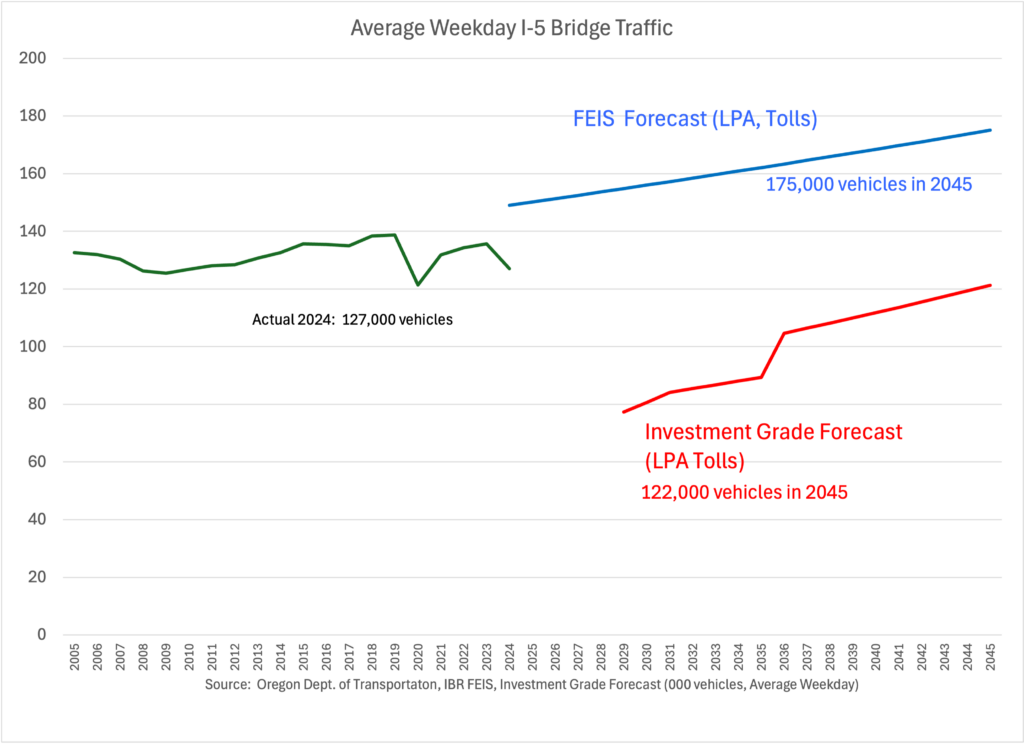
And this shouldn’t be any surprise: this was exactly the finding of the investment grade analysis prepared a decade ago (at a cost of $1.4 million) for the nearly identical Columbia River Crossing Project.
IBR officials routinely claim that the current bridge carries about 143,400 vehicles per day. That’s an exaggeration: ODOT’s own traffic reports show average weekday traffic on the I-5 bridges is about 127,000 vehicles in 2024 (the most recent year for which data is available. But if you believe the IBR’s claim of the “baseline” level of traffic, the permanent decline is even worse: a bridge that carries 20,000 fewer cars twenty years from now than it carries today. Which raises a logical question: What happens to all this traffic?
This confirms IBR’s 2023 “Level 2” traffic studies showing massive diversion
The findings of this new “Level 3” study mirror closely the findings of a 2023 “Level 2” study undertaken by the same consulting firm. This study shows the estimated tolls that will be charged, the amount of revenue tolls would raise, and the average level of traffic using the I-5 bridge under tolls. We converted the annual data reported in these financial reports to average weekday traffic.
The Level 2 report assumed that the IBR will begin charging tolls on the existing I-5 bridge in 2026. The report finds that tolling will depress traffic on I-5 and cause diversion to I-205. The following chart shows the predicted daily level of trips across the I-5 bridge according to the IBR’s published environmental analysis. IBR officials claim that about 140,000 vehicles per day crossed the I-5 Columbia River bridges in the base year of 2019 (this figure is inaccurate, but is used as the basis for these projections). The project’s Environmental Impact Statement (the blue line on the chart) shows how much they predicted traffic would increase through 2045. In contrast, The red line on the chart shows what the Level 2 study predicted would happen to weekday I-5 traffic if tolls were implemented in 2026. Traffic will fall by almost half, to only about 70,000 vehicles per day.
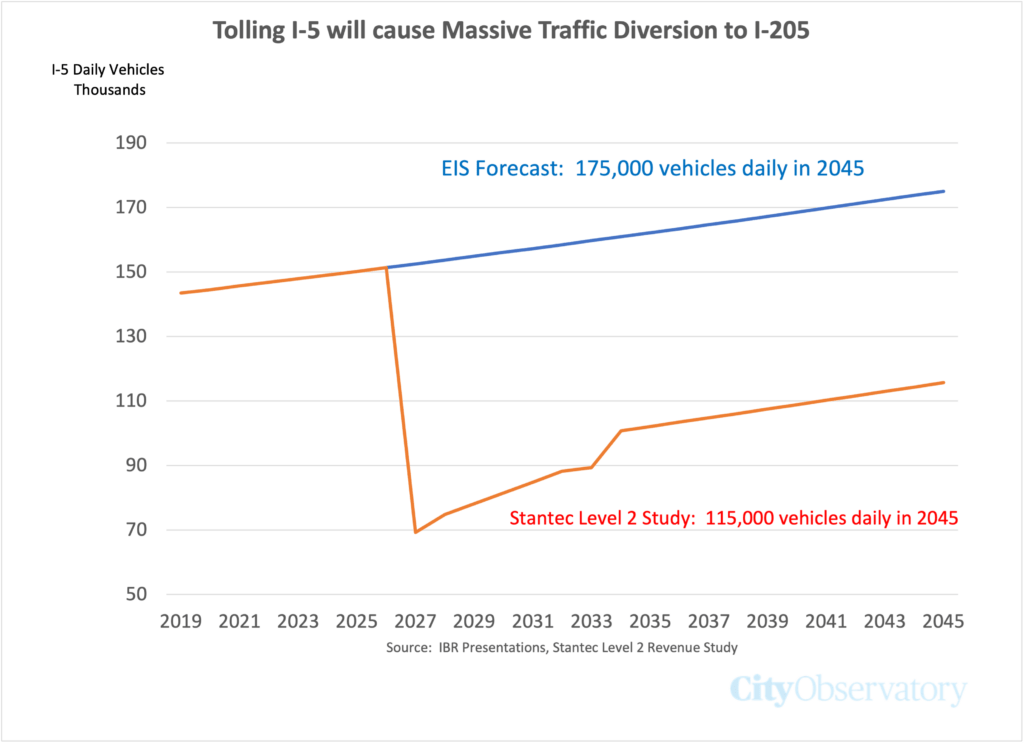
These high toll levels will prompt many users to avoid the I-5 bridge. The Stantec Level 2 modeling predicts how many will divert to I-205. (The as yet unreleased Level 3 final study will show the same).
Stantec Level 2 study concluded tolling I-5 will cause tens of thousands of vehicles to divert to the I-205 bridge. The Stantec study estimates that tolling I-5 would cause more than 50,000 fewer vehicles to use the I-5 bridges, and that this would cause tens of thousands of vehicles to shift to the I-205 bridge.
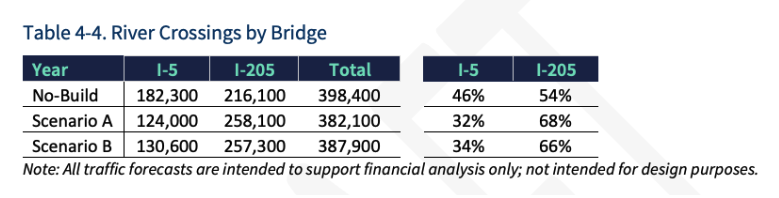
Stantec, Interstate Bridge Replacement Project, Level 2 Traffic and Revenue Study, February 24, 2023, page 4-10
Metro’s “Kate” regional travel demand model produced comparable estimates of traffic diversion under various tolling scenarios. On average, it found that about 55 percent of diverted I-5 traffic will instead cross the I-205 bridge. This estimate implies that tolling I-5 will add more than 30,000 vehicles per day to I-205.
We’ve known for more than a decade that I-5 tolls would produce massive diversion
Portland area residents who’ve followed this issue ought to have a sense of deja vu. The results of the Stantec Level 2 and Level 3 studies confirm the results obtained in the CDM Smith Investment Grade Analysis for the Columbia River Crossing a decade ago. In 2013, the Oregon and Washington highway departments paid CDM Smith about $1.4 million to produce an “investment grade” study that would qualify the project for federal loans and private bond financing. CDM Smith’s investment grade analysis (IGA), assumed that pre-completion tolling would start in 2019, and when it did, traffic on the I-5 bridge would fall precipitously, and remain below historical levels indefinitely. The CDM Smith study also concluded that the bulk of this traffic would shift to the I-205 bridge. This was front-page news in The Oregonian on January 11, 2014.
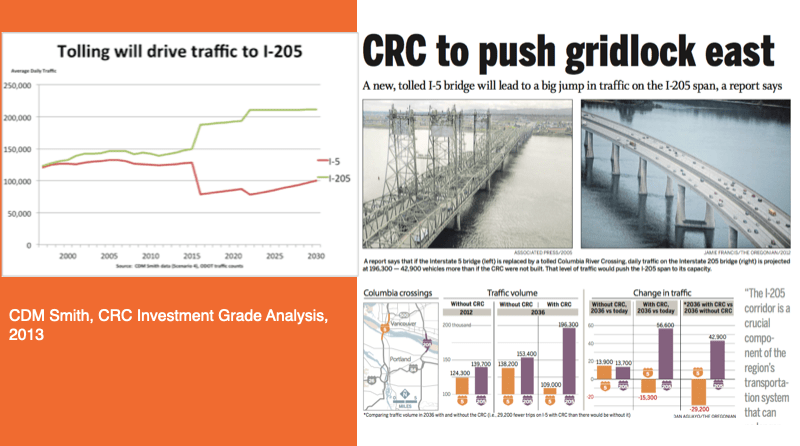
These studies don’t come cheap: Thirteen years ago, we paid CDM Smith $1.4 million for its Investment Grade Study. Three years ago, we paid Stantec $770,000 for its “Level 2” study. The cost of the soon-to-be-released Level 3 study is approximately $2.1 million.

Also read:
- Opinion: Were Republican voters just sleeping during the August primary election?
 CCRP Chairman Matt Bumala says 60% of primary no-shows in the 17th and 18th districts were Republicans.
 - Opinion: WA Cares’ launch showcased care WA Cares did not provide
 Gov. Ferguson showcased a caregiving arrangement at the WA Cares launch that the program had not paid for a single day of.
 - Auditor, auditor candidate address scrutiny over job title
 Greg Kimsey says roughly 40 county employees hold the deputy county auditor designation Kelly used in his campaign.
 - Opinion: Is Mitchell Kelly misleading voters with his ‘deputy auditor’ claim?
 Clark County HR records show no position called “Deputy County Auditor” has ever existed, Anderson argues.
 - Opinion: Democrats rig the ballot to save their income tax
 Churchill argues the ballot disclosure warning voters of education cuts describes revenue never collected and not yet allocated.
 wpDiscuz