


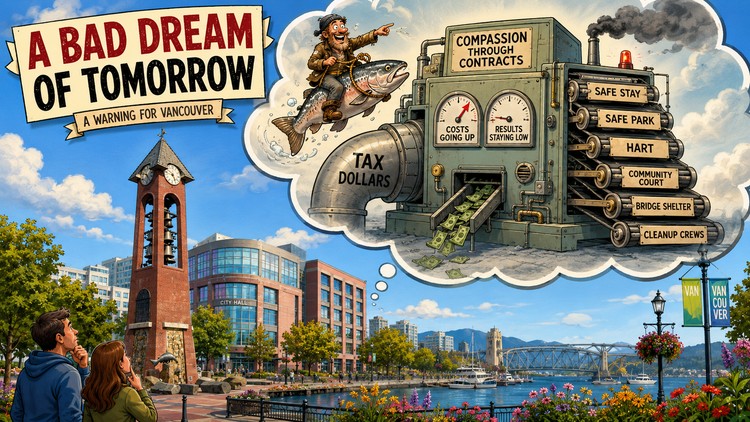
🎧 Vancouver’s Homeless Machine: Contracts Without Results
Peter Bracchi discusses how Vancouver’s compassion became a machine of contracts, costs, and consequences
Editor’s note: Opinions expressed in this letter to the editor are those of the author alone and may not reflect the editorial position of ClarkCountyToday.com
There was a time when Vancouver still looked like a city that understood itself. City Hall was a building, not a machine. A sidewalk was for walking. A park was for the public. A creek was water, not a cleanup contract. Public money was supposed to be spent carefully, explained clearly, and measured by results.
If you had warned a Vancouver taxpayer in 1984 about the city’s future, he might have thought it was a bad dream: Safe Stay sites, Safe Park, HART, Community Court, cleanup crews, nonprofit operators, emergency declarations, contract amendments, and now a Bridge Shelter — all layered on top of one another, none of them replacing the last.
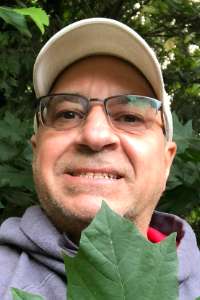
Peter Bracchi
The language would change first. Camping would become “outdoor habitation.” Enforcement would become “engagement.” Spending would become “investment.” Failure would become “capacity need.” And every crisis would need a budget.
First came the Safe Stay sites. Then more Safe Stay sites. Then Safe Park. Then HART. Then Community Court. Then more nonprofit contracts. Then extensions and amendments. Then a Bridge Shelter. And still the old programs remain.
If each new program is the answer, why do the old answers stay?
The future city has a ready reply: “No single solution works for everyone.” It is the perfect sentence. It justifies every expansion, every contract, every increase, every delay, and every failure to end what was supposed to be temporary.
The laws changed too. Public-space violations were no longer treated simply as violations. They became matters for assessment, referral, outreach, coordination, storage, engagement, and court diversion. HART became the gatekeeper between complaints, camps, cleanups, service referrals, and enforcement. Community Court became the path for offenses that once would have gone through ordinary legal channels.
Meanwhile, the ordinary taxpayer still has to obey every rule: pay the property tax, pay the utility bill, get the permit, follow the code, don’t block the sidewalk, don’t dump garbage, and don’t pollute the creek. But when public land is taken over by tents, trash, fires, blocked access, and environmental damage, the answer becomes complicated, expensive, and endless.
The taxpayer asks, “How much has this cost?” The city answers with charts. He asks, “How many people moved into permanent housing?” The city answers with people served. He asks, “Are parks cleaner?” The city answers with tons of garbage removed. He asks, “Is the creek protected?” The city answers with plans. He asks, “Will the spending stop?” The city answers with another contract.
Burnt Bridge Creek has become a witness. It hears speeches about climate action, restoration, equity, sustainability, and environmental stewardship. Then it absorbs years of camp impacts, garbage, erosion, fires, vegetation damage, human waste concerns, and repeated cleanups.
Downtown has changed too. Sidewalks are blocked. ADA access becomes a documented concern instead of a protected right. Public spaces become contested spaces. Residents learn where not to walk. Businesses learn what not to expect. Neighborhoods learn that complaints can be recorded without changing outcomes.
And still City Hall says the system is working.
Working for whom?
Compassion should be measured by results, not contracts. Are people leaving homelessness? Are public spaces restored? Are neighborhoods safer? Are creeks cleaner? Are emergency calls reduced? Are cleanup costs falling? Are older programs closing because they are no longer needed?
If the answer is no, then the machine is not solving the crisis. It is feeding on it.
Vancouver should not wait until every pilot becomes permanent, every emergency becomes a funding stream, and every sidewalk, park, creek, and neighborhood is asked to sacrifice itself in the name of managed compassion.
Before approving more spending, the City Council should give the public a full accounting: every Safe Stay cost, every Safe Park cost, every HART cost, every Community Court cost, every cleanup cost, every nonprofit contract, every amendment, every capital expense, every Bridge Shelter cost, and every measurable result.
Not slogans. Not sympathy. Not a process. Results.
If the Bridge Shelter is truly the next solution, what older program will be reduced or closed? If Safe Stays are still needed, what exactly did they solve? If HART is working, why do the same problems keep returning? If Community Court is accountable, where is the proof that behavior and conditions have improved?
A city can be compassionate without being foolish. It can help people without abandoning law. It can provide shelter without surrendering public space. It can fund services without writing blank checks. It can care for the vulnerable while still protecting taxpayers, neighborhoods, parks, sidewalks, and waterways.
A bad dream only becomes the future if nobody wakes up.
Vancouver/Clark County still have time to wake up.
Peter Bracchi
Vancouver

Also read:
- Opinion: Were Republican voters just sleeping during the August primary election?
 CCRP Chairman Matt Bumala says 60% of primary no-shows in the 17th and 18th districts were Republicans.
 - Opinion: WA Cares’ launch showcased care WA Cares did not provide
 Gov. Ferguson showcased a caregiving arrangement at the WA Cares launch that the program had not paid for a single day of.
 - Auditor, auditor candidate address scrutiny over job title
 Greg Kimsey says roughly 40 county employees hold the deputy county auditor designation Kelly used in his campaign.
 - Opinion: Is Mitchell Kelly misleading voters with his ‘deputy auditor’ claim?
 Clark County HR records show no position called “Deputy County Auditor” has ever existed, Anderson argues.
 - Opinion: Democrats rig the ballot to save their income tax
 Churchill argues the ballot disclosure warning voters of education cuts describes revenue never collected and not yet allocated.
 wpDiscuz