



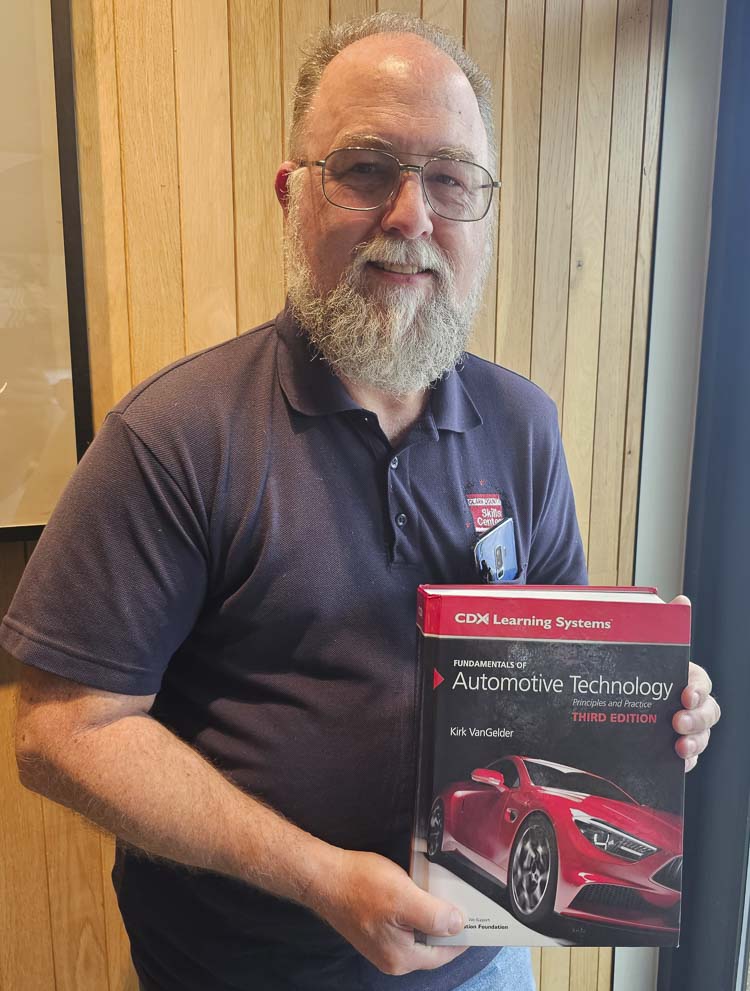
Kirk VanGelder, who has spent his career studying and teaching automotive technology, says that by the time a new Interstate Bridge is completed, autonomous vehicles will be the norm, and a better service for taxpayers than less than 2 miles of light rail
Paul Valencia
Clark County Today
The timing of the construction of the Interstate 5 Bridge replacement project and new technologies associated with autonomous vehicles could be perfect, a local expert has told Clark County Today.
So in sync, in fact, that there would be little or no reason to include a small, yet expensive, extension of Oregon’s light rail system into Vancouver.
Imagine, if you will, that the I-5 Bridge replacement project finalized its plans, received approval and funding, and construction started as early as late 2025 or early 2026. Now imagine if Vancouver city leaders get what they want in the project, too — the rest of Clark County to pay up to $2 billion for less than 1.9 miles of light rail track from the Expo Center in North Portland into downtown Vancouver.
Some estimates say it could take up to eight to 10 years to complete the project.
By that time, Kirk VanGelder says, there would be a much better option than less than 10,000 feet of fixed train tracks.
In some larger cities, the future is now. Robo-taxis are already serving the public all over the world, including in America.
VanGelder has spent a career in teaching auto technology. In fact, he has written a book on the subject: Fundamentals of Automotive Technology. He is currently working on a revised third edition of this textbook that is used throughout the English speaking world at colleges and trade schools. A college and high school teacher from Clark County, VanGelder gave his opinion at a recent C-TRAN Board of Directors meeting during public comment.
VanGelder said C-TRAN and city officials could have buyer’s remorse for asking taxpayers to purchase less than 2 miles of light rail.
“Autonomous vehicle (technology) is going to be the preferred solution as soon as it is available,” VanGelder said.
In his expert opinion, it will be available by the time the bridge is built or shortly thereafter.
VanGelder would advise transit agencies across the country to invest in autonomous vehicles. One day, people will be able to order a vehicle to pick them up at Point A and deliver them to Point B. Well, that is happening now through ride share programs and taxis. In the future, those trips will be driverless. Transit agencies such as C-TRAN should be looking at investing in a new form of mass transit, VanGelder says, in order to better serve the taxpaying public, and for better service directly.
Autonomous vehicles could make light rail obsolete, he said.
If C-TRAN and the county do invest in light rail, VanGelder said it would accommodate maybe 10 percent of the population of Clark County.
“We could take money and accommodate 80-plus percent of the county, for probably less money, and give them a better service,” VanGelder said.
Billions of dollars for less than two miles of fixed track? Or a system that can take you and your friends directly where you want to go in an urban environment?
“The next step is going to be autonomous vehicles, which go wherever you want, can pick you up, deliver you, and do so at your convenience,” VanGelder said. “That’s going to be the selling point. It will be between getting on a train full of strangers with other issues or taking your own personal transportation that comes to your door.”
If light rail comes to Vancouver — at the cost of taxpayers throughout Clark County — one will be able to ride the train to Portland International Airport. Of course, for a Ridgefield resident, that would mean driving to Vancouver or taking a bus to a new park and ride, getting on a light rail train to travel south, slowly through North Portland to the Rose Quarter. Then changing trains to travel east toward Gateway, and then north again to the Airport.
Or, in say 2035, perhaps there will be an option to have an autonomous vehicle take you directly from Ridgefield to the airport. Which one would you choose?
C-TRAN already has a rideshare program. Today, The Current will pick you up from your door and deliver you to a doctor’s office or the grocery store, for the same cost as a bus fare. For now, The Current — with human drivers, or course — only delivers customers within districts designated by C-TRAN. But if one wants to travel outside of the district, The Current will take a customer to a bus transit center.
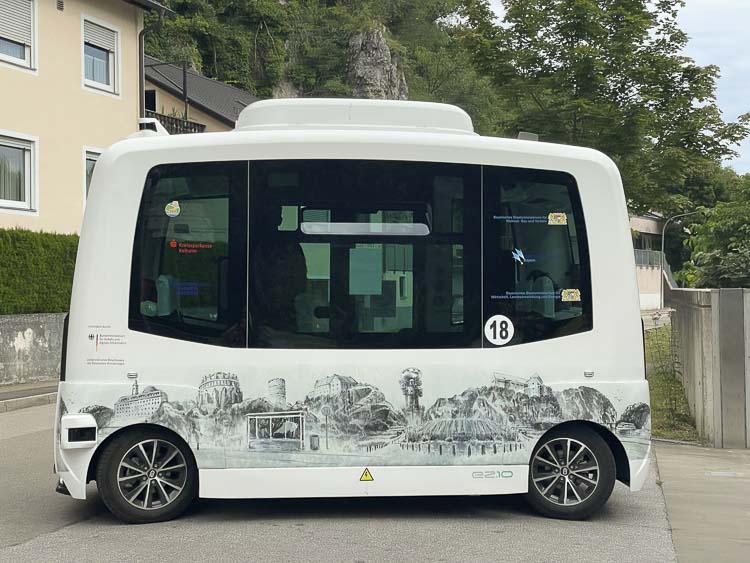
If C-TRAN is already investing in rideshare programs, why would it not potentially expand that program to include autonomous vehicles in the future, and/or expand the coverage area? Autonomous vehicles — vans or small buses — would be less expensive than light rail cars, and they would have the ability to serve a larger area than less than 2 miles of track.
So just how close are we to autonomous vehicles?
It helps, VanGelder said, to get an understanding of how the industry describes levels of autonomy in vehicles.
Older cars, with no cruise control, are at Level 0, for example. All driving conditions are solely controlled by the driver.
- Level 1: all driving conditions are controlled by the driver, but some systems can act independently, such as braking, steering, and standard cruise control. This is where most cars are today.
- Level 2: one system controlling braking, steering, and acceleration can act independently of the driver. There is adaptive cruise control and lane keep.
- Level 3: Critical controls are turned over to the Advanced Driver Assistance Systems under certain driving environments. Drivers can still take control.
- Level 4: Fully autonomous as far as safety control under most, but not all, environments.
- Level 5: A fully autonomous system.
Today, the Mercedes-Benz S Class and EQS Sedan are the most autonomous vehicles available to the general public, according to a report provided by VanGelder. They are designated as Level 3.
But experts say a lot is going to change in the coming years. By the end of this decade, Level 2 and Level 3 systems likely will become standard features in new vehicles for the public. In the early 2030s — and the bridge likely won’t be done until 2034 at the earliest — it is anticipated that there will be large-scale deployments of Level 4 robo-taxis and other autonomous commercial vehicles.
There are test programs going on right now in America. There is a pilot program in West Palm Beach, Fla, with a Level-4 autonomous electric shuttle.
Waymo has delivered one million rides per month in early 2025 in cities in California, Arizona, and Texas, for example. Waymo is on track to provide more than 25 million rides in 2025, up from 4 million rides in 2024.
VanGelder noted the timing in a report he provided to Clark County Today: In the early 2030s, there will be a large-scale deployment of autonomous taxis and other commercial vehicles.
That works, he said, because the purpose of the new bridge is to take people “from here to there, either by private or public entities,” VanGelder said.
Detractors say autonomous vehicles will not help with traffic. VanGelder noted that with less than 2 miles of added track to the current light rail system, cars will still be needed.
Residents from east Vancouver or Camas will still need to find a way to get to the light rail station in downtown Vancouver.
Plus, VanGelder noted, the systems in autonomous cars will find the fastest routes available. Also, for people using autonomous cars as a rideshare, they can schedule pick-ups during non-peak times, when possible. Those cars will arrive at the customer’s convenience.
VanGelder is not against mass transit. He noted that light rail does have its benefits, especially just before and after large sporting events in Portland, for example. You are a proponent of buses over fixed light rail. They are not limited to a single track. But the cost to add just less than 2 miles of track to bring MAX to Vancouver does not seem to make much economic sense to him, when alternative modes of transportation are going to be available about the time any new bridge is completed.
“Once this gets into place,” VanGelder said of the system of autonomous vehicles, “it’s going to make other systems obsolete. People will select the more convenient way.”
Also read:
- Washington’s studded tire deadline is March 31
 Drivers must remove studded tires by March 31 or face a $137 fine, with WSDOT urging early action due to busy service centers and no planned deadline extension.
 - VIDEO: WA diesel hits record $6.53, crushing truckers and school budgets
 With diesel nearing $6.53 per gallon in Washington, trucking businesses and school districts now confront sharply higher fuel expenses affecting budgets and workers.
 - Opinion: In plain sight – yielding to pedestrians
 Drivers often fail to see pedestrians due to inattentional blindness, which highlights the need for more focused awareness at intersections and stronger safety practices.
 - Expect delays on SR 14 in Vancouver for guardrail repairs Wednesday
 State Route 14 travelers in Vancouver should plan for morning delays as WSDOT will close two eastbound lanes for guardrail repairs, affecting mileposts 6.0 to 7.0.
 - Overnight closure planned on westbound SR 14 Camas Slough Bridge Tuesday
 WSDOT crews will close westbound SR 14 at Exit 14 in Camas to collect bridge deck samples and plan future repairs; detours will be in effect.
 wpDiscuz
