



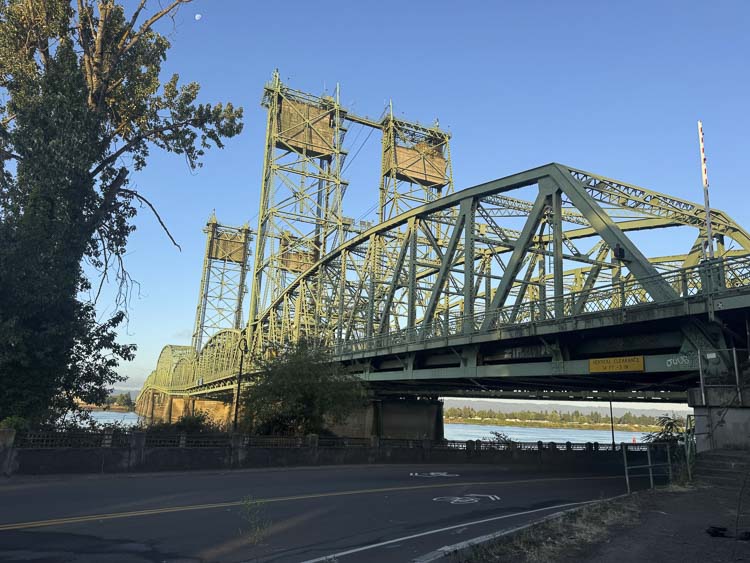
Payments totaling $140 million will only be made if the Coast Guard permits a fixed-span bridge and construction begins
VANCOUVER – Oregon and Washington officials believe they have moved one step closer to replacing the Interstate Bridge after signing agreements with the four river users identified as being affected by a proposed fixed-span bridge across the Columbia River.
These agreements paved the way for the Oregon Department of Transportation (ODOT) and Washington State Department of Transportation (WSDOT) to submit an updated Navigation Impact Report on behalf of the Interstate Bridge Replacement (IBR) Program to the U.S. Coast Guard proposing a fixed-span bridge of 116 feet vertical navigation clearance. Officials believe this is a critical milestone towards receiving a bridge clearance permit to replace the 108-year-old Interstate Bridge connecting the two states.
“This project is critical for Washington state,” Washington Governor Bob Ferguson said. “A fixed span removes the only stoplight on I-5 between Canada and Mexico, supports our economy and has broad consensus across many stakeholders. Reaching agreement between all four river users for the first time shows a clear path forward.”
IBR officials claim the proposed 116-foot high replacement fixed-span bridge would continue to provide access for 99% of river traffic, while removing the stoplight on Interstate 5 to improve safety and reliability for roadway commerce, vehicles and transit. The impacts to identified river users have now been mitigated through the agreements. IBR and transportation officials claim there is strong regional and community support that a fixed-span bridge would best address the needs of all users.
“The IBR Program has demonstrated that a fixed-span bridge is the best solution for the largest number of users for the future transportation reliability and safety the region needs,” Oregon Governor Tina Kotek said. “I appreciate Governor Ferguson’s partnership in making sure we can get to the next milestone for the new bridge.”
IBR officials claim a new movable span would perpetuate the same issues travelers experience with the existing movable bridge, including travel delays, reduced freight mobility and a high crash rate. Based on past estimates without accounting for inflation, construction of a movable span bridge would cost approximately half a billion dollars more (in 2022 dollars) than a fixed span and would cost $1 million more per year to operate and maintain. By comparison, these agreements totaling $140 million represent a more cost-effective solution to advance the IBR Program to construction according to proponents of the proposed bridge replacement. Payments will only be made if the Coast Guard permits a fixed-span bridge and construction begins.
River user agreement process
The IBR Program conducted extensive analysis and outreach to better understand the potential impacts to river users resulting from a fixed-span bridge with 116 feet of clearance. River users were identified as businesses that own or operate vessels that navigate the Columbia River, or manufacture products shipped under the Interstate Bridge. The IBR Program engaged independent experts to assess these potential impacts based on industry data and information provided directly from river users.
Comprehensive valuation processes were conducted to analyze current and projected business conditions using a thorough review of operations, vessel characteristics, site capabilities, employment data, financial statements and future revenue forecasts. It also considered potential business losses resulting from lost market opportunities and potential effects from changes to river users’ operations. An additional independent assessment was conducted, which validated that the process supporting negotiations was appropriate and adequate.
These agreements are intended to support the continued operation of these businesses at their current locations and in the region and demonstrate to the Coast Guard that the Program has addressed potential impacts.
Next steps to USCG revised decision on fixed or movable bridge
Next steps include the Coast Guard reviewing the information provided in the Program’s updated NIR. The Coast Guard will then hold a 30-day navigation comment period for river users and review those comments. At the conclusion of these steps, the states are hopeful that the Coast Guard will issue a revised Preliminary Navigation Clearance Determination for a fixed-span bridge. The Coast Guard’s decision is expected in early 2026.
Following this process, the Program’s federal lead agencies in the environmental review process – the Federal Highway Administration and Federal Transit Administration – can issue an Amended Record of Decision approving the Program to move into construction.
Also read:
- Opinion: ‘If they want light rail, they should be the ones who pay for it’
 Clark County Today Editor Ken Vance argues that supporters of light rail tied to the I-5 Bridge replacement should bear the local cost of operating and maintaining the system through a narrowly drawn sub-district.
 - Opinion: IBR falsely blaming inflation
 Joe Cortright argues that inflation explains only a small portion of the IBR project’s cost increases and that rising consultant and staff expenses are the primary drivers.
 - Letter: The Interstate Bridge Replacement Program’s $141 million bribe can be better spent on sandwich steel-concrete tubes
 Bob Ortblad argues that an immersed tunnel using sandwich steel-concrete tubes would be a more cost-effective alternative to the current Interstate Bridge Replacement Program design.
 - A sub-district vote could be a way to go to pay O&M costs associated with light rail
 Clark County Council members heard details on how a voter-approved C-TRAN sub-district could be created to fund long-term operations and maintenance costs for light rail tied to a new Interstate Bridge.
 - Letter: British Columbia’s new immersed tunnel can solve Interstate Bridge Replacement Program’s $17.7 billion problem
 Bob Ortblad argues that an immersed tunnel similar to a project underway in British Columbia could significantly reduce costs and impacts associated with the Interstate Bridge Replacement Program.

Who are the four river users?
FFS just build another bridge like the 205. Done!
The choice should not be made based on the height of the bridge. It should not be about whether it is a green bridge or a blue bridge. The present I-5 bridge has an estimated remaining life of over a hundred years. Keep it. Use it up, wear it out, make it do.
If a “stoplight” is undesirable on I-5, spend the money to put a new bridge ten miles west, let the through traffic use that.
I am so glad they are concerned about these silent 4 businesses. Do any of the 4 do business with the state? How about listening to the people and taking a vote again so they can say no again. If the Coast Guard says no are the states going to go judge shopping because this is the normal route for them. Spend, spend, spend that is what government does best!