




🎧 I-5 Bridge: Cancel Light Rail, Add Two Lanes Each Way
Douglas Tweet believes transportation officials should cancel light rail entirely from this I-5 bridge project, and use the savings to build two auxiliary lanes in each direction instead
Editor’s note: Opinions expressed in this letter to the editor are those of the author alone and may not reflect the editorial position of ClarkCountyToday.com
In April, 2026, the I-5 Interstate Bridge Replacement Program (IBR) published its Final Supplementary Environmental Impact Statement (FSEIS). Now the US Department of Transportation (DOT) is reviewing it.
Per the FSEIS, the IBR Recommended Design (One Auxiliary Lane in each direction) fails to meet a primary goal to reduce traffic congestion. Current estimated IBR construction costs are up to $15.2 billion, and could increase over the 20-year construction period, all for a more congested corridor.
A superior FSEIS design builds two auxiliary lanes both ways, which significantly reduces congestion and supports freight mobility. The table below summarizes the traffic congestion analysis presented in the FSEIS.
Congestion is shown in 2019 and predicted 2045 congestion for both designs based on modeling. It details hours of congestion, travel time (on I-5 from I-205 in north Vancouver to I-405 in north Portland), and extent of congestion (in miles), for Southbound traffic during the morning peak and Northbound traffic during the afternoon peak. Lower numbers mean better traffic conditions.
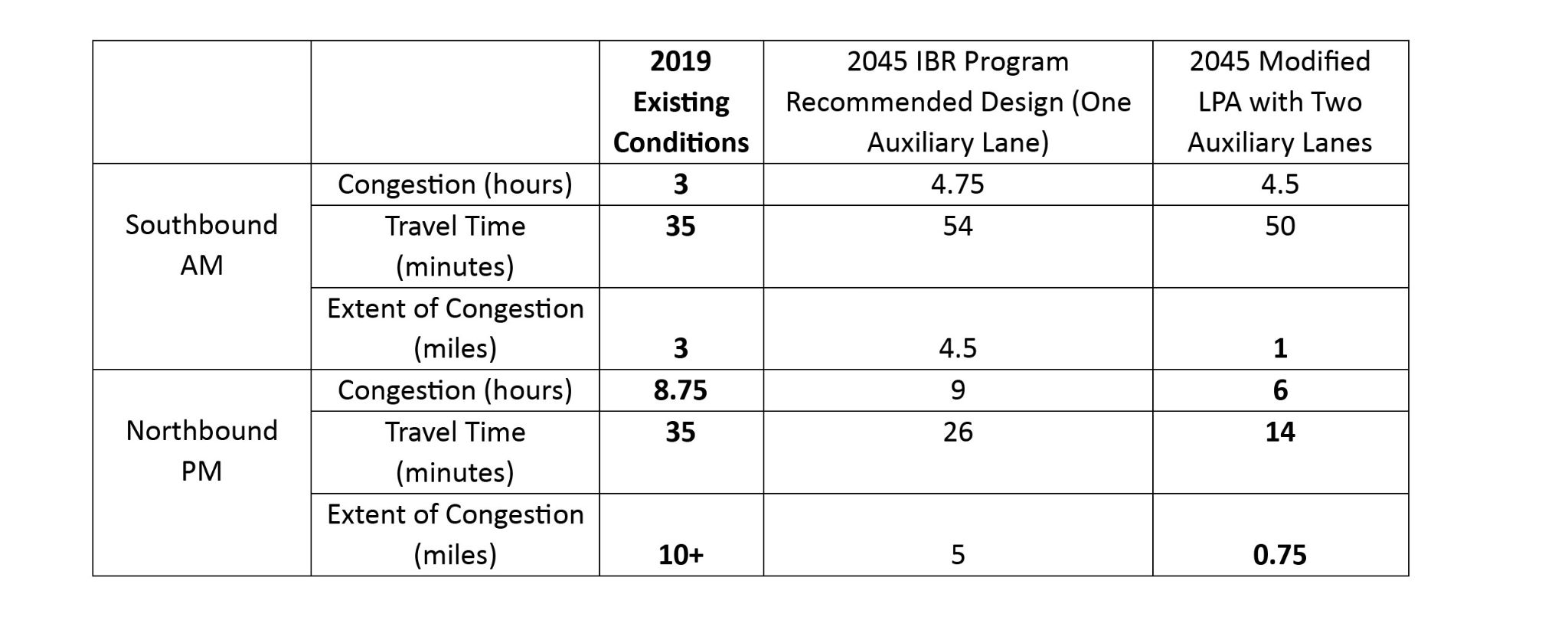
(Data are from Tables 3.1-3, 3.1-4, 3.1-14, 3.1-15, and 3.1-18 of Chapter 3.1 Transportation.)
The Two Auxiliary Lane design is better than One Auxiliary Lane design by every measure of congestion.
The One Auxiliary Lane in 2045 is worse than 2019 conditions for all measures except Northbound travel time and extent.
The Two Auxiliary Lane design in 2045 is better than 2019 conditions for all measures except Southbound travel time and congestion. The Two Auxiliary Lane design shows dramatic improvement over 2019 for Northbound PM, reducing congestion by 31%, travel time by 60%, and extent of congestion by over 90%.
IBR officials admit that the Two Auxiliary Lane option reduces Southbound congestion and “substantially” reduces Northbound congestion. (Section 3.1 Transportation, page 3.1-49). And yet, they recommend the design with just One Auxiliary Lane in each direction.
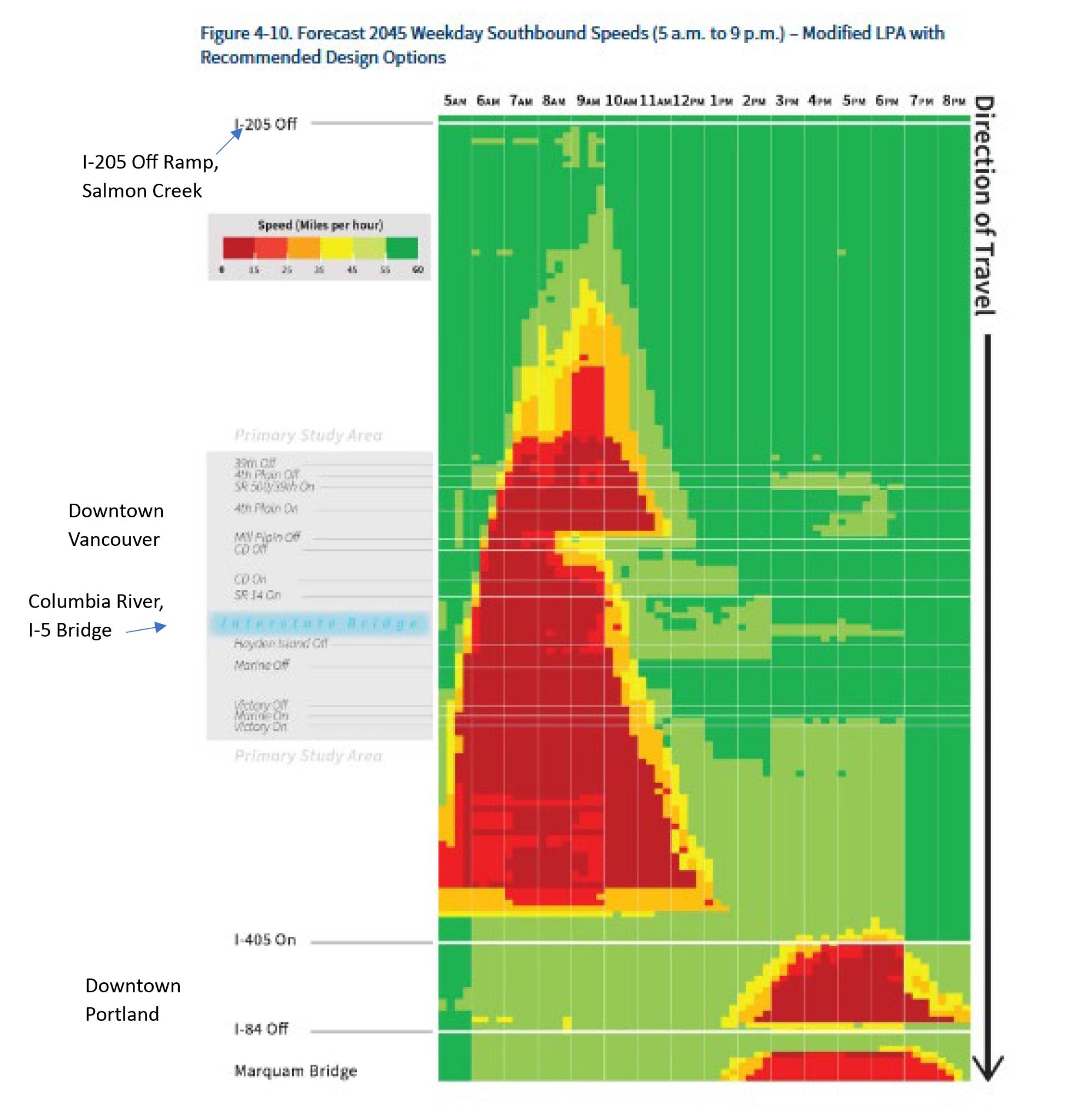
Visualization of Speeds for the Two models: FSEIS traffic speed forecasts
2045 weekday Southbound speeds for the IBR Recommended Design (One Auxiliary Lane). The vertical scale is located along I-5 from I-205 in Salmon Creek across the Columbia River to the Marquam Bridge in downtown Portland. The horizontal scale is the time of day from 5 a.m. to 9 p.m. Colors indicate traffic speed: Red is slowest (<15mph) and green fastest (>55mph). Speeds are slowest in the AM, and much faster in the PM. Source: pp 4-33ff of the Transportation Technical Report.
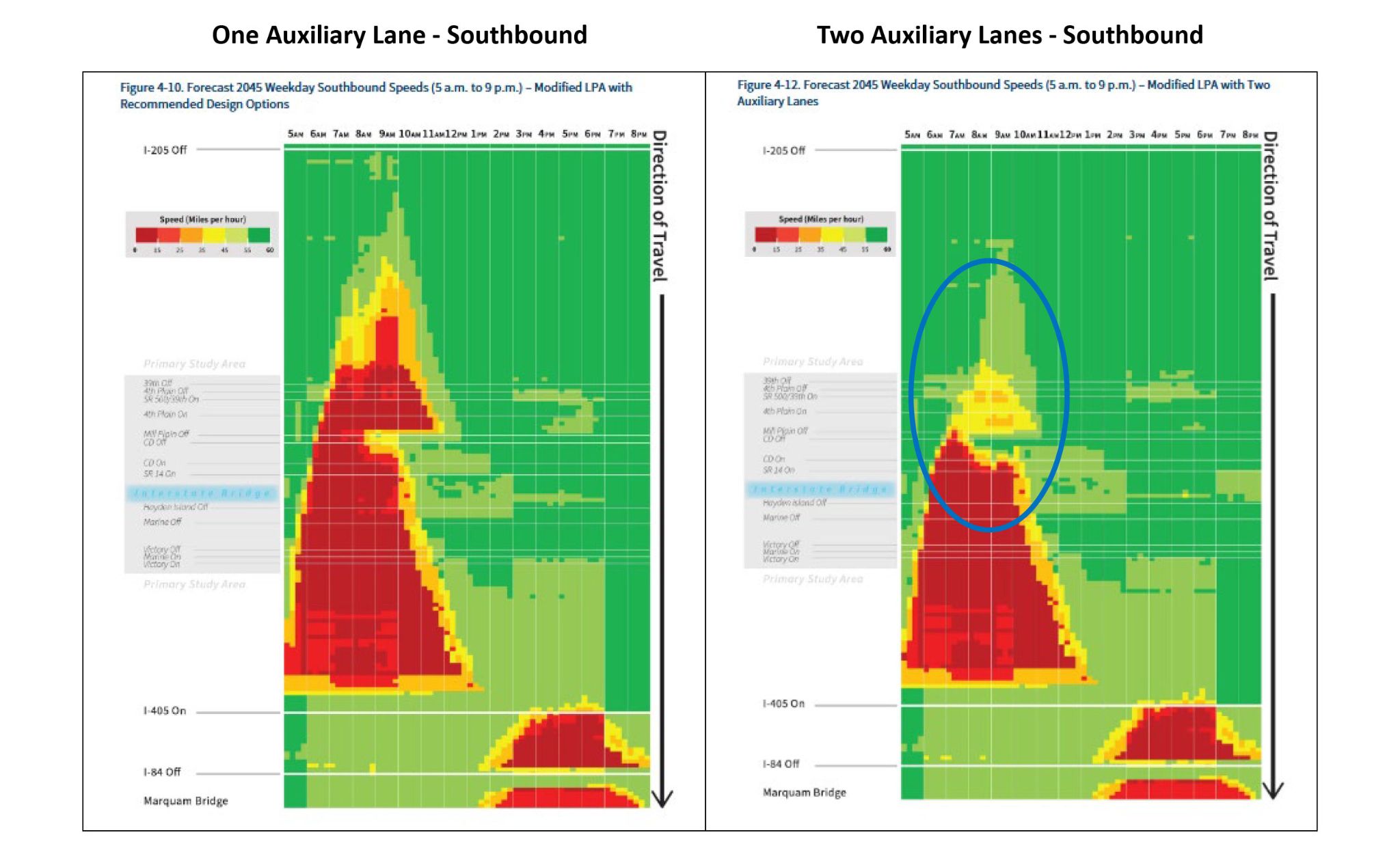
2045 Southbound forecasts comparison: IBR recommended (left) vs. design with Two Auxiliary Lanes (right). Two Auxiliary Lanes show AM speed increases north of downtown Vancouver, highlighted by blue ellipse.
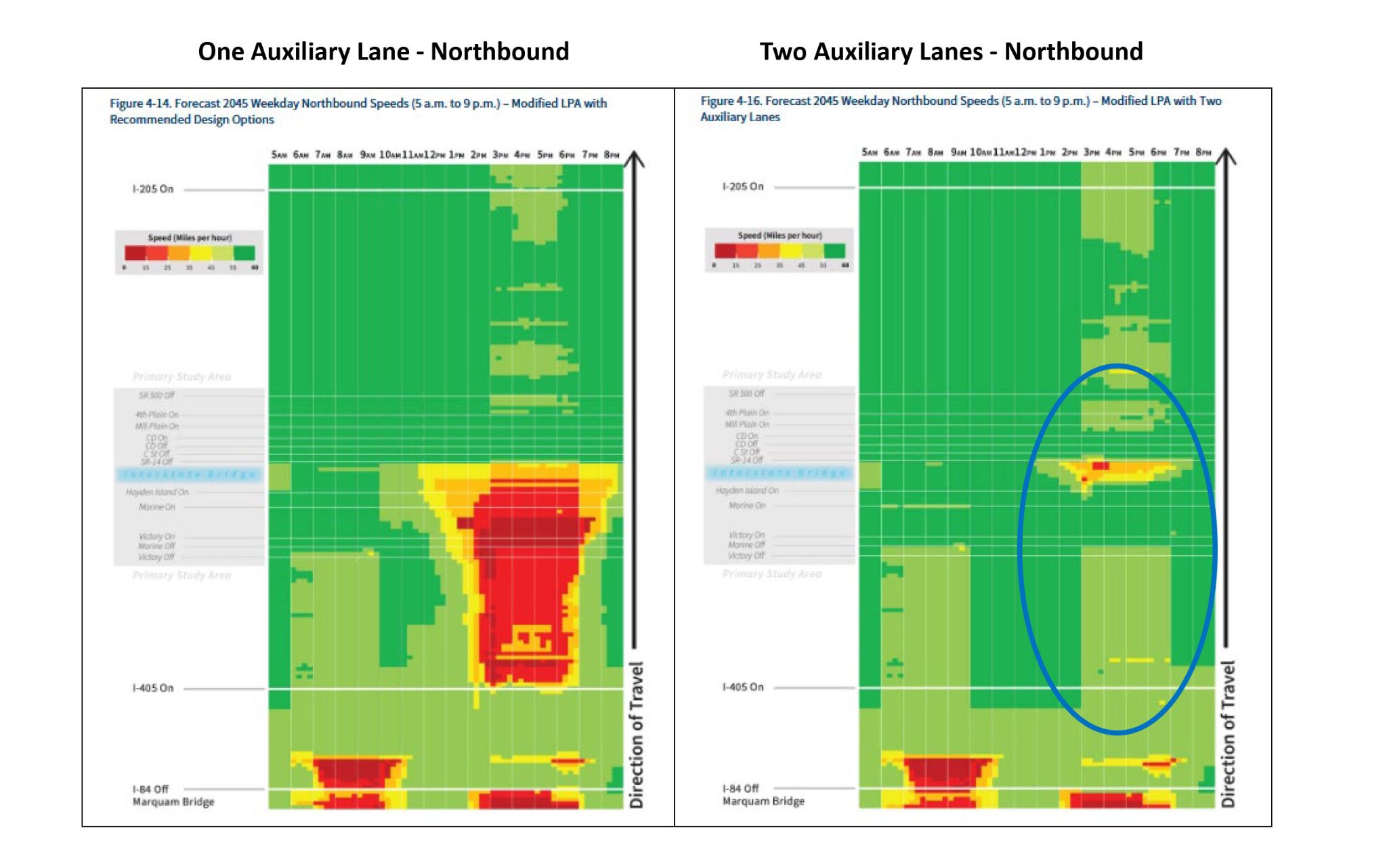
2045 Northbound forecasts comparison, IBR recommended (left) vs. design with Two Auxiliary Lanes (right). Two Auxiliary Lanes show a dramatic increase in speed in the afternoon, highlighted by blue ellipse.
As shown in the following bar graph for 2019 “existing conditions”, space allocation for the IBR bridge designs are grossly unfair. They devote approximately half of the bridge to Light Rail, buses, pedestrians & bicycles (2.3% of person trips in 2019). Vehicle traffic, freight trucks, delivery vans, ambulances, etc (97.7%) are crammed into the other half. Their 2045 forecast is not much better. Even assuming IBR’s inflated transit predictions, half of the bridge goes to just 12% of users.
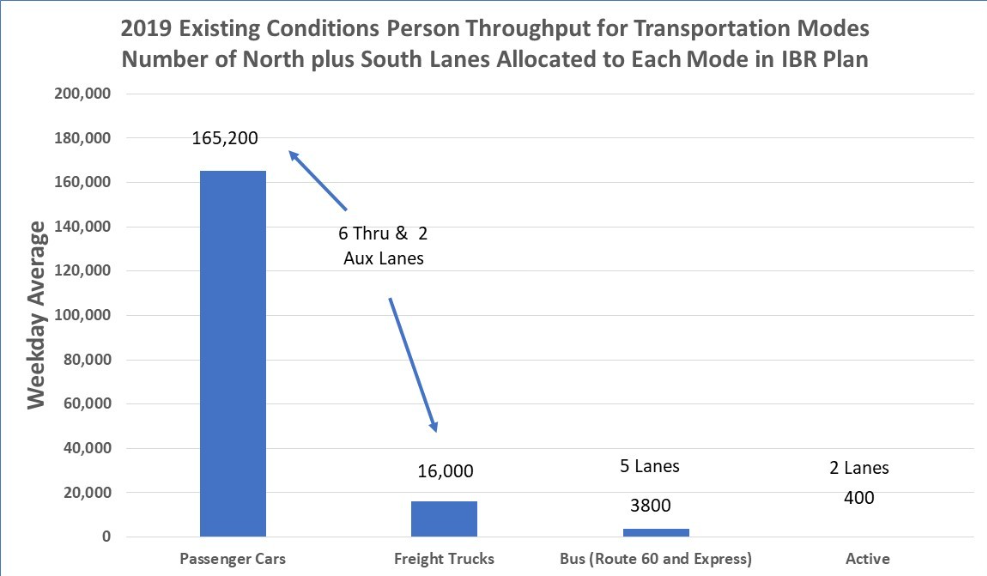
2019 Existing Conditions, various modes of transportation across I-5 bridge. IBR planned lane space allocations. Data: Table 4-7 from Transportation Technical Report, p 2-26.
Conclusion: Cancel light rail entirely from this I-5 bridge project, and use the savings to build Two Auxiliary Lanes in each direction instead.
The resulting significant improvement in congestion and travel times will benefit all vehicles: automobiles, freight trucks, emergency vehicles, transit buses/vans, etc.
Douglas Tweet
Camas

Also read:
- Letter: I-5 Bridge – Eliminate light rail, include two auxiliary lanes each way instead
 IBR’s own data shows two auxiliary lanes outperform the recommended one-lane design on every congestion measure.
 - POLL: How would you rate the overall direction of Clark County right now?
 Clark County Today asks residents to rate the county’s direction as leaders plan for growth, safety, and affordability.
 - Washingtonians could see toll rates increase to $18 along SR 167, I-405 next year
 State officials may raise SR 167 and I-405 toll rates to $18 after a $10 million revenue shortfall was identified.
 - US House passes sweeping ‘gender ideology’ bill aimed at trans kids in schools
 The 217-198 House vote ties federal school funding to parental consent on student gender records.
 - Opinion: Fix licensing. Expand access. Lower costs. Free workers.
 Universal licensure recognition could replace Washington’s patchwork of occupation-by-occupation licensing compacts.
