



Joe Cortright doesn’t believe the IBR’s strategy will work in getting the Coast Guard to agree to a lower bridge
Joe Cortright
City Observatory
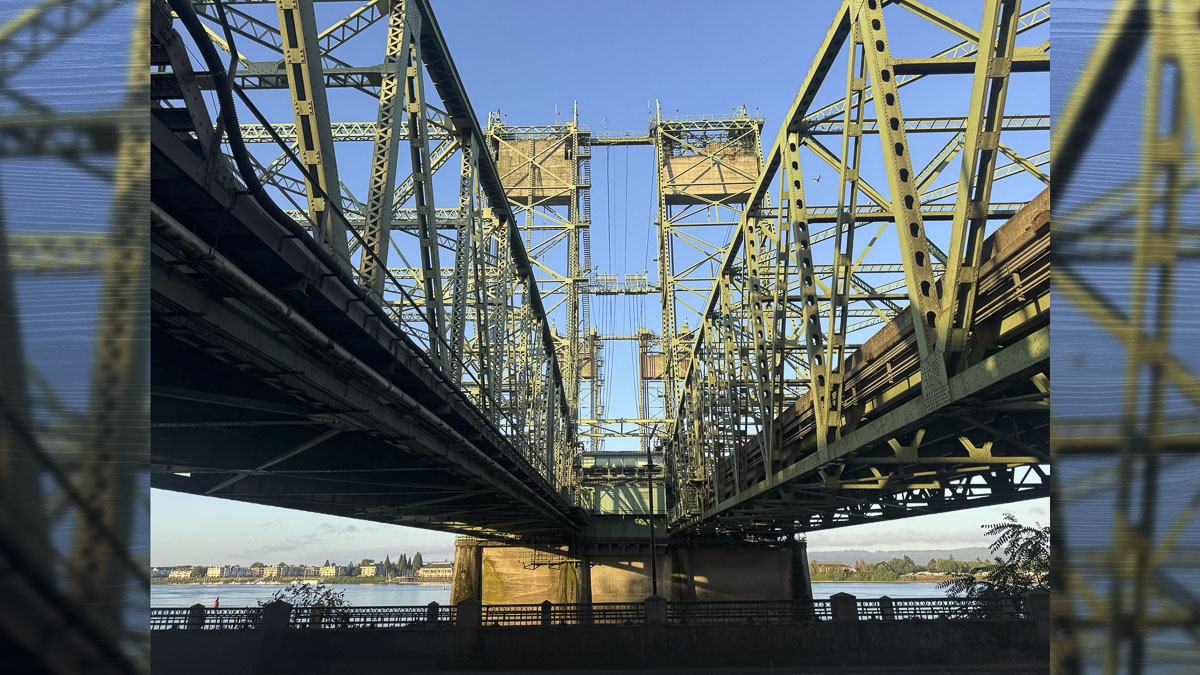
The Oregon and Washington transportation departments want to build a low fixed span to replace the current I-5 lift bridge.
They’ve signed $140 million in deals with four shippers whose current operations would be affected by the reduced clearance. They’re hoping this convinces the Coast Guard to allow a low span.

But the Coast Guard has signaled that isn’t sufficient, and that it wants a higher span to protect future uses of the river, not merely the current users. The Coast Guard already said so in 2022 in response to a previous IBR report containing virtually the same information.
“IBR’s proposed bridge . . . contradictory to the U.S. Coast Guard’s mandate from Congress to maintain freedom of navigation on the navigable waters of the U.S. and to prevent impairment to U.S. navigable waterways.” US Coast Guard, June 2022.
Simply bribing the current users of the river is not the legal standard applied by the Coast Guard; instead, Coast Guard has a century-old legal responsibility to prioritize the interests of potential navigation uses of the river.
IBR is “proceeding at its own risk” with plans for a low fixed span, and the Coast Guard has already said it will insist on 178-feet of navigation clearance. It seems highly unlikely that the Coast Guard will reverse its earlier finding, which aims to protect a range of future uses of the river over the next 100 years or more.
The bad blood between the Coast Guard and the state highway departments makes this even harder to picture, and now, with a new administration, the Coast Guard (part of the Department of Homeland Security) may have little interest in yielding to the highway departments of two blue states.
Bad blood on the Columbia: DOTs vs. Coast Guard
Under federal law, the Coast Guard has absolute legal power to decide what gets built over navigable waterways. Fifteen years ago, the two state DOTs had an epic bureaucratic battle with the Coast Guard about the navigation clearance for the proposed Columbia River Crossing – a very similar fixed span bridge that would have impeded navigation.
The new IBR proposal has echoes of that dispute, and shows the remaining bad blood between the Coast Guard and the two state highway departments. Fifteen years ago, the highway departments attempted to foist an even lower 95 foot design on the Coast Guard – based on paying about $86 million to affected river users. The Coast Guard objected to that design and insisted on adding 21 feet to the final design. CRC officials waited until the very end of the environmental review process to seek approval for the navigation clearance, hoping “run out the clock” and to bring pressure on the Coast Guard to go along with their low design. Their gamesmanship cost them a couple of years and set the stage for the collapse of the CRC in 2013.
This battle between the Washington and Oregon DOTs and the Coast Guard prompted a national level re-write of the rules on how navigation clearance determinations would be made. The new process – designed to avoid highway agencies trying to strong-arm the Coast Guard into approving projects – required the agencies to submit navigation information well before the environmental review process commenced, and for the Coast Guard to determine the needed clearance early on, so that agencies wouldn’t advance proposals that couldn’t be approved.
The Coast Guard Decides What Gets Built
Under a century-old federal law, the Coast Guard decides whether, and under what conditions, bridges can be built across navigable waterways (like the Columbia River). The statute provides that the Coast Guard’s duty is to protect both users and uses of navigable waterways. The distinction is important, because it means that the Coast Guard isn’t simply looking at who is using the river now, but how the river might be used over the next several decades, and in doing so, its responsibility is to protect the interests of navigation. The Coast Guard issued its “Preliminary Navigation Clearance Decision” or PNCD in 2022, saying that only 178 foot clearances would be approved, and that if the two state DOTs brought forward any other alternatives they were “proceeding at their own risk.”
On October 5, 2025, the Interstate Bridge Replacement Project filed a new “Navigation Impact Report” with the US Coast Guard, hoping to persuade the Coast Guard to reverse the decision it made three years ago that any project had to provide for at least 178 feet of vertical navigation clearance. The IBR’s press release and media coverage make it seem like cash payments to a handful of river users are all that is needed to get a bridge permit. But that’s simply not true.
The Coast Guard has already weighed in with its opinion: a new Columbia River bridge needs to allow for at least 178 of vertical clearance over the river. In June, 2022, when it issued its preliminary determination, the Coast Guard made it unambiguously clear that alternatives that didn’t provide at least a 178-foot vertical navigation clearance did “unreasonably obstruct” river navigation. It wrote:
Our PNCD concluded that the current proposed bridge with 116 feet VNC [vertical navigation clearance], as depicted in the NOPN [Navigation Only Public Notice], would create an unreasonable obstruction to navigation for vessels with a VNC greater than 116 feet and in fact would completely obstruct navigation for such vessels for the service life of the bridge which is approximately 100 years or longer.
B.J. Harris, US Coast Guard, to FHWA, June 17, 2022, (emphasis added).
The reasons for the Coast Guard’s decision are clearly laid out in its June 17, 2022 letter:
- Current users need to move structures and vessels with a clearance of between 130 and 178 feet.
- Vessels and their cargos are growing larger over time. Marine industries need the flexibility to accommodate larger structures in the future.
- There are no alternative routes for waterborne traffic to reach areas East of the I-5 bridges; in contrast there are many alternate routes for terrestrial traffic (cars, trucks and trains).
- Water access to the area East of the I-5 bridges, including PDX airport and the Columbia Business Center marine industrial area in Vancouver may be needed in the event of a natural or national emergency
- Historically, the Columbia Business Center has been a preferred site for shipyard activity (it housed the Kaiser Shipyard in World War II) and may be needed again for this purpose in the future
The Coast Guard’s 2022 PNCD makes it clear that it is strongly committed to maintaining the existing river clearance, that it won’t approve a 116-foot bridge, and that the economic effects of this would be unacceptable. It also pointedly directs the two state DOTs to evaluate either a tunnel or a moveable span to meet its 178-foot requirement:
The Columbia River System is an extremely important interdependent-multimodal supporting national and international commerce critical to local, national and global economies. Reducing the capability and capacity of the Columbia River System would severely restrict navigation. IBR’s proposed bridge as depicted in Public Notice 02-22 with its 35% reduction of VNC from 178 feet to 116 feet is contradictory to the U.S. Coast Guard’s mandate from Congress to maintain freedom of navigation on the navigable waters of the U.S. and to prevent impairment to U.S. navigable waterways. As new structures are built, navigation clearances should be improved or at a minimum maintained. Any proposed new bridge should have a VNC of greater than or equal to that of the existing I-5 twin bridges of 178 feet or preferable, unlimited VNC, as well as a HNC as permitted during the final USACE 408 permit. There are alternative options to accomplish this VNC to include a tunnel or a high-level lift bridge or bascule bridge, which would provide an unlimited vertical clearance. A modern similar successful project is the Woodrow Wilson Bridge over the Potomac River in Washington, DC that was completed in 2009. It is a higher-level double bascule lift bridge on an interstate (I-95) with transit. The added height of the new bridge reduced the number of bascule bridge openings for vessel passage by 76%. (Emphasis added)
Also in 2022, IBR officials mis-represented to the Legislature the standards that would apply to the IBR, claiming that the bridge was grand-fathered under old rules, and didn’t need to go through the new process agreed to by USDOT and Coast Guard after the CRC debacle. That’s simply untrue.
Bribing existing users won’t persuade the Coast Guard
The IBR, in its new 2025 navigation report, argues that it should be allowed to build a much lower fixed span, with just a 116-foot vertical clearance, because it has entered into agreements with current river users to pay them off. The payoffs consist of money to modify existing vessels and equipment to be able to transit under a new, lower fixed span, or simply to compensate them for the inability to move anything taller than 116 feet.
IBR thinks that the payoffs to a handful of existing users ought to convince the Coast Guard to allow a low fixed span, but that’s highly debatable. Nothing in the IBR’s new navigation report challenges the findings of fact the Coast Guard has already made about the need to protect the lower Columbia River for future uses, including industrial development over the next century (or more).
Finally, it’s worth thinking about the very much changed political context. The Trump Administration takes a much different view of big transportation projects, especially in blue states, than did the Biden Administration. Already, USDOT is slow-rolling Biden era grants, and the $2.1 billion in Biden-funding for the Interstate Bridge Project could be rescinded if construction doesn’t begin by September 30, 2026. And it’s worth noting that the Coast Guard is part of the Department of Homeland Security, headed by Secretary Kristy Noem, who seems to have an axe to grind against Portland.
Bribes are no bargain
The state DOTs have characterized the payments to river users as a comparative bargain, because it will enable them to avoid the $400 million or more cost of adding a lift-span to their design for the crossing. What that ignores is that if one were to build a lift span bridge, the overall structure could be much lower, and as a result, the approaches could be much lower, and this would obviate the need to rebuild, high in the air, the interchanges just north and south of the river. Only about 20 percent of the cost of the project is the actual bridge; about 60 percent is the cost of widening five miles of highway, building elevated approaches and rebuilding seven interchanges. It is likely that a bridge design incorporating a lift span — and not changing the approaches or interchanges on either side of the river — much like the design chosen for the replacement of the Burnside Bridge in downtown Portland, could be vastly cheaper than the current IBR design.
Also read:
- VIDEO: WA diesel hits record $6.53, crushing truckers and school budgets
 With diesel nearing $6.53 per gallon in Washington, trucking businesses and school districts now confront sharply higher fuel expenses affecting budgets and workers.
 - Opinion: In plain sight – yielding to pedestrians
 Drivers often fail to see pedestrians due to inattentional blindness, which highlights the need for more focused awareness at intersections and stronger safety practices.
 - Expect delays on SR 14 in Vancouver for guardrail repairs Wednesday
 State Route 14 travelers in Vancouver should plan for morning delays as WSDOT will close two eastbound lanes for guardrail repairs, affecting mileposts 6.0 to 7.0.
 - Overnight closure planned on westbound SR 14 Camas Slough Bridge Tuesday
 WSDOT crews will close westbound SR 14 at Exit 14 in Camas to collect bridge deck samples and plan future repairs; detours will be in effect.
 - Opinion: Stay in your lane – seriously, it’s the law
 Drivers must choose the nearest lane when turning in Washington, and left turns bring added risk. Even with signals, every driver must help prevent crashes by following law.
 wpDiscuz
