



Rep. John Ley examines Clark County’s ‘fair share’ of TriMet’s operating expenses?
Rep. John Ley
For Clark County Today
There is a roughly two decade battle playing out before citizens of Clark County – who bails out Portland’s TriMet? The former Columbia River Crossing (CRC) was “a light rail project in search of a bridge.” The current project proposed by the Interstate Bridge Replacement Program (IBR) is a resurrection of the failed earlier effort, but with a $2 billion price tag (for just the light rail element). The I-5 Bridge replacement project continues to deliver “a bridge too low” for the US Coast Guard.

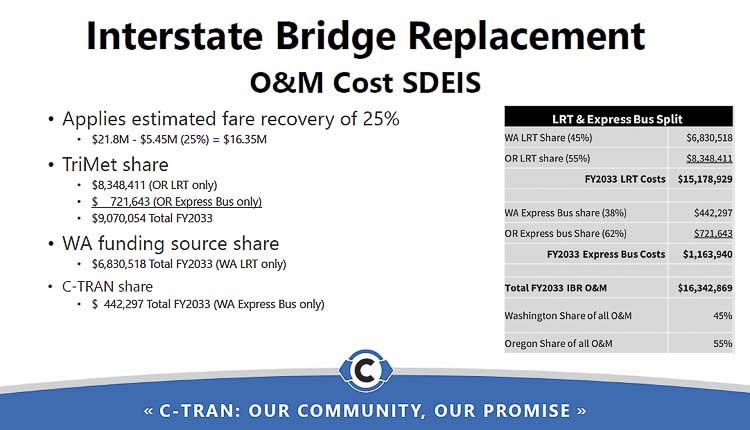
Who pays is a critical component of the discussion, as each state would pay roughly $500 million for light rail capital costs, “if” the federal government funds $1 billion. But TriMet is also demanding roughly $22 million per year in new taxes to cover operations and maintenance costs (O&M), of which an estimated $7.2 million would come from Clark County taxpayers.
One could view TriMet as the bully which controls significant politics on the Oregon side of the river. With the demand for a $2 billion, 1.83-mile extension of their Yellow Line MAX into Vancouver, Clark County’s largest city is aiding and abetting TriMet.
How do you stand up to a bully? Clark County’s small cities feel they are being taken advantage of, potentially being forced to pay for light rail service that allegedly benefits Vancouver. That battle is now being played out at the C-TRAN Board of Directors.
“How many times do you go into business with a partner that is failing? You don’t do it,” Camas Councilor Tim Hein said.
Past history
This is a problem that began more than a decade ago. Vancouver Mayor Anne McEnerny-Ogle and other Vancouver officials didn’t like the pushback they were getting from Clark County Commissioners David Madore and Tom Mielke on a variety of issues before the C-TRAN Board.
Things exploded when Madore pushed back hard on then C-TRAN CEO Jeff Hamm and attorney Tom Wolfendale, who negotiated and then signed a horrible agreement with TriMet. It ceded C-TRAN’s eminent domain authority to TriMet, without revealing the exact details of the agreement until after it was signed.
That contract was negotiated in secret in the fall of 2013. Some news reports indicate it was being changed/modified just hours before Hamm and Wolfendale shared minimal details with the C-TRAN Board during a presentation.
That agreement has never been rescinded. It includes language saying it is “absolute and irrevocable” which is ludicrous. It included a $5 million penalty clause which C-TRAN would have to pay TriMet if they didn’t agree to TriMet’s demands.
This happened in the fall of 2013. Less than a year later, the allocation of Board seats was redistributed, taking one away from the county and giving it to our small cities in 2015.
Washington state refused to fund its $450 million for the CRC in the 2013 legislative session. Oregon was considering going it alone. Out of nowhere, this agreement was secretly concocted to give TriMet the ability to extend light rail into Vancouver.
It wasn’t until mid 2014 that the CRC allegedly died when the Oregon legislature refused funding the entire project. In reality, it was quietly put on the back shelf until changes in the political landscape allowed for the resurrection of the project in 2019.
Dollars and cents
| Jurisdiction | 2024 Sales Tax Collected | 2024 Service Area Population Estimates | 2024 Fixed Route and C-VAN Operating Expenses | |||
| City of Vancouver | $49,361,531 | 58% | 202,600 | 44% | $53,592,023 | 70% |
| Clark County UGA | $18,862,380 | 22% | 164,598 | 36% | $15,824,079 | 21% |
| Camas | $5,045,549 | 6% | 27,660 | 6% | $1,990,782 | 3% |
| Battle Ground | $4,651,651 | 5% | 22,470 | 5% | $2,504,543 | 3% |
| Ridgefield | $3,811,407 | 4% | 15,790 | 3% | $315,002 | 0% |
| Washougal | $2,835,296 | 3% | 18,150 | 4% | $1,891,038 | 2% |
| La Center | $616,678 | 1% | 4,045 | 1% | $69,120 | 0% |
| Yacolt | $213,926 | 0% | 1,670 | 0% | $11,954 | 0% |
| Totals | $85,398,419 | 100% | 456,983 | 100% | $76,198,541 | 100% |
One common theme in political debates is “the rich must pay their fair share.” Vancouver is “the rich” in Clark County government. The city has NOT been paying its fair share for a long time when it comes to taxes for C-TRAN operations.
An analysis prepared for Camas and small cities compared tax revenues paid to C-TRAN versus the services received. Vancouver residents paid 58 percent of the taxes, yet received 70 percent of the service and benefits from C-TRAN operations. It would owe an additional $4.2 million per year to cover the services its citizens receive.
Rural Clark County citizens paid $3 million more than the cost of the services they received. Each of the six small cities paid more in C-TRAN taxes than they received in service according to the report.
Vancouver has been picking the pockets of citizens in small cities and rural Clark County for a long time, potentially decades, for C-TRAN bus service that primarily benefits Vancouver. If the Vancouver City Council believes in “equity,” then the city should be paying an additional $4.2 million and provide financial relief to the rural and small city residents by the same amount.
If one adopts a “user pays” model, Vancouver receives 70 percent of the service; Clark County 21 percent; Camas and Battle Ground 3 percent; Washougal 2 percent; and Ridgefield, La Center and Yacolt less than 1 percent.
Will Vancouver pay for 70 percent of the cost of C-TRAN service? Will it pay for 70 percent of the TriMet light rail cost? Actually, since it will be the only beneficiary of the MAX Yellow Line extension, shouldn’t they pay 100 percent of the $21.8 million O&M cost increase demanded by TriMet?
Adding the $4.2 million annually for existing C-TRAN service and the full $7.2 million for the transit component of the I-5 Bridge replacement project indicates Vancouver would be on the hook for an additional $11.4 million annually.
In December, when the TriMet O&M costs were revealed, Mayor McEnerny-Ogle, upon hearing the huge pushback from Hein and small cities, didn’t say her city would pick up the lion’s share of the annual cost burden. Instead, she pivoted and asked C-TRAN staff to immediately approach the state to see if the legislature or WSDOT could pay.
Her apparent mindset was demanding other people pay – just like TriMet.
By the end of January, she had received a very firm “No!” from Democrats in Olympia. They had already laid the groundwork of there being a financial “crisis.” The state refused to help the mayor in her desire to bail out TriMet operations with Washington state funds.
TriMet is predicting a 25 percent farebox recovery of operating costs. Yet when asked, C-TRAN’s Scott Patterson said “the estimated farebox recovery of 25 percent is overly optimistic.” This means additional taxes from local residents, given the reality that TriMet farebox recovery is only about 8 percent today.
The core issue is TriMet is broke. It would be in bankruptcy if it was a private corporation.
TriMet officials are demanding Clark County taxpayers help bail them out of their financial problems. “Rich” Vancouver doesn’t want to pay the full cost from current city revenues, so they want new taxes and other taxpayers to pick up the cost.
It’s all about other people’s money to bail out bankrupt TriMet.
TriMet is in such a bad financial position, its leadership demanded a 5-fold increase in a statewide jobs tax earlier this year from the Oregon legislature. That got pared back to 300 percent and now it’s a doubling of the “head tax” on Oregon jobs. The Oregon legislature will wrestle with new transportation taxes this weekend in a special session.
But the overwhelming take away is TriMet demands to pick anyone’s pocket who is willing to turn a blind eye to its financial mismanagement. In the past decade, TriMet operating expenses have gone from $535 million in 2015 to $931 million in 2024. It has burned through $6 billion over the past decade, losing money at nearly twice the rate of inflation.
If TriMet’s mismanagement continues at the same pace, 5.7 percent annually, the current $7.2 million annual contribution could be $12.5 million a decade later. It has been bailed out by the Oregon legislature in 2017 with the statewide jobs “head tax” (STIF). TriMet officials expect $45 million in STIF funding for the current year.
C-TRAN ridership peaked back in 1999 at 7.75 million annual boardings. Today, it remains at about 5 million boardings. Clark County’s population has grown from about 347,000 in 2000 to about 542,000 today. That’s a 56 percent growth in population, yet a 35 percent decline in transit ridership in the past quarter century.
Clark County must avoid permanent financial entanglement with TriMet until it gets its financial house in order. It’s a huge risk with zero benefits to people outside downtown Vancouver. Yet Vancouver residents are already receiving a subsidy from the rest of Clark County residents for their mass transit service.
What will the small cities do? Camas has already threatened to withdraw from C-TRAN if its residents are taxed for light rail. Will other cities join them?
Also read:
- VIDEO: WA diesel hits record $6.53, crushing truckers and school budgets
 With diesel nearing $6.53 per gallon in Washington, trucking businesses and school districts now confront sharply higher fuel expenses affecting budgets and workers.
 - Opinion: In plain sight – yielding to pedestrians
 Drivers often fail to see pedestrians due to inattentional blindness, which highlights the need for more focused awareness at intersections and stronger safety practices.
 - Expect delays on SR 14 in Vancouver for guardrail repairs Wednesday
 State Route 14 travelers in Vancouver should plan for morning delays as WSDOT will close two eastbound lanes for guardrail repairs, affecting mileposts 6.0 to 7.0.
 - Overnight closure planned on westbound SR 14 Camas Slough Bridge Tuesday
 WSDOT crews will close westbound SR 14 at Exit 14 in Camas to collect bridge deck samples and plan future repairs; detours will be in effect.
 - Opinion: Stay in your lane – seriously, it’s the law
 Drivers must choose the nearest lane when turning in Washington, and left turns bring added risk. Even with signals, every driver must help prevent crashes by following law.
 wpDiscuz
