



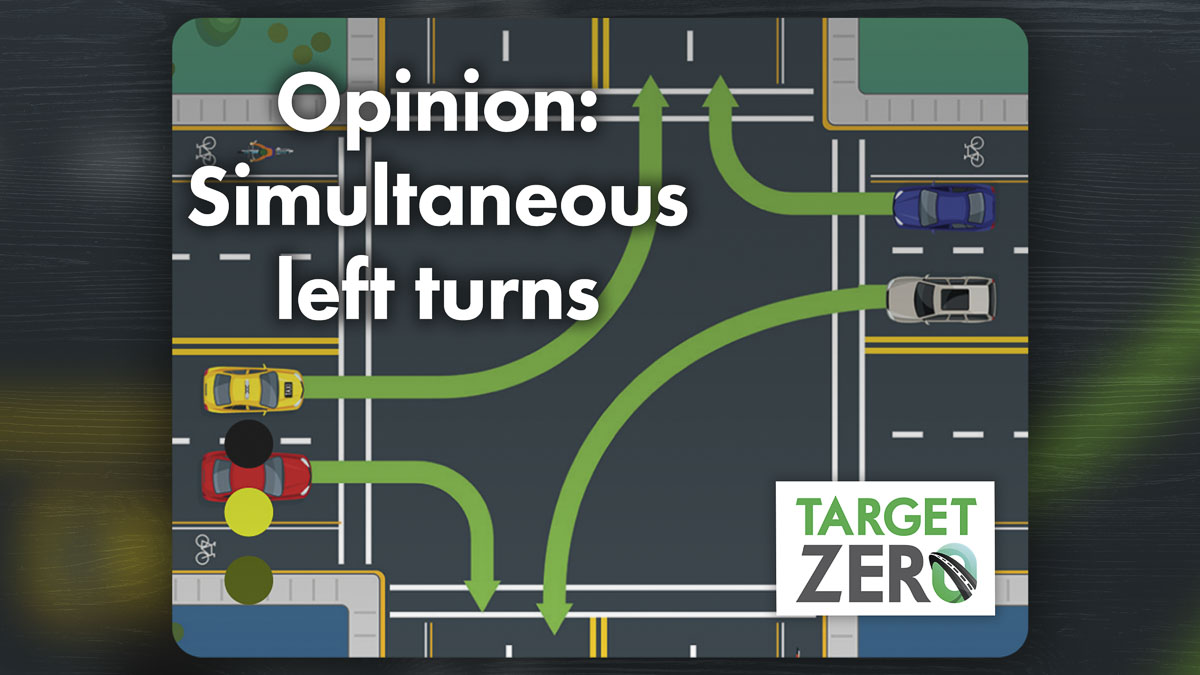
Target Zero Manager Doug Dahl answers a question about simultaneous left turns
Doug Dahl
The Wise Drive
Q: My wife and I have a question. Say two cars on a two-lane highway approach an intersection from opposing directions at the same time, both wanting to turn left. Usually both drivers make their turns by passing each other on the left, but we recall from years ago that both drivers are to pull forward until parallel to each other and make their turn after passing by the other vehicle. What’s right?
A: Setting aside the law for a moment, I suppose what’s most important is that whatever they do, they both do the same thing. Realistically though, we can’t set aside the law, and there is a right answer.

So we’re all clear on the scenario, the best way I can describe this is to imagine that someone stuck a big orange pylon in the center of an intersection. In example one from your question, both drivers turn left before they get to the pylon. In example two, they both turn after they pass the pylon (and each other). If this were ballroom dancing for cars, the second maneuver might be more lovely and graceful but, as far as I know, ballroom dancing for cars isn’t a thing. And now that I’ve mentioned it, if it becomes a reality TV show I want partial credit for the idea.
Memory is tricky. You can be 100 percent sure you recall something correctly and still be 100 percent wrong. One memory study showed participants a fake picture of them in a hot air balloon and about half of the participants developed a false memory of the event. Of a more serious nature, three-quarters of wrongful criminal convictions that were overturned with DNA evidence involved witness misidentification.
We all misremember things, so there’s no judgement here when I tell you that you probably don’t remember your driving instruction correctly. The law states that “whenever practicable, the left turn shall be made to the left of the center of the intersection…” Just in case the law was different in previous decades, I looked back 50 years in the Revised Code of Washington. The wording is slightly different, but the rule remains the same.
Confirming the language in the law, the Washington Driver Guide has a diagram of cars making left turns in an intersection. The bold green lines representing the cars’ routes show that they pass to the left of each other, turning before they reach the center of the intersection. If I were to add a pylon to the graphic, both left-turning drivers would turn on the near side of it and pass the pylon with the passenger sides of their cars closest to it.
For any readers thinking to themselves, “Of course that’s how you drive through an intersection,” I’ll encourage you to have enough humility to recognize that while you’re right this time, there are probably some driving rules you’ve misremembered too. How much of what you learned in high school do you think you’ve remembered accurately? Hopefully we remember more about how to drive than we do about trigonometry or English lit since we practice regularly, but I’ve written about 500 of these columns now responding to driving questions, so that’s a good indicator of how much we misremember or forget entirely.
Safe driving depends on all of us following a shared set of rules, but we’re humans, and we sometimes misremember and make mistakes. Along with following the driving rules as best as you remember them, leave a bit of extra space (and a generous amount of understanding) for when other drivers don’t get it quite right.
Also read:
- Opinion: Half the road, full stop – Understanding pedestrian right-of-way
 Doug Dahl explains how Washington’s law requires drivers to stop when a pedestrian is within one lane of their half of the road, not just when directly in front.
 - Opinion: What is the cost of a bridge?
 John Ley argues the I-5 Bridge replacement’s soaring cost stems from costly extras like light rail, noting other states deliver larger, toll-free bridges for much less.
 - Letter: Vancouver Mayor Anne McEnerny-Ogle makes several serious and incorrect engineering statements
 Bob Ortblad critiques engineering claims by Vancouver Mayor Anne McEnerny-Ogle, highlighting cost and safety advantages of an immersed tunnel for the I-5 crossing.
 - Washington’s studded tire deadline is March 31
 Drivers must remove studded tires by March 31 or face a $137 fine, with WSDOT urging early action due to busy service centers and no planned deadline extension.
 - VIDEO: WA diesel hits record $6.53, crushing truckers and school budgets
 With diesel nearing $6.53 per gallon in Washington, trucking businesses and school districts now confront sharply higher fuel expenses affecting budgets and workers.
