



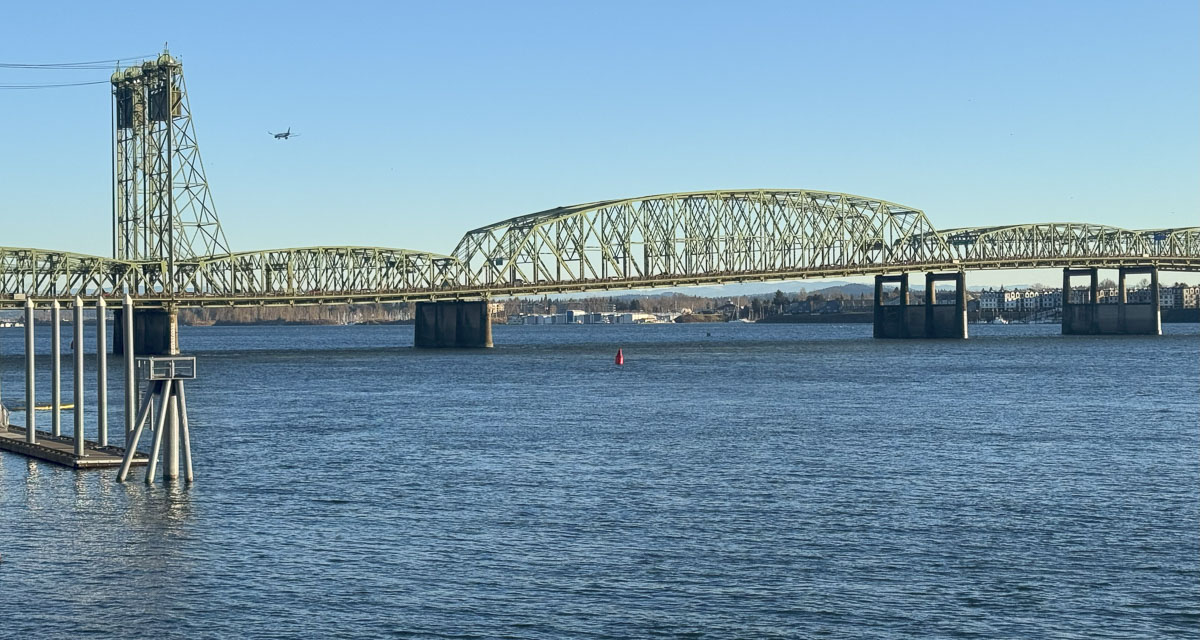
Neighbors for a Better Crossing is a grassroots organization of residents, business owners, and retired engineers advocating for safe, affordable, and evidence-based solutions for the Interstate Bridge crossing
Neighbors for a Better Crossing (NFBC) is urging immediate transparency and a comprehensive, up-to-date seismic study of the current Interstate 5 bridges before any further work proceeds on the Interstate Bridge Replacement (IBR) Program’s proposed $7.5 billion megaproject.
IBR’s fear-based messaging lacks verified engineering data
The IBR program continues to rely on a dramatic video — produced by its marketing team — depicting the current I-5 bridges collapsing into the Columbia River during a Cascadia Subduction Zone earthquake.
“For the past four years, IBR has used this video to instill fear in the public and elected officials to promote construction of a new bridge,” according to retired engineer Bob Ortblad.
However, a Public Disclosure Request filed by Ortblad revealed no current engineering analysis supports the video’s narrative. He concluded the imagery is based on outdated or nonexistent studies.
No new seismic studies released despite federal seismic grant
In 2022, IBR received a $1 million grant from the Federal Highway Administration to study the bridge’s seismic and geotechnical conditions, including Hayden Island. Despite this, neither the Washington State Department of Transportation (WSDOT) nor the Oregon Department of Transportation (ODOT) has released any current bridge-specific seismic assessments. This lack of transparency makes IBR’s repeated claims of the bridge’s imminent collapse misleading at best — and propagandistic at worst.
Existing bridge may be more resilient than acknowledged
Historical evaluations — including a 2009 ODOT report and a 2007 WSDOT assessment—cited risks related to timber-pile foundations and the bridge’s age. However, Ortblad points to compelling evidence that suggests otherwise: the current bridge’s 90- to 120-foot-long, tightly spaced wooden piles compact soil more than 50 feet below projected liquefaction zones, making them act as a “fail-safe against liquefaction damage.” A Japanese engineering study supports this principle.
In contrast, the IBR’s proposed design uses only six drilled shafts per pier, set in uncompacted soil, and features twin trusses that are twice as long, twice as wide, 50 feet taller, and five times heavier than the current structure. The construction process is expected to require five years of intense drilling, causing significant harm to Columbia River fish and marine ecosystems.
Retrofitting the existing bridge proven feasible and far less costly
A 2006 Columbia River Crossing study brought together a panel of bridge and geotechnical engineers to assess seismic vulnerabilities and retrofit options for the existing Interstate bridges. When asked whether retrofitting was feasible, the panel responded clearly: “Yes, it is technically feasible to retrofit the existing bridges to the current seismic safety standards.”
The panel outlined concepts for strengthening or replacing vulnerable bridge components and estimated the cost between $88 million and $190 million. This raises serious questions about the necessity of a $7.5 billion replacement project — especially in the absence of updated engineering data.
Despite this, the IBR program proposes demolishing the existing bridges, which currently carry six lanes of traffic, to build a new structure with only three lanes of traffic and one auxiliary lane in each direction.
In contrast, preserving the current bridges for pedestrian and bike traffic, and constructing an Immersed Tube Tunnel (ITT) could provide 10 to 14 total freeway and local access lanes, along with pedestrian and bicycle pathways — offering greater capacity, connectivity, and safety at a lower cost.
“Taxing and tolling citizens without updated seismic evidence is unjustified—especially when an Immersed Tube Tunnel is a proven, cost-effective, and more resilient option,” said Gary Clark of Neighbors for a Better Crossing. “We need proof, not assumptions.”
Request for structural and seismic data denied
Despite widespread IBR claims portraying the existing Interstate Bridges as structurally compromised and seismically vulnerable, little verifiable data has been released to support those statements. The bridge, listed on the National Register of Historic Places, is entitled to special protections — heightening the need for transparency.
NFBC submitted Public Disclosure Requests to WSDOT and ODOT seeking bridge elevation drawings, dimensional renderings, and side-view illustrations from the Hayden Island perspective. Both requests were denied, despite IBR’s claims to be accessible and transparent with the public.
NFBC has escalated the matter by filing two separate Freedom of Information Act (FOIA) requests with the U.S. Federal Highway Administration, requesting information from the IBR program. One request seeks detailed elevation drawings with dimensions, and renderings. The other specifically requests all materials related to the existing bridge’s structural and seismic condition, as well as the development of public messaging strategies related to those topics. Both FOIFA requests are currently pending.
Public Disclosure undermines IBR narrative
Bob Ortblad also filed his own Public Disclosure Request and received the 1,622-page I-5 Columbia River Crossing Design Ground Motions Report. Upon review, he found it only models the seismic behavior of the proposed new bridge — and entirely omits any assessment of the existing bridge’s seismic performance.
“My suspicion that the IBR earthquake video lacked supporting engineering analysis was confirmed by my public disclosure request,” Ortblad stated.
Safety risks with IBR construction diversion and design
Ortblad further warns that the IBR’s construction plan would reduce six lanes of traffic to just four for three years, likely increasing congestion, collisions, and emergency response times. The final design includes a 3% to 4% grade — the steepest of any interstate bridge in the country—and a sharp, steep S-curve on the north-facing Vancouver approach. Ortblad warns that these features could pose serious hazards in conditions such as wind, rain, fog, and black ice
“Where is the data-driven safety analysis of deaths and injuries for this three-year diversion and the final high bridge?” Ortblad asks.
ITT alternative dismissed without fair study
By contrast, an Immersed Tube Tunnel (ITT) would save billions of dollars, reduce construction time, enhance seismic resilience, better accommodate future growth, and preserve valuable historic and community assets.
However, IBR disqualified this alternative using flawed excavation and dredging calculations. When challenged, IBR later admitted that their calculations were incorrect in an email to Ortblad. IBR blamed third party software saying, “Duplication occurred in the model where some excavation quantities were counted more than once. While this error does result in a change in the quantity of excavation material, it does not change the decision,” IBR officials told Ortblad.
There are at least 13 immersed tube tunnels in the United States and nearly 200 worldwide. Notable examples include the Fraser Tunnel in Vancouver, BC and the I-95 tunnel under Baltimore Harbor.Demonstrating the proven success of this technology in complex, urban, and environmentally sensitive settings
IBR’s ongoing omissions undermine public trust
The IBR’s failure to disclose updated seismic studies and its dismissal of viable alternatives call into question the integrity of its environmental review process. NFBC believes a full reassessment is essential before construction begins in 2026–2027.
The Oregon Legislators failure to pass a transportation funding bill further underscores the need to reassess more efficient and cost-effective bridge alternatives.
Key NFBC Requests:
- Release an updated, independent seismic assessment of the current bridge before construction approval.
- Halt preliminary engineering and the use of fear-based public messaging.
- Conduct a third-party feasibility study of the Immersed Tube Tunnel alternative tailored to the region.
- Ensure the IBR’s environmental review reflects public-facing, evidence-based data.
About Neighbors for a Better Crossing
Neighbors for a Better Crossing is a grassroots organization of residents, business owners, and retired engineers advocating for safe, affordable, and evidence-based solutions for the Interstate Bridge crossing — prioritizing the needs and voices of the communities it serves.
Information provided by Neighbors for a Better Crossing.
Also read:
- Vancouver leaders want C-TRAN to look into fixed rail infrastructure throughout the city
 Councilor Erik Paulsen says existing Vine stops already have the floor height to support tram conversion.
 - Letter: I-5 Bridge – Save $billions, reduce congestion and improve safety
 Camas resident Douglas Tweet argues eliminating light rail could save $2.5 billion and reduce bridge width by 31 feet.
 - Vancouver amends municipal code, banning pedestrians from staying on traffic islands, medians
 Vancouver’s new ordinance targets people who remain on medians, not those crossing legally at crosswalks.
 - Washington gas prices stay high despite Iran deal as automatic tax hike looms
 Washington’s gas tax rises 2% on July 1 under a new inflation-tied annual indexing mechanism.
 - Letter: The IBR’s concrete obscenity
 Bob Ortblad argues $17.7 billion buys one extra lane for five miles — and 30 years of debt for future generations.
 wpDiscuz
