



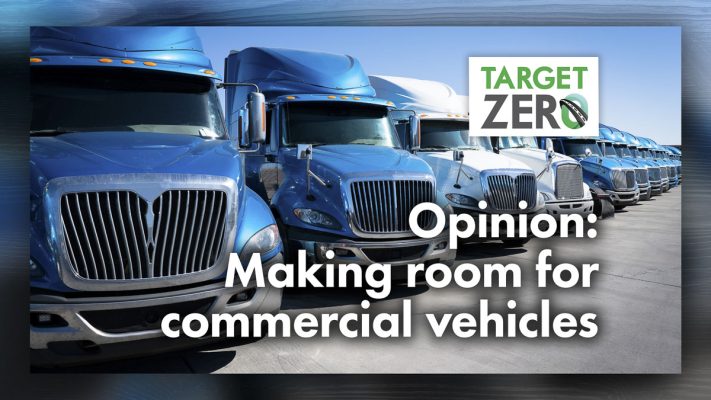
Target Zero Manager Doug Dahl answers the question of does the law require that drivers leave more room around big commercial vehicles compared to other cars and trucks?
Doug Dahl
The Wise Drive
Q: As a Class A commercial driver, I see a lot of drivers failing to maintain sufficient distance from commercial vehicles. I don’t think they understand the risks involved in being too close. Does the law require that drivers leave more room around big commercial vehicles compared to other cars and trucks?
A: In an earlier column I made the comparison between a soda can, a Honda Civic, and a freight train, noting that the weight ratio between the 12 ounce can and the Honda was similar to the Honda and the train – about 4000 to one. At 35 to one, the ratio of a Honda Civic and the largest commercial vehicle isn’t quite as dramatic – it’s more like comparing an average 5th grader to the Honda. I think we’d agree that it’s still an unfair fight and the 5th grader will lose every time. That’s borne out in collision data; in crashes with passenger cars and large trucks, 97 percent of the vehicle occupants killed were in passenger vehicles.

Our innate desire to survive should compel us to leave enough room when driving near commercial vehicles, but does the law also require it? Yes, at least in part, but it requires some additional understanding. Washington’s passing law forbids drivers from pulling in front of a vehicle they passed “until safely clear of overtaken traffic.” How far is safely clear? A lot more when passing a commercial vehicle, because of the difference in stopping distance.
Stopping distance depends on a lot of things – vehicle speed, road surface, weather, brakes, tires, driver attention – so at the risk of oversimplifying, consider this: at 60 mph, it takes a passenger car about 225 feet to stop on flat dry pavement, while a semi-truck would need 335 feet to stop. Truck drivers don’t follow the three-second rule for following distances; they go with seven or eight seconds. Let’s say you pass a semi on the freeway and then want to move in front of it. If you don’t leave seven or so seconds between you and the truck behind you, in a hazard that requires hard braking you haven’t given the truck enough space to stop without rear-ending you.
There’s no law about driving in the blind zone of a commercial vehicle, but it’s still a poor idea. And those blind zones are bigger than you might expect. The blind zone behind a semi can stretch out nearly 200 feet. Both sides of a big rig have blind zones big enough to swallow up your car, especially on the passenger side of the truck. How can you tell when you’re in a truck’s blind zone? If you can’t see the driver’s face in their mirror they can’t see you. Even the front of the truck has a blind zone extending out about 20 feet because of the height of the truck cab, but you’d be crazy to be there anyway because, you know, stopping distance.
And then there’s turning space. When a vehicle turns the rear wheels follow a shorter path than the front wheels, and as a vehicle gets longer the difference becomes greater. To make a turn at some intersections a truck might need to swing wide in the opposite direction first, and in two-lane roundabouts big trucks need both lanes. (That’s why the signs say, “Do not drive beside trucks in roundabouts.)
The law requires that drivers “exercise due care and caution” appropriate to the circumstances. What does “due care and caution” look like around commercial vehicles? At its simplest, more room between you and them in every direction.
Also read:
- VIDEO: WA diesel hits record $6.53, crushing truckers and school budgets
 With diesel nearing $6.53 per gallon in Washington, trucking businesses and school districts now confront sharply higher fuel expenses affecting budgets and workers.
 - Opinion: In plain sight – yielding to pedestrians
 Drivers often fail to see pedestrians due to inattentional blindness, which highlights the need for more focused awareness at intersections and stronger safety practices.
 - Expect delays on SR 14 in Vancouver for guardrail repairs Wednesday
 State Route 14 travelers in Vancouver should plan for morning delays as WSDOT will close two eastbound lanes for guardrail repairs, affecting mileposts 6.0 to 7.0.
 - Overnight closure planned on westbound SR 14 Camas Slough Bridge Tuesday
 WSDOT crews will close westbound SR 14 at Exit 14 in Camas to collect bridge deck samples and plan future repairs; detours will be in effect.
 - Opinion: Stay in your lane – seriously, it’s the law
 Drivers must choose the nearest lane when turning in Washington, and left turns bring added risk. Even with signals, every driver must help prevent crashes by following law.
