
After six years of deliberation and $270 million in consulting fees, the Interstate Bridge Replacement Program (IBR) has finally released its 10,000-page Final Environmental Impact Statement (FEIS). But far from providing a roadmap for construction, the document reveals a project that is legally insolvent, physically truncated, and built on a foundation of flawed “Highway Department math.”

Joe Cortright
Here are eight reasons the IBR project shouldn’t — and legally can’t — move forward:
- Half a project: The FEIS evaluates a massive $15.5 billion build-out, but ODOT and WSDOT only plan to build a $7.6 billion “core.” By leaving out the light rail and highway connections used to justify the project’s environmental benefits, the agencies have invalidated their own environmental impact statement.
- Fiscal Insolvency: Federal law requires projects to be part of a “fiscally constrained” plan. With both DOTs effectively broke and no guarantee of future funding, starting a project they cannot afford to finish is a direct violation of federal transportation regulations.
- The “Independent Utility” requirement: Federal rules prohibit “half-built” projects. A bridge that ends in a bottleneck or a light rail line that stops 90 feet in the air above the Vancouver waterfront lacks “independent utility” — meaning it’s a billion-dollar expenditure that provides no stand-alone benefit.
- The Light Rail Legal Fiction: To bypass state land use laws, the IBR claims a “Land Use Final Order” (LUFO) intended for light rail. However, with transit construction likely delayed until after 2030, the project is a highway expansion masquerading as a transit project to dodge legal scrutiny.
- Bogus Traffic Projections: The FEIS claims traffic will grow at 1% annually, yet official counts show I-5 traffic has actually fallen to 1990s levels (127,000 vehicles/day). The agencies are suppressing “Investment Grade” data that would prove the bridge is being over-engineered for demand that doesn’t exist.
- Negative Benefit-Cost Ratio: U.S. DOT grants require a project’s benefits to outweigh its costs. With the price tag exploding to $15 billion while benefits remain capped at roughly $4 billion, the IBR no longer meets basic federal cost-effectiveness standards.
- A Violation of Climate Law: State and regional policies mandate a 10% reduction in driving, but the IBR is predicated on a 25% increase in vehicle miles traveled (VMT). The FEIS fails to disclose this fundamental conflict with Oregon’s legally adopted climate goals.
- Consultant Capture: Over half a billion dollars has been billed by consultants for a project that former Administrator Greg Johnson calls “basically the same” as the failed CRC. The current plan extends construction to 2050, ensuring a “forever project” that serves the billing cycles of engineering firms rather than the public interest.
After more than six years of work, and more than $270 million in consulting bills, we at last have a “Final Environmental Impact Statement (FEIS)” for the proposed Interstate Bridge Replacement project. Never mind, for the moment, it’s more than two years behind its own announced schedule. Here are eight reasons the project shouldn’t (and can’t legally) move forward.
First, the newly minted 10,000 page (including appendices) FEIS, describes a project that the Oregon and Washington DOTs aren’t planning to build. Because the price has ballooned to more than $15 billion (more about that in a minute), ODOT and WSDOT are planning to proceed with only a fraction of the project envisioned in the FEIS. Significantly, they’re going to leave out most of the light rail, much of the highway connections, and at least one seismically vulnerable structure.
Here’s the problem: the FEIS assumes that all of that will be in place, and that for example, the availability of light rail transit will offset the negative environmental effects of widening the freeway. Because they’re only going to build a fraction of the project described in the FEIS, they actually don’t have a valid EIS for the project they’re going to build. If they can’t guarantee that they’ll actually build the entire project, including the environmentally beneficial portions, the EIS simply isn’t valid. If they’re only going to build the “Core Set of Projects”, they need a revised EIS which discloses the impacts of building just that truncated project.
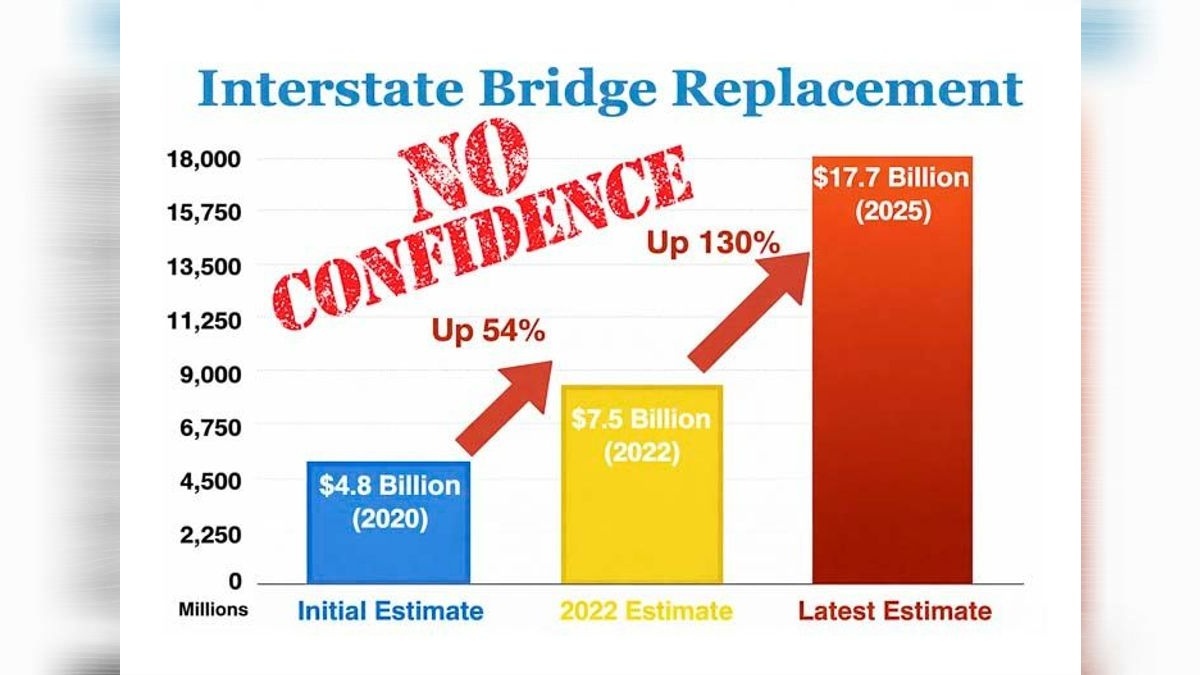
Second, as hinted above, they don’t have the money to build this. After more than two years of delay in releasing a new cost estimate, ODOT and WSDOT have finally publicly admitted the project will cost as much as $15.5 billion. Both state DOTs are basically broke, and don’t have the money to pay for it. They say they will proceed with the truncated $7.65 billion “core,” but have been unable to accurately forecast costs to date, and have had costs for another nearby Interstate Bridge project (the I-205 Abernethy Bridge) more than triple. Neither the federal government, nor the region, have any guarantee that anything more than this tiny fraction of the whole project will ever be built.
This is a legal problem as well as a financial problem. Federal regulations require that funding for projects be part of an adopted “fiscally constrained” transportation plan in order to start construction. It’s a requirement that’s designed to prevent exactly what the two DOTs are planning–to start construction on a project they don’t have the money to finish. Metro’s RTP hasn’t identified the $15.5 billion they’d need to build this project. According to federal regulations Metro’s Regional Transportation Plan (which serves as the region’s federally required metropolitan transportation plan or MTP) has to show us the money:
The MTP “shall include a financial plan that demonstrates how the adopted transportation plan can be implemented.” Requirements include: estimates of costs and revenue sources “that are reasonably expected to be available to adequately operate and maintain Federal-aid highways (as defined by 23 U.S.C. 101(a)(5)) and public transportation (as defined by title 49 U.S.C. Chapter 53)”; estimates of available funds from all necessary financial resources; recommendations for additional strategies to support the availability of any new sources; all projects and strategies proposed for funding under title 23 U.S.C., title 49 U.S.C. Chapter 53
Third, federal requirements also prohibit half-built projects. Another regulation requires that if an agency takes on just a truncated portion of a larger project, and can’t guarantee that it will build anything else, that it has to demonstrate that the project has “independent utility,” meaning that it makes sense and provides benefits without further investments. US DOT regulations provide:
f) Any action evaluated under NEPA as a categorical exclusion (CE), environmental assessment (EA), or environmental impact statement (EIS) must:
(1) Connect logical termini and be of sufficient length to address environmental matters on a broad scope;
(2) Have independent utility or independent significance, i.e., be usable and be a reasonable expenditure even if no additional transportation improvements in the area are made; and
But large chunks of the proposed “Core” elements don’t have any independent utility–there will be added lanes on the bridge and approaches that simply and suddenly end, or merge into a much narrower roadway. Added lanes on the bridge and approaches effectively have little or no utility, unless the rest of the freeway is widened–they’re just intentionally creating a new bottleneck. And it’s hard to argue that a light rail line that stops in mid-air 90 feet above the downtown Vancouver waterfront has “independent utility”–especially when the agency isn’t planning to build any of the structured parking spaces it said were needed to encourage people to use transit.
Fourth, the Interstate Bridge Project likely violates the key Oregon land use law on which its approval is predicated. In 1996, Oregon passed a special exception to state land use laws to allow the expedited construction of light rail projects. The Interstate Bridge Project – like the Columbia River Crossing more than a decade ago – has planned to use this exception to get a “Land Use Final Order.” The idea was that because the light rail portion was integral, was part-and-parcel of the project, and that the highway portion was just an appurtenance to the light rail project, that both the highway and light rail together qualified for the LUFO. But it's apparent the plan is to delay construction of the light rail – which may simply never happen. CTRAN officials have said it may cost as much as $3.5 billion, and they don’t even plan to ask for $1 billion from the federal government before 2030. It’s hard to see how they can claim it is a “light rail” project under these circumstances.
Fifth, it’s now apparent that the project’s traffic projections are utterly bogus. Traffic projections are the foundation of the EIS. The document asserts, nonsensically, that even if I-5 isn’t expanded, that traffic will continue to increase at more than 1 percent per year. This allows them to claim (falsely) that a new bridge, with tolls and light rail, will have slightly fewer cars and trucks (and attendant pollution) 20 years from now. But in fact, traffic on the I-5 bridges is highly constrained by peak hour capacity, and traffic levels have actually been going down in recent years. They are not, as the FEIS claims, 142,000 vehicles per day, but according to official ODOT traffic counts, have fallen to 127,000 vehicles per day – the same as twenty years ago.
In addition, as we’ve pointed out, ODOT is concealing and delaying new and more accurate traffic projections being prepared as part of the project’s required Investment Grade Analysis. These projections will show a need for vastly less highway capacity across the Columbia River, directly contradicting the claims made in the FEIS. Environmental Impact Statements are required to meet a standard of having scientific validity: IBR’s traffic projections don’t meet those standards.
Sixth, the IBR has failed to demonstrate that the new, more expensive version of the project complies with federal legal requirements that the investment be “cost-effective.” The US Department of Transportation requires, as a condition of getting a federal grant, that a “benefit-cost analysis” shows that a project has more economic benefits than costs. The IBR’s three-year old benefit-cost study was based on the project’s now outdated cost estimate, and claimed total benefits of no more than about $4 billion. Now that the cost of the project has exploded, it no longer has a positive benefit cost ratio, and doesn’t comply with this basic federal grant requirement.
Seventh, the IBR project is based on traffic projections that are inconsistent with, and lead to a violation of Oregon climate laws. Oregon and Metro have both adopted climate plans and regulations that call for a decrease in per capita driving of about one-third by 2050. But the IBR’s traffic projections – on which both the project’s need statement and EIS are based – call for essentially no decrease at all in per capita driving. At the regional scale, the difference in per capita driving means that instead of reducing total driving by about 10 percent, the IBR traffic projections call for increasing driving by about 25 percent – in direct violation of state and regional climate policies. And it’s a legal problem that the FEIS, which is required to disclose whether projects are consistent with state and local laws, doesn’t reveal that the project will have this negative impact.
Eighth, the IBR is metastasizing into a forever project, run by and for the benefit of the consulting firms who are running the show. The Interstate Bridge Project is actually staffed not by state employees, but overwhelmingly by consultants, who make more money the longer the project drags on and the more expensive it gets. Between the revived IBR and its predecessor, the Columbia River Crossing, which project director Greg Johnson called “basically the same project” consultants have billed close to half a billion dollars without breaking ground. Their plans to extend construction almost to 2050, could lead, according to their own estimates, more than an additional billion dollars in staff and consulting costs. The IBR has been captured, and is being run by consultants, with no interest in protecting Oregon and Washington taxpayers, or solving basic transportation problems, but instead simply creating a lucrative and unending.
Far from being a done deal, the Interstate Bridge Replacement Project is still a bad deal, and in many ways an illegal deal. It’s long past time to pull the plug on this expensive monstrosity and figure out a cheaper, more effective solution the region can actually afford.


Comments
Loading comments…