



Vancouver resident Robert Wallis shares his claim that WSDOT and ODOT have failed to provide the public with honest information regarding a proposed tunnel solution for the I-5 Bridge replacement project
Editor’s note: Opinions expressed in this letter to the editor are those of the author alone and do not reflect the editorial position of ClarkCountyToday.com
Thank you Clark County Today for your coverage of the tolling issues related to the Interstate Bridge Replacement (IBR) project. Although I am writing about the tunnel issue, that issue has one thing in common with tolls – the failure of WSDOT and ODOT to provide the public with honest information. In doing so, they are undermining the integrity of the process that ensures the public gets value from their tax dollars.

It has recently come to light that the public was deceived by the IBR project team into believing that the tunnel option was not feasible. The question is – will that same deceit be brought to bear upon the tolling issue?
The IBR project team’s deceit regarding the tunnel is addressed in the “tunnel too deep” engineering report available on my Linkedin site (Robert Wallis in Vancouver, Wa.). In essence, they made an engineering error (very likely on purpose) which greatly exaggerated the tunnel depth. That error made the tunnel option appear way more expensive than it would otherwise be. That “tunnel too deep” error also made the connections to Downtown Vancouver unfeasible, which was the primary reason the tunnel option was never given serious consideration.
My concern is that the IBR project team may attempt to deceive the public and their elected officials on tolls the same way they deceived them on the tunnel option. I just hope someone pays enough attention to notice. I think the tunnel versus bridge issue is important, but the fact is that the toll issue is even more important, which is why I appreciate the attention being given to it by Clark County Today. With that attention, perhaps the tolling decision will be made on the basis of fact, instead of fiction, as was the case with the decision to reject the tunnel as a viable option for the IBR.
Robert Wallis
Vancouver

Also read:
- Opinion: Inviting courts into health care policy discussion
 Elizabeth New (Hovde) warns that Senate Joint Resolution 8206 could invite lawsuits by placing vague health care mandates into Washington’s Constitution.
 - Opinion: 24 States In. Washington Out? $732 Million Lost?
 Vicki Murray argues Washington risks forfeiting $732 million in federal education funding if state leaders do not opt into the federal tax-credit scholarship program.
 - Opinion: Nationwide strike in support of illegals and opposing the rule of law?
 Lars Larson argues that a reported nationwide strike reflects opposition to immigration enforcement and the rule of law, criticizing political leaders and media coverage.
 - POLL: Should councilors serving on boards be required to vote the way the full council decides?
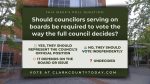 A new poll asks whether Clark County councilors serving on boards should be required to vote in line with the full council’s position or retain independent judgment.
 - Opinion: Olympia wants a 4-day work week. It won’t work out as the politicians think it will
 Mark Harmsworth argues that House Bill 2611’s proposed 32-hour workweek would raise costs, strain small businesses, and undermine Washington’s economic competitiveness.

The IBR team is promoting tolls, knowing that the cost of collecting tolls in WA is often over 50% of the toll! Tolls are planned for both the I-5 and I-205 bridges, and OR plans to toll I-5 and I-205 roadways as well. WA state already tolls some bridges, and roadways. This article from 2019 is an under-estimate of the high cost of tolls funded by debt.
Op-ed: The insanity of bonding tolls
In 2021, the “cost of collection” on Seattle’s I-405/SR-167 corridor was 68 percent. That an extremely inefficient means of collecting money for transportation.
The gas tax has under a 1 percent cost of collection. No new infrastructure has to be created to collect those funds.
Furthermore, the Washington state tolling system has had to be bailed out by the state legislature for the past 3 years, due to the volatility of toll revenues. The SR-99 tunnel in Seattle is “under water” for the next 30 years and will permanently need to be rescued by other tax dollars from the legislature.