
Camas resident Douglas Tweet says C-TRAN I-5 Bridge bus ridership does not justify expensive light rail
Editor’s note: Opinions expressed in this letter to the editor are those of the author alone and may not reflect the editorial position of ClarkCountyToday.com
The Interstate Bridge Replacement Program’s (IBR) I-5 Bridge replacement plan includes light rail plus Express bus service with expensive larger buses. Light rail adds far more capacity than needed, and adds $Billions to project costs. Light rail would merely replace a single bus Route #60 to connect to Jantzen Beach and the Max Yellow Line at Delta Park in North Portland.

Cascade Policy Institute reported in 2022 that The I-5 Bridge Replacement Project’s Administrators Are Misleading State Legislators About Light Rail.
“TriMet’s Yellow Line has consistently underperformed in frequency of service, travel times, and especially ridership, as demonstrated in a 2019 report from Cascade Policy Institute. While the pandemic has significantly decreased ridership levels on all public transit, the Yellow Line was well short of its projected ridership even before the lockdowns. The IBR administrators’ presentation conveniently leaves out this fact. Cascade’s report showed that, as of April 2019, ridership was 27% lower than TriMet’s 2020 projections and had been falling for three consecutive years. Right before the pandemic, in February 2020, ridership remained at approximately the same level as the year prior, with 13,890 weekday riders. This was well below the 18,100 riders TriMet had promised by 2020 when it began constructing the Yellow Line.”
C-TRAN ridership data for buses crossing the I-5 Bridge shows that bus ridership is half that of 20 years ago. I analyzed C-TRAN monthly NTD Ridership data for “boardings” on bus routes across the I-5 Bridge from January 2018 through August 2025. From monthly data I estimated a weekday average, shown in the graph below.
2006: 3300 weekday transit trips (see Pg. 3-24 of FEIS CRC project report)
- 2018-2019 Pre-Covid: ~3200 total weekday boardings, similar to 2006.
- 2020-2022 Covid: Huge initial drop, slow increase, still well below pre-Covid values,
- 2023-2025: Ridership Stagnant
- Route 60: ~900 daily boardings, to Jantzen Beach & Delta Park Max light rail station over ~19- hour days. ~450 people, if round trips.
- Express buses: ~600 weekday boardings, ~300 round trips.
- Includes Routes 105/105X to downtown Portland, and 190 to OHSU/Marquam Hill.
- Total: ~1500 weekday boardings (less than half pre-Covid ridership)
Why spend $Billions for a 1.9 mile light rail extension with unknown $Millions for annual O&M costs for under 500 daily riders on Route 60? Buses can meet demand for many years. If needed later, more or larger buses can be added.

Latest IBR ridership presentation (CVTV video available)
At the June 2025 C-TRAN Board meeting, IBR Program Administrator Greg Johnson reported that the model IBR used to forecast future ridership was not acceptable to the Federal Transit Agency. The FTA requires use of a standard model (STOPS), used nationwide. At the Oct. 14 C-TRAN Board meeting, Mr. Johnson and two IBR executives presented new ridership analysis using the STOPS model to forecast PAST ridership data! (Starts at 1:02 time marker in video). They claimed that daily light rail boardings in fall of 2024 were about 5000, not the ~900 bus boardings actual C-TRAN 2024 data shows for Route 60. Yet, there was NO light rail crossing I-5 bridge in 2024. Steve Witter of IBR stated these much higher numbers are “ridership as if we put in that system today…” (1:05:50). When asked by board member Tim Hein of Camas where these numbers came from, the highly paid executives were not prepared to answer, and suggested that technical “experts” could make a future presentation with details (1:18-23). Mr. Witter responded that IBR assumes the extra daily riders would come from the Vine buses.
Vancouver City Councilor Bart Hansen asked if they had looked at ridership forecasts vs results for light rail systems in Portland (TriMet), and Sound Transit in Puget Sound area (1:26:30). Remarkably, these executives claimed they were unable to find any information, in spite of partnering with TriMet (1:26:50). Information on both TriMet and tri-county Sound Transit is readily available. TriMet’s financial and ridership problems have been in the news recently. KPTV reported that “The transit agency is working to close a $300 million budget gap. TriMet says the shortfall is due in part to declining ridership and rising operating costs.” Hein noted TriMet is struggling, yet IBR wants C-TRAN to form a business partnership with TriMet to bring light rail to Clark County. (1:22)
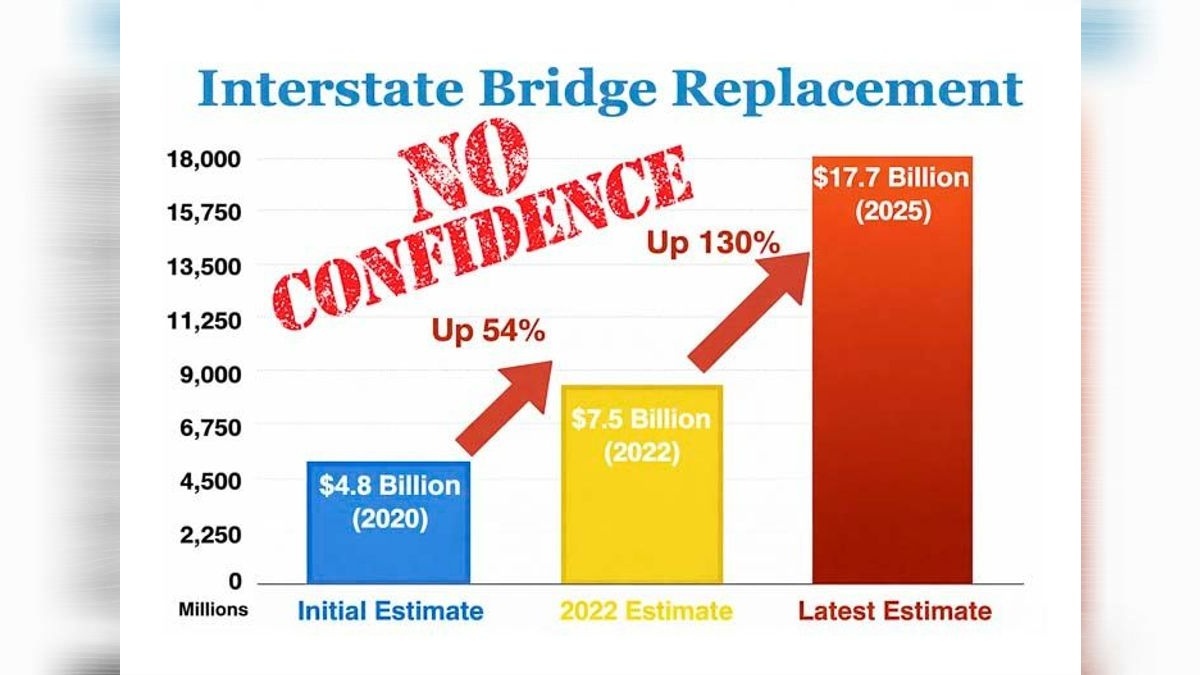
Tolls are planned on the I-5 Bridge to help cover the $BILLIONS required to build the IBR’s mega-project.
Citizens input on C-TRAN’s 2045 plans that includes light rail Deadline: October 31. See link: https://storymaps.arcgis.com/stories/6fa7057514014075abafb026df189974
Douglas Tweet, PhD
Camas

Comments
Loading comments…