



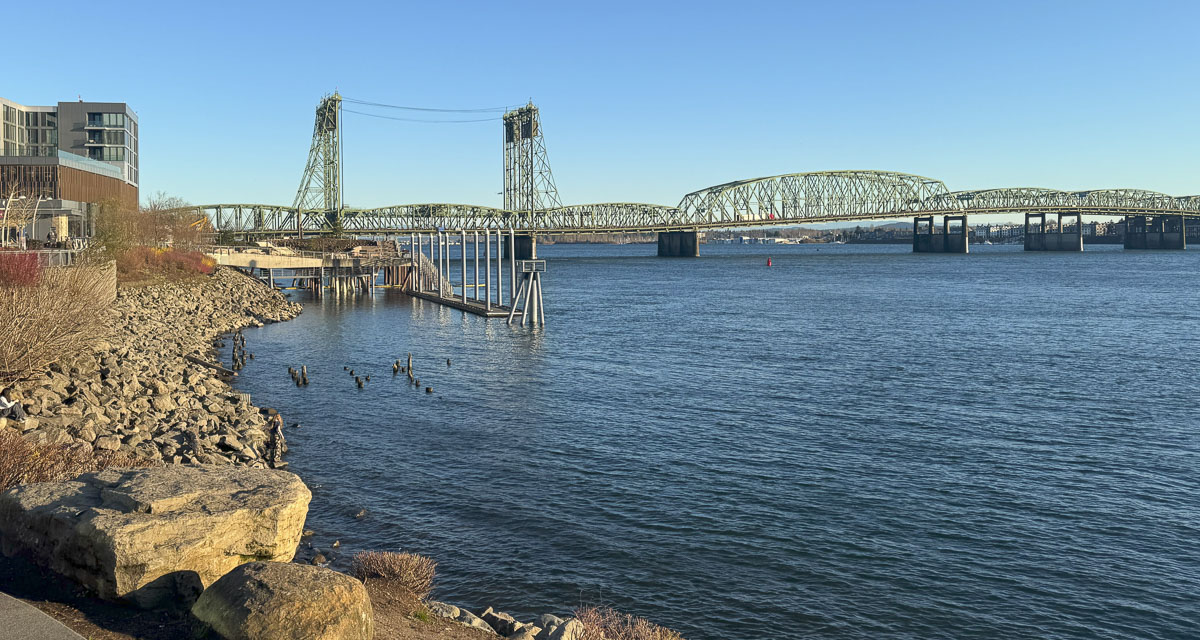
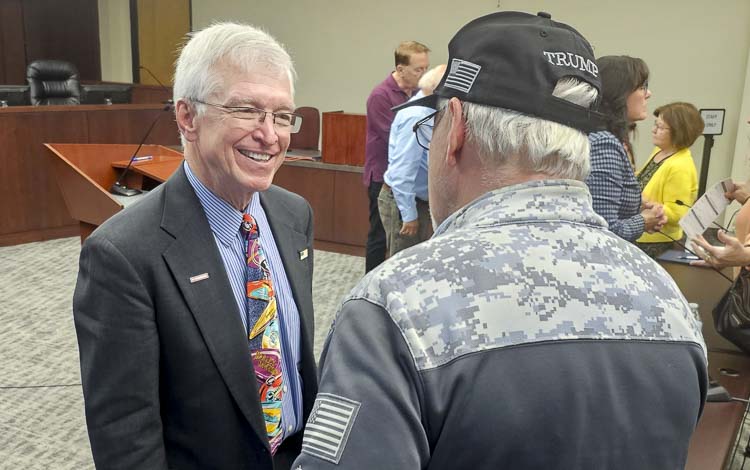
John Ley, a state representative for Washington’s 18th Legislative District, said at a town hall on Saturday that the Interstate Bridge replacement project is “scrambling” and “concerned” regarding federal dollars
Paul Valencia
ClarkCountyToday.com
The four Republicans were there to answer questions about the recent state legislative session and give their opinions on a variety of topics.
Stephanie McClintock and John Ley, representatives for Washington’s 18th Legislative District, and Ed Orcutt and Peter Abbarno, representatives for the 20th Legislative District, took turns answering questions at a town hall Saturday in Battle Ground.
When one guest asked for an update on the Interstate Bridge replacement project, three representatives all looked at one colleague and asked him to take the lead.
This was John Ley’s moment.
Ley, a newcomer to the legislature, had noted in his introduction to the town hall audience that transportation issues for Southwest Washington citizens were his top priority when he ran for office. Ley rose to popularity in Clark County for his thorough research of the original Columbia River Crossing plans, light rail, TriMet, and all the costs that the Oregon transit system wanted Clark County residents to endure.
“They are worried. They are scrambling,” Ley told the crowd, referring to officials with the Interstate Bridge replacement project.
He noted that there was an original price tag of $3.2 billion to $4.8 billion. Then it was between $5 and $7.5 billion.
“It’s been two-and-a-half years and they haven’t given us a revised cost update,” Ley said. “That’s a problem. We should know. They should be telling the legislatures in both states an honest answer.”
Ley went on to provide his own analysis of the costs, based on what the project is asking from the legislature.
At one point in the process, he said, there was an expected sum from federal dollars, plus investments from Oregon and Washington. But another big chunk was to be borrowed — from “Wall Street” Ley said — with the money being repaid by tolls. This is where the figures get a little scary for some conservatives, Ley said.
A while back, the project was going to ask for $1.2 billion that would be paid back by tolling revenue. Then that number grew to $1.6 billion. Well, the bill that came to the transportation committee this past spring asked for $2.5 billion.
There were some gasps from the crowd at the town hall when Ley mentioned that number.
“That’s double the amount they originally talked about,” Ley said. “That’s a pretty good hint on how much they think the cost of the project is going to go up.”
That also means the cost to everyday folks who will use the new bridge would increase.
Ley noted that recently there was talk about tolls being as high at $4.70 each way during peak hours.
“If you double the amount you’re borrowing … you’ve got to double the tolls to pay it off,” Ley surmised. “So I’m thinking, round numbers, that’s $10 each way.”
He called that “totally unaffordable,” noting that could be as much as $5,000 a year for daily commuters. Plus a huge cost for freight haulers and businesses.
That sticker shock could lead to many drivers changing their routes.
“People respond to financial pain,” Ley said. “They will do whatever they can to avoid it.”
The Glenn Jackson Bridge on Interstate 205, already congested, Ley said, would become a “nightmare.”
On a related note, Ley said project officials are “appropriately concerned” that they might not get the huge investment from the federal government, with the Trump administration taking a serious look at where all money is spent throughout the nation.
In summary:
“The money is not in the bank,” Ley said. “Still don’t have a final bridge design. We don’t have a final price tag. The Coast Guard says it’s a bridge too low. There are a lot of moving parts. They had hoped to break ground in late 2025, early 2026. I don’t think that’s going to happen. … They don’t have approval.”
Orcutt talked about the length of bonds associated with transportation projects. He said he has heard some say 40 years. He heard that Sound Transit in the Seattle area is looking to lengthen bonds out to 70 years. Orcutt called that “absolutely absurd.”
Still, he is supportive of a replacement for the Interstate Bridge.
“We need to do it, but we need to do it with the right bridge, and we need to do it with an affordable bridge,” Orcutt said.
He was interrupted by a guest at the town hall who shouted: “We need to do it with another bridge.” That was in reference to a third bridge over the Columbia River.
Orcutt said he agreed, noting there are five bridges over the Cowlitz River in Cowlitz County serving a population of 100,000. There are 500,000 or so in Clark County, plus 2 million in the Portland area.
“There are eight lanes going in each direction on those five bridges (in Cowlitz County). Down here, there are only seven lanes going in both directions for a much higher population,” Orcutt said. “It’s ridiculous to think you can do this with just two bridges. We do need a third bridge.”
However, he added, there is no momentum for a third bridge right now.
Another guest asked how long the current Interstate Bridge could last.
Ley took on that question.
“With proper maintenance, indefinitely,” he said.
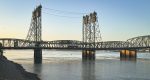
“One of the arguments you hear about the bridge … it’s over a hundred years old. Only half of it is over a hundred years old,” Ley reminded the gathering. “The other (half) was built in 1957.”
Plus, he said, the older half of the bridge has been retrofitted.
If he were in charge, he would want a third bridge (or tunnel) and keep the current bridge, but change it to a local connector between Vancouver, Hayden Island, and Marine Drive. Make the current bridge two lanes each way, lower the speed limit, add safety shoulder lanes, and maintain it for decades longer.
The plan for the new bridge also includes a light rail stop at the waterfront, but it would be 90 feet above the ground at that location, Ley said. He called that a ridiculous expenditure.
If light rail is a must, then the better solution is an immersed tube tunnel, Ley argued.
Also read:
- C-TRAN offering free service on Transit Equity Day, Feb. 4
 C-TRAN will offer free service across its entire system on February 4 in observance of Transit Equity Day, honoring the legacy of Rosa Parks.
 - Opinion: The many reminders not to speed
 Doug Dahl examines the many technological and policy-based reminders aimed at reducing speeding and explains why most drivers still choose not to use them voluntarily.
 - Rep. John Ley’s new bill calls for an independent audit of Interstate 5 Bridge Replacement Project
 Rep. John Ley introduced legislation requiring an independent audit of the Interstate 5 Bridge Replacement Project to review costs, management, and oversight.
 - Opinion: IBR’s evasive, misleading and dishonest excuses for higher cost
 Joe Cortright argues the Interstate Bridge Replacement Program has withheld detailed cost estimates while offering contradictory explanations for rising costs tied to the I-5 Bridge project.
 - Rep. David Stuebe sponsors bill to strengthen enforcement of auto insurance laws and protect Washington drivers
 Rep. David Stuebe has introduced HB 2308, a bill aimed at strengthening enforcement of Washington’s auto insurance laws and increasing accountability for repeat uninsured drivers.

To be clear — I do NOT want light rail coming into Clark County at this time. There is no demand for increased mass transit over the Columbia River over either the I-5 or the I-205 bridges. C-Tran reports ridership on their “express” buses over the river is essentially flat. About 550 daily “boardings” use the current 3 express bus lines into Portland.
The $2 billion price tag for the 1.8 mile MAX light rail extension on the IBR is outrageous. It’s over one quarter of the total cost of the project. Furthermore, TriMet is demanding 19 new light rail vehicles for the project. That’s a huge RIPOFF of taxpayers, as they only purchased FOUR new light rail vehicles for their 10-mile “Better Red” light rail extension from Beaverton to Hillsboro.
Furthermore, TriMet wants to FLEECE the taxpayers, as they are demanding between $190 million and $290 million for those 19 new light rail vehicles. That equates to between $10 million and just over $15 million per vehicle. Yet they admitted they only paid $4.5 million for each of the four new light rail vehicles they bought for the Better Red extension last year.
Added to the problems mentioned above, is the OUTRAGEOUS demand by TriMet that taxpayers pony up over $20 million each year for the operations and maintenance (O&M) of the 1.8 mile light rail extension. C-Tran has provided bus service over the Columbia River for over 40 years & TriMet or Portland have NEVER paid a single penny towards C-Tran O&M costs. Furthermore, that cost is roughly 4-5 times their actual O&M costs, on a per mile basis.
IF light rail “must” be part of any bridge project, then TriMet MUST pay for the entire capital costs for the new MAX vehicles, for the new track and electrical lines, and station costs, etc. They also MUST pay for the entire O&M costs for providing the light rail service. Clark County taxpayers shouldn’t pay for any of these costs. Only those who chose to ride the transit should pay the passenger fares.
Finally, TriMet is in a “death spiral” according to John Charles, of the Cascade Policy Institute. https://www.clarkcountytoday.com/opinion/opinion-do-we-still-need-trimet/
Keep in mind TriMet lost $850 million last year. They are demanding HUGE tax increase from the Oregon state legislature, or they claim they will CUT up to 2/3 of their current bus routes.
https://www.clarkcountytoday.com/opinion/opinion-trimets-fiscal-cliff-a-caution-for-clark-county-taxpayers/
Clark County taxpayers must not be tied to any of the financial problems of TriMet.
Hopefully you, John, being in an influential position, are (or have already) taking this to the proper U.S. federal-level authorities under the Trump administration. It is felt that letters from us “little people” fall on deaf ears should we write to a federal office.
And we can all hope that the USCG will soon stand up and officially declare the current plans null and void due to the lack of adequate river clearance height.
The IBRP is one the biggest boondoggles ever in the history of Washington State, being right up there with the failed WPPSS.
Susan — indeed. I have already sent a letter to the DOT Secretary Duffy.
We need DOGE to scrutinize this project!
I submit that if this project could not get done under Joe Biden and Pothole Pete, it has absolutely no chance under Donald Trump. Time to cut our losses and cancel this entire mess.