



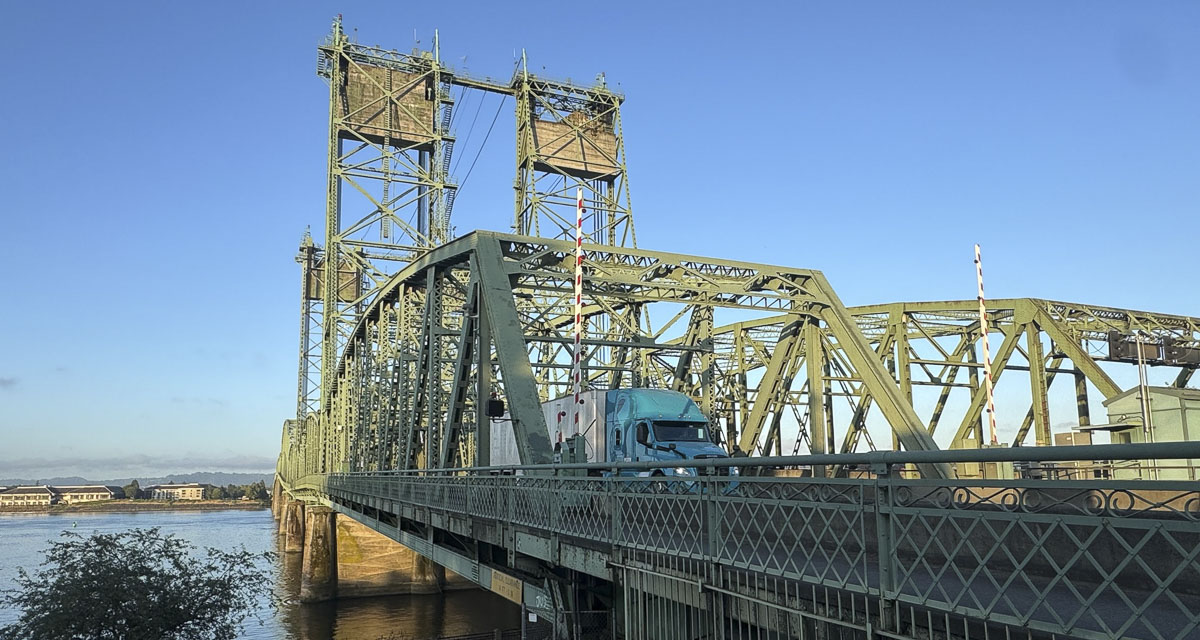
Many in Southwest Washington oppose the $2 billion light rail element of the project due to concerns about cost, potential negative impacts on their communities, and a perceived lack of benefit
Brett Davis
The Center Square Washington
Officials involved in a major project to replace the aging Interstate 5 Bridge over the Columbia River that connects Portland, Ore., and Vancouver, are confident that federal funding for the project won’t be derailed.
That’s even as the Trump administration has terminated approximately $4 billion in unspent federal funding for California’s High-Speed Rail project. The California High Speed Rail Authority is suing the Trump administration over the cancellation of federal funding.
The nearly $2.1 billion in federal funding so far for the Interstate Bridge Replacement Program (IBR) comes primarily from two major grant programs: the $600 million Mega Grant Program and the $1.5 billion Bridge Investment Program. The project also received a $30 million Reconnecting Communities grant.
According to Sam Stites with the IBR Communications Team, the IBR Program is a separate endeavor from the California High-Speed Rail, with its own dedicated funding streams and planning process involving the states of Oregon and Washington and the federal government.
“The grant agreements required to access the $2.1 billion in federal funds already awarded to the Program through the Mega Grant and Bridge Investment Program (BIP) Grant were both fully executed and signed earlier this year by ODOT/WSDOT and the Federal Highway Administration,” he emailed The Center Square.
ODOT is the Oregon Department of Transportation, and WSDOT is the Washington State Department of Transportation.
“A portion of the funds from these grants have already been obligated, with future obligations occurring for the remaining funds once we reach the construction phase,” Stites explained. “The IBR Program currently expects to receive an amended record of decision in early 2026 from the Federal Highway Administration and Federal Transit Administration, which provides federal approval to move to construction.
“The combined $2.1 billion from these grants is critical for the project, and we will continue to work with our federal partners and congressional delegation about our ability to access these funds, and to seek clarity on federal changes as they’re announced.”
Stites noted the complexity of the massive IBR Program, which is estimated to cost between $5 billion and $7.5 billion. This estimate includes the construction of a replacement bridge and other program components, with a projected timeframe of 2025-2035. The IBR Project is currently projected to begin construction in 2026.
“As with any major infrastructure project that requires years of planning and construction, changes in elected leadership from the federal level through local jurisdictions [are] expected,” Stites said. “The IBR Program appreciates the support received across all levels of leadership. We look forward to continued conversations with federal, state and local elected leaders about how we can continue to work together to deliver a safer and more reliable multimodal replacement bridge and corridor.”
The IBR Program is not without controversy, especially regarding the inclusion of light rail. Many in Southwest Washington oppose light rail due to concerns about cost, potential negative impacts on their communities, and a perceived lack of benefit. Proponents argue that light rail is essential for addressing environmental concerns, reducing congestion, improving transportation options, and promoting economic growth.
This report was first published by The Center Square Washington.
Also read:
- C-TRAN offering free service on Transit Equity Day, Feb. 4
 C-TRAN will offer free service across its entire system on February 4 in observance of Transit Equity Day, honoring the legacy of Rosa Parks.
 - Opinion: The many reminders not to speed
 Doug Dahl examines the many technological and policy-based reminders aimed at reducing speeding and explains why most drivers still choose not to use them voluntarily.
 - Rep. John Ley’s new bill calls for an independent audit of Interstate 5 Bridge Replacement Project
 Rep. John Ley introduced legislation requiring an independent audit of the Interstate 5 Bridge Replacement Project to review costs, management, and oversight.
 - Opinion: IBR’s evasive, misleading and dishonest excuses for higher cost
 Joe Cortright argues the Interstate Bridge Replacement Program has withheld detailed cost estimates while offering contradictory explanations for rising costs tied to the I-5 Bridge project.
 - Rep. David Stuebe sponsors bill to strengthen enforcement of auto insurance laws and protect Washington drivers
 Rep. David Stuebe has introduced HB 2308, a bill aimed at strengthening enforcement of Washington’s auto insurance laws and increasing accountability for repeat uninsured drivers.

Its time to get the US Coast Guard to weigh in on this fiasco again, and perhaps for the last time. There is no way the USCG will agree to close the Columbia River to traffic at Vancouver, just to accommodate Mayor Annie’s Loot Rail.
I still have absolutely no confidence in any of the numbers being presented. I’ll bet a burger that when the next estimate finally emerges it will be at or very near $12 Billion. There is no possible way to justify a project like that.
I’d give you a thumbs-up “+”, if I could. CCT has evidently decided they don’t want readers to easily indicate their perception of comments made here.
Sorry, it’s fixed now! Thanks!