



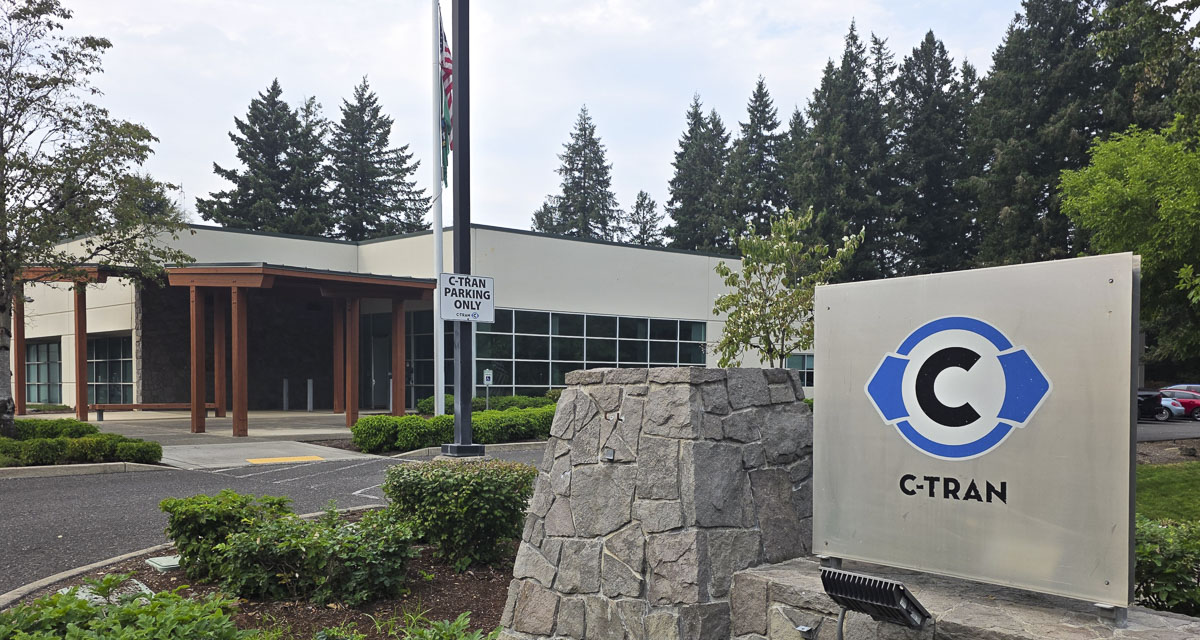
A long executive session did not result in any action being taken by the C-TRAN Board of Directors on Tuesday in regard to the Board Composition Review Committee’s compromise that was presented last month
Paul Valencia
Clark County Today
 See Grok’s analysis of this story
There was no action taken by the C-TRAN Board of Directors on Tuesday in regard to the Board Composition Review Committee’s directive last month, but there likely was plenty of reaction during an Executive Session.
An Executive Session was called to go over board composition, initially to last roughly 20 minutes. Board members extended another 20 minutes and 10 more minutes before resuming the public portion of the C-TRAN meeting.
Bart Hansen, the vice chair of the C-TRAN board, made a brief mention that no action would be taken this week regarding the composition review committee.
That means the C-TRAN board did not accept nor deny the review committee’s directive to go to a 4-3-2 composition — with conditions.
Last month, the committee voted to give the city of Vancouver four seats on the C-TRAN board, three to Clark County, and two to be shared by the smaller cities that make up C-TRAN. The committee did so on two conditions, compromises, if you will: That the small cities would not have to pay for operations and maintenance of light rail’s extension into Vancouver without an approving vote of the people or those city councils, and that the three representatives from Clark County must come from districts that do not also represent parts of the city of Vancouver. That was to ensure that Vancouver does not have overrepresentation on the C-TRAN board.
Hansen, who said he is not allowed to discuss specifics regarding discussions during Executive Session, said that he is unsure if or when the Board Composition Review Committee would meet again.
As of today, the review committee’s directive made on Nov. 18 — the 4-3-2 proposal with conditions — remains in limbo, waiting for action to be taken.
While the public does not know what exactly happened in the Executive Session on Tuesday, we do know that the City of Vancouver voted to disregard the review committee’s proposal. The Vancouver City Council voted on Dec. 1 to move to have the C-TRAN Board accept the 4-3-2 proposal, but without conditions. It is the city’s belief that the composition review committee cannot impose conditions.
Hansen was the lone Vancouver council member to vote against that proposal during the Dec. 1 city council meeting. However, had it come to a vote at the Dec. 9 C-TRAN meeting, he would have been obligated to vote the city’s direction. The city’s representatives on the C-TRAN board vote together on any issue that is previously taken up by the city.
Erik Paulsen, Vancouver City Council member and a member of the C-TRAN board, gave three options for the city to consider on Dec. 1:
One would be to adopt the recommendation as made, the 4-3-2 proposal with conditions. But, Paulsen said, he was confident that it would be legally challenged.
Another idea would be to send the proposal back to the review committee.
The third option, one Paulsen argued for, would be to adopt the 4-3-2 proposal and “effectively disregard” the two conditions.
Hansen said he believes the caveats are unenforceable, but he is uneasy with the idea of accepting one part of a proposal while disregarding other parts of the proposal. It could “open us up for litigation,” he said.
Hansen said it would be better to send it back to the review committee for the committee to find another solution.
This past summer, the city of Camas floated the possibility of leaving C-TRAN. The City of Ridgefield wrote a passionate recommendation for the small cities to have at least three representatives on the C-TRAN board. The smaller cities that help make up C-TRAN have wondered what the benefits would be if C-TRAN gets in business with Oregon’s Tri-Met, with the proposed extension of Oregon’s light rail into Vancouver.
That is why Hansen pushed for option 2, in hopes of having the composition review committee fix this problem.
“To override the wishes of some of these folks … I think we’re pushing them further into that realm,” Hansen said. “To lose a Battle Ground, or a Camas, or a La Center or any of them is painful to us. I’m going to go with whatever this council decides, of course. At the same time … this is me, on the record, saying Option No. 2 is the best option for us.”
The city council voted in favor of Option 3, the 4-3-2 proposal without stipulations. The council and mayor voted 6-1.
Based on discussions from the past year at C-TRAN board meetings and the composition review committee, the small cities are feeling the squeeze.
In August, Sean Boyle, representing La Center, wondered if the Southwest Washington Regional Transportation Council should just change its name to the Vancouver Transit Zone.
Wil Fuentes, a member of the Clark County Council and the C-TRAN board, replied that the name change has a nice ring to it.
Is C-TRAN getting closer to becoming V-TRAN?
Late in Tuesday’s C-TRAN meeting, Troy McCoy, representing Battle Ground, asked that at the next meeting there be a discussion and possible action on the MLPA — the Modified Locally Preferred Alternative for the Interstate Bridge Replacement Program.
The MLPA language has been in limbo for most of 2025 after then board member Michelle Belkot was about to vote to protect taxpayers from paying for operations and maintenance associated with light rail. The next day, she was kicked off the C-TRAN board by her colleagues on the Clark County Council. That led to lawsuits. Belkot’s case went federal and is still waiting for a court date.
As of now, the MLPA states that C-TRAN may be allowed to negotiate the possibility of paying for operations and maintenance. Belkot was trying to revert to older language that stated C-TRAN will not pay for operations and maintenance.
Also on Tuesday, the C-TRAN board did vote to accept the Washington State Transit Association’s 2026 legislative priorities. That includes this passage: “Continue to research and explore what funding mechanisms, outside of existing local authority, might be possible to support the operations and maintenance of the Interstate Bridge Replacement’s Light Rail program into Washington state.”

This independent analysis was created with Grok, an AI model from xAI. It is not written or edited by ClarkCountyToday.com and is provided to help readers evaluate the article’s sourcing and context.
Quick summary
The C‑TRAN Board of Directors took no action on the Board Composition Review Committee’s 4‑3‑2 seating proposal after a lengthy executive session, leaving the committee’s recommended conditions unresolved. The city of Vancouver has instructed its representatives to support the 4‑3‑2 structure but reject the attached conditions, raising concerns about potential litigation and about smaller cities feeling sidelined in future decisions.
What Grok notices
- Provides clear background on the proposed 4‑3‑2 board structure and the two linked conditions, helping readers follow what is being debated.
- Includes quotes from board members such as Bart Hansen that illustrate differing views on fairness, enforceability, and the risk of future disputes.
- Highlights concerns from smaller cities and some board members about representation, voting power, and exposure to potential light‑rail‑related costs.
- Mentions related issues like MLPA language and prior lawsuits, giving context for why trust and legal clarity are central to this discussion.
- Does not spell out the current legal status of the committee’s conditions or how state law treats them; readers may wish to review governing statutes and interlocal agreements.
Questions worth asking
- How might adopting the 4‑3‑2 structure without the conditions affect smaller cities’ willingness to remain in the C‑TRAN district?
- What legal authority does the composition review committee have to recommend or bind the board to specific conditions?
- In practical terms, how would a 4‑3‑2 board configuration change voting dynamics on future light‑rail, BRT, or high‑cost capital projects?
- What options exist if one or more smaller jurisdictions choose to leave the transit district over representation or cost‑sharing concerns?
- How do other multi‑jurisdictional transit agencies in Washington structure their boards to balance population, geographic diversity, and financial responsibility?
Research this topic more
- C‑TRAN – board meeting packets, minutes, and composition review committee reports
- Washington State Auditor’s Office – reports on governance, interlocal agreements, and transit‑district compliance
- Municipal Research and Services Center (MRSC) – guidance on transit board structures and regional governance
- Revised Code of Washington – statutes on public transportation systems and regional transit authorities (including RCW 81.104 and 35.58)
Also read:
- Letter: Vancouver Mayor Anne McEnerny-Ogle makes several serious and incorrect engineering statements
 Bob Ortblad critiques engineering claims by Vancouver Mayor Anne McEnerny-Ogle, highlighting cost and safety advantages of an immersed tunnel for the I-5 crossing.
 - Washington’s studded tire deadline is March 31
 Drivers must remove studded tires by March 31 or face a $137 fine, with WSDOT urging early action due to busy service centers and no planned deadline extension.
 - VIDEO: WA diesel hits record $6.53, crushing truckers and school budgets
 With diesel nearing $6.53 per gallon in Washington, trucking businesses and school districts now confront sharply higher fuel expenses affecting budgets and workers.
 - Opinion: In plain sight – yielding to pedestrians
 Drivers often fail to see pedestrians due to inattentional blindness, which highlights the need for more focused awareness at intersections and stronger safety practices.
 - Expect delays on SR 14 in Vancouver for guardrail repairs Wednesday
 State Route 14 travelers in Vancouver should plan for morning delays as WSDOT will close two eastbound lanes for guardrail repairs, affecting mileposts 6.0 to 7.0.
 wpDiscuz
