



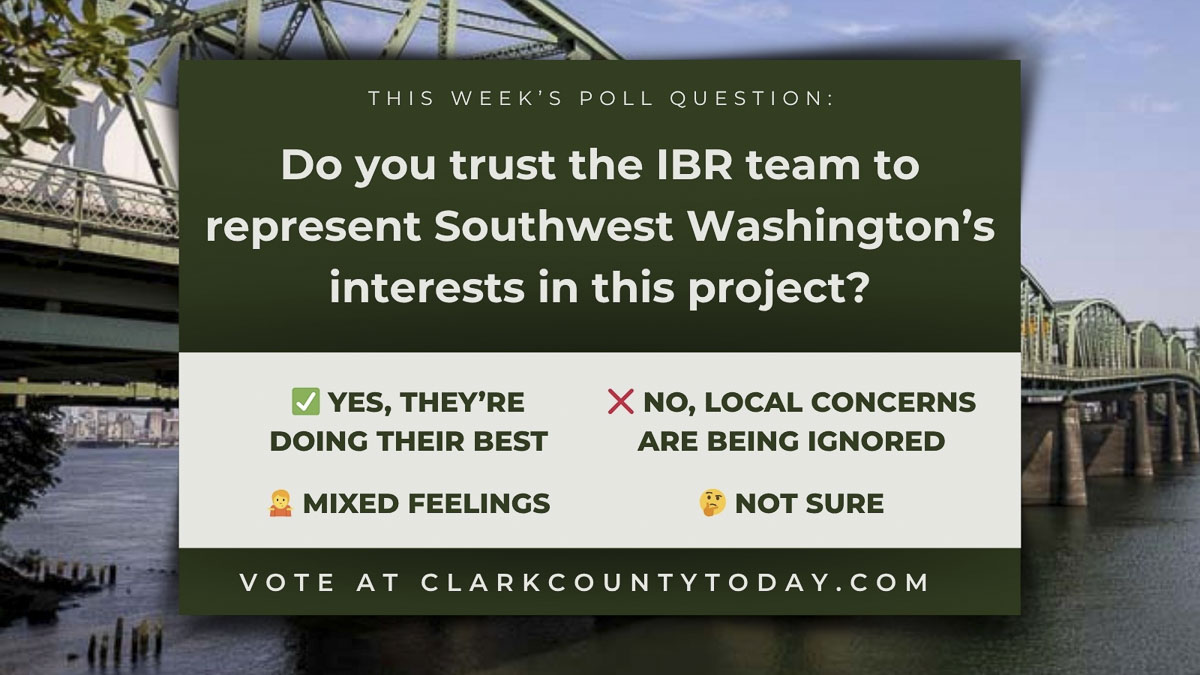
Light rail is part of the new I-5 bridge plan, but who should foot the bill for keeping it running?
As the Interstate Bridge Replacement Program advances, light rail remains a key element—despite ongoing debate in Southwest Washington. Project administrator Greg Johnson says light rail is moving forward with or without C-TRAN funding, but questions remain about who will cover the cost of operations and maintenance. With no final numbers released yet and public opposition still strong in parts of Clark County, should local taxpayers be on the hook? Share your opinion in this week’s poll.
More info:
Interstate Bridge Replacement Program moving forward with plans for light rail

IBR officials updated the C-TRAN Board on Tuesday with light rail plans, as Greg Johnson confirmed direction from both states’ leadership to proceed despite unresolved fu...
Read more
Also read:
- Opinion: Half the road, full stop – Understanding pedestrian right-of-way
 Doug Dahl explains how Washington’s law requires drivers to stop when a pedestrian is within one lane of their half of the road, not just when directly in front.
 - Opinion: What is the cost of a bridge?
 John Ley argues the I-5 Bridge replacement’s soaring cost stems from costly extras like light rail, noting other states deliver larger, toll-free bridges for much less.
 - Letter: Vancouver Mayor Anne McEnerny-Ogle makes several serious and incorrect engineering statements
 Bob Ortblad critiques engineering claims by Vancouver Mayor Anne McEnerny-Ogle, highlighting cost and safety advantages of an immersed tunnel for the I-5 crossing.
 - Washington’s studded tire deadline is March 31
 Drivers must remove studded tires by March 31 or face a $137 fine, with WSDOT urging early action due to busy service centers and no planned deadline extension.
 - VIDEO: WA diesel hits record $6.53, crushing truckers and school budgets
 With diesel nearing $6.53 per gallon in Washington, trucking businesses and school districts now confront sharply higher fuel expenses affecting budgets and workers.
 wpDiscuz
