



Rep. John Ley says nearly 40 percent of current MAX vehicles are spares according to federal reports
Rep. John Ley
For Clark County Today
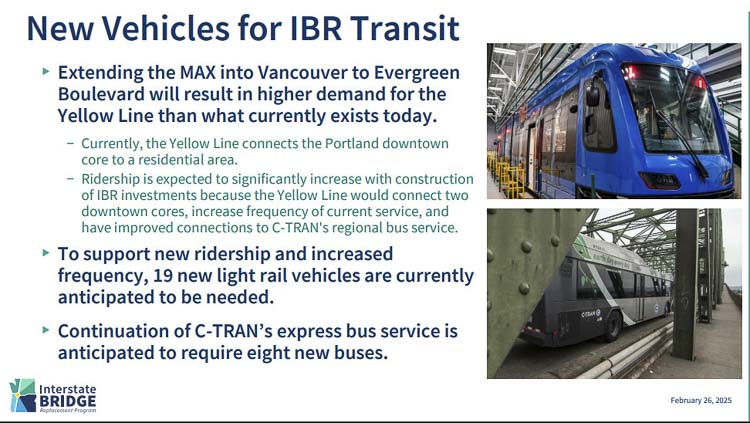
Even before the Interstate Bridge Replacement Program (IBR) said Portland’s TriMet needed 19 new light rail vehicles for a 1.83-mile extension of the MAX Yellow Line, people were skeptical of the need for light rail coming into Clark County. Yet Program Administrator Greg Johnson and his team said there would be 26,000 to 33,000 transit boardings on the I-5 corridor in 2045. They told the community C-TRAN would also need Bus Rapid Transit (BRT) departures every 3 minutes to meet the peak demand in addition to MAX departures every 6.7 minutes.

Yet they failed to use a federally required program (STOPS) to predict ridership. When they did, ridership projections dropped 84 percent to just 4,600 to 5,400 daily. “We guessed,” Johnson told the C-TRAN Board in June. Citizens were not provided that information when they were allowed to offer public comment on the proposal as part of the NEPA process last year.
The program was asked last week, how many new light rail vehicles and how many new buses would be needed to deliver the revised service. They have provided no answer yet.
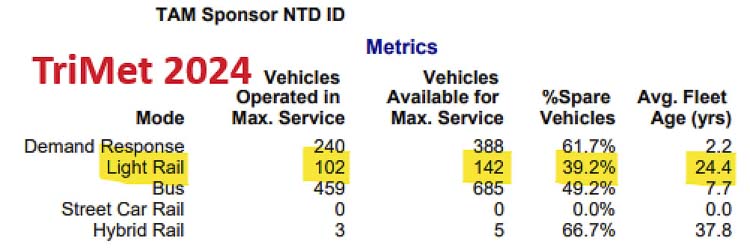
The Federal Transit Administration (FTA) reports that TriMet has 39 percent “spare” vehicles. In 2024 MAX service required 102 light rail vehicles to operate peak hour service; they own 142. With 40 spare vehicles, TriMet can easily handle a 1.83-mile extension of the Yellow Line with existing train cars.
The original IBR estimate was based on nine light rail train departures per hour and express bus service every three minutes (20 per hour) during peak times. The new proposal is four light rail trains an hour (current Yellow Line service) and eight express bus departures every hour.
The IBR told the public and legislators that the 19 new light rail vehicles would cost $190-290 million. Additionally, they said they needed a significant expansion of TriMet’s Gresham Ruby Junction maintenance facility at an additional $45-65 million.
They proposed $30–45 million for eight new C-TRAN double decker buses and facilities. Added to that are $90–140 million for the Evergreen park and ride plus another $30–45 million for the Vancouver Waterfront facility.
Eliminating the purchase of any MAX vehicles and facilities would potentially save the IBR between $235 million and $355 million of project costs attributed to TriMet capital costs. It could save $150 million to $230 million for C-TRAN. Overall, the transit component’s price tag is $2 billion of the $7.5 billion total current price tag.
The September TriMet ridership report indicates total MAX ridership decreased 13.4 percent during the weekday peak. The MAX weekend ridership decreased by 3 percent on Saturday and by 11.5 percent on Sunday compared to last year.
TriMet is currently in a financial crisis. They report needing to cut at least $300 million a year in costs. That’s about one third of their operating budget. Cutting expensive light rail service with declining ridership seems to be a logical solution, preserving cheaper and more flexible bus service to as much of the tri-county area as possible.
The need to cut light rail service to save operating funds coupled with TriMet’s 40 “spare” light rail vehicles, shows there is no need for the IBR to buy new MAX train cars. They can simply use one or two of their spare vehicles.
The C-TRAN express bus service is overly optimistic. Prior to the pandemic lockdowns, they had seven separate express bus lines over the Columbia River. Today they have just three lines.
Ridership over the river has been essentially “flat” for several years at about 525 boardings on the I-5 corridor. C-TRAN has no reason to add express bus service in the near future. They currently have 18 spare buses available, some from the four express lines no longer being operated.
With 40 spare light rail vehicles, one might wonder what is normal for a transit agency. Charles Prestrud of the Washington Policy Center shared the following.
“As for how many new light rail cars will be needed, you are right to wonder about TriMet’s math. The attached National Transit Database profile shows that in 2024 TriMet had a spare ratio of 39.2 percent. The desired spare ratio is generally 15-20 percent, so they have more spare rail cars than they need.
I do note that TriMet’s light rail fleet had an average age of 24.4 years, which is approaching the time when planning for replacement would start (the useful life for rail cars is usually about 35 years, but it can vary depending on a lot of factors). In any case, if TriMet is really going to cut service by 18 percent (or even 9 percent) and they currently have more than forty spare light rail cars, then it is very hard to see why they would need more for a short two-mile extension that only adds three stops. My hunch is that TriMet saw the I-5 Bridge project as a way to get FTA (and perhaps C-TRAN) to pay for a bunch of new rail cars.”
Prestrud noted “the revised service plan has only four trains per hour (which is a pathetically low level of service) then presumably they would need only half as many rail cars. Actually, if demand is that weak they shouldn’t be buying any new rail cars because the demand could easily be accommodated with express bus service.”
As for where service cuts might be made, he notes the Yellow line has the lowest (or second lowest) ridership of the five lines. That might make it a leading candidate for service reductions.
The National Transit Database shows that in 2024 TriMet’s hourly operating cost for MAX was $464.84 (for a vehicle revenue hour of service). “That’s rather pricey,” Prestrud said. “What is interesting and what the C-TRAN board should be worried about, is the cost trajectory. In 2017 TriMet’s hourly operating cost was $222.51.”
The cost per service hour has more than doubled in eight years. Over the same time period productivity has fallen from 63.7 boardings per service hour to 43 boardings per hour. “Costs up, productivity down,” he said. “Why would any competent governing board commit to buying into those trends?”
C-TRAN’s bus operating cost per hour is $196.73 versus TriMet’s MAX cost of $464.84. Clark County can run 2.3 buses every hour for the same cost as Portland’s light rail. One more reason the C-TRAN Board should avoid any financial entanglements with TriMet.
Also read:
- Expect delays on SR 14 in Vancouver for guardrail repairs Wednesday
 State Route 14 travelers in Vancouver should plan for morning delays as WSDOT will close two eastbound lanes for guardrail repairs, affecting mileposts 6.0 to 7.0.
 - Overnight closure planned on westbound SR 14 Camas Slough Bridge Tuesday
 WSDOT crews will close westbound SR 14 at Exit 14 in Camas to collect bridge deck samples and plan future repairs; detours will be in effect.
 - Opinion: Stay in your lane – seriously, it’s the law
 Drivers must choose the nearest lane when turning in Washington, and left turns bring added risk. Even with signals, every driver must help prevent crashes by following law.
 - POLL: After hearing state leaders describe the I-5 Bridge as vulnerable in an earthquake, what is your reaction?
 State and local leaders describe the I-5 Bridge as structurally at risk but recommend drivers continue crossing it while complex replacement plans unfold.
 - WA and OR scale back I-5 Bridge ambitions as cost balloons
 A $14.4 billion price tag prompts Washington and Oregon leaders to delay portions of the I-5 bridge project and prioritize just the main spans.
 wpDiscuz
