



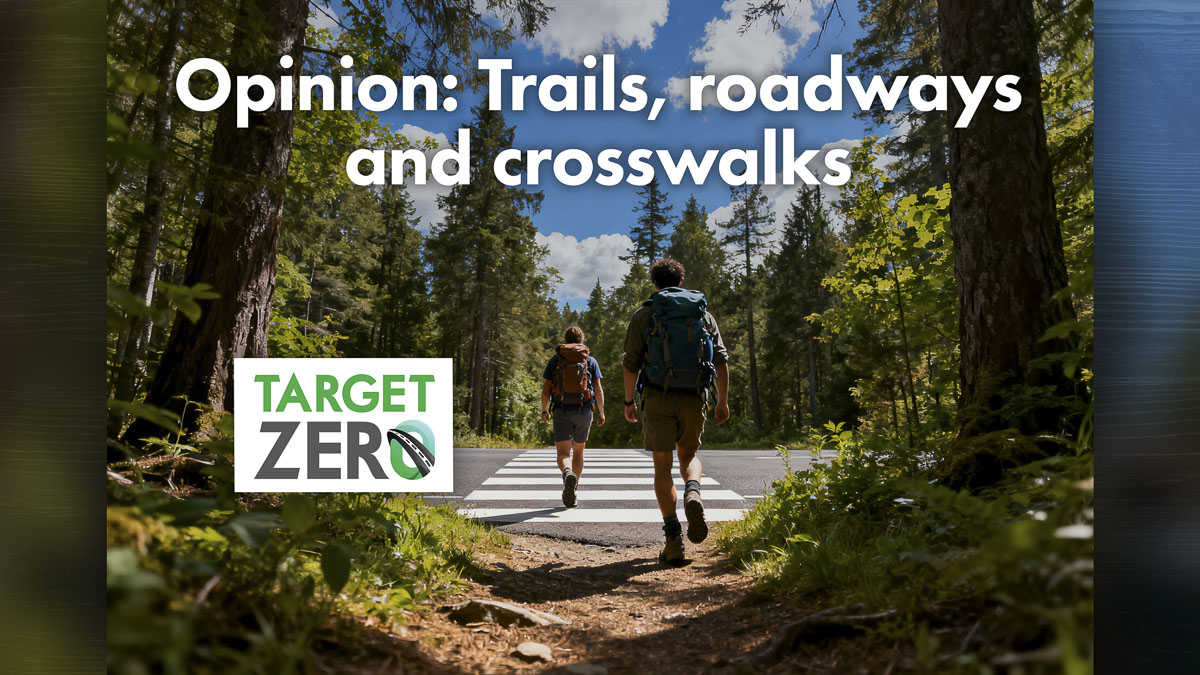
Doug Dahl addresses a question of hiking trails that cross a road and marked as a crosswalk
Q: Many places where hiking trails cross a road are marked as a crosswalk. Are those crossings which aren’t marked considered implied crosswalks in which pedestrians have the right-of-way? In a related question, sometimes there are stop signs on the trails. What is the impact of those signs, and do they have any legal meaning for walkers?
A: It seems a bit silly to put up stop signs for walkers, doesn’t it? I mean, if you’re travelling at around three miles per hour, you’re almost stopped already. For all the trail users traveling on foot, those stop signs weren’t put there for you. But since they are there, well, I’ll get to that in a minute.
Let’s start by clarifying some terms, starting with ‘crosswalk.’ The definition in the law is not reader friendly, so let’s go with this: Crosswalks exist at every intersection of roadways. They extend across the roadways from each of the corners of the intersection. When there’s paint on the road, like zebra stripes or a ladder, that’s a marked crosswalk. But the law is clear that paint or no paint, if there’s an intersection, there are crosswalks.

What, then, is an intersection? Where roads intersect, that’s an intersection. Too obvious, right? It’s there in the description. But to answer our question we need to know, when a trail crosses a road, does the trail count as a road?
The RCW defines a roadway, in part, as “ordinarily used for vehicular travel.” While bicycles are considered vehicles, it’d be hard to argue that a trail or shared-use path fits the definition, especially since the law goes on to say that sidewalks and shoulders are not part of the roadway even though they can be used by cyclists. Plus, the law doesn’t even consider a junction between an alley and a street to be an intersection.
No intersection means no automatic crosswalks. If you’re a hiker on a trail that crosses a roadway, unless there’s a marked crosswalk, you’re required to yield the right-of-way to traffic on the road. It’s also a good survival skill.
Getting back to those stop signs on trails, they’re put there for the cyclists. Or, at least, mostly for cyclists. The Manual on Uniform Traffic Control Devices includes the regulation of low-speed human or electric-powered transportation devices as well.
At a walking pace, if a densely wooded trail suddenly opened up to a roadway, you could easily stop if needed to yield to traffic. At cycling speeds, you’d need a warning. Depending on vehicle speeds, traffic volume, and visibility, traffic engineers may install either yield or stop signs on bicycle facilities (which include shared paths) that cross roadways.
Do walkers have to stop at those stop signs? The law states that drivers, cyclists, and pedestrians shall obey “any official traffic control device applicable to thereto,” and I can’t find anything that exempts pedestrians from those stop signs. Now, here’s a twist: a few years ago Washington passed a law that allows cyclists to treat stop signs as yield signs, when safe to do so. Does that mean that walkers are required to stop, while cyclists may not have to?
However you interpret the law, if you’re a trail user, it’s still you versus a multi-ton projectile that doesn’t have a stop sign. Drivers, please remember that imbalance of power and be vigilant – if you’re the biggest and fastest, you have a responsibility to be the safest too. Trail users, please remember that even a painted crosswalk isn’t a free pass and you’re putting your safety in the hands of a stranger.
Also read:
- Opinion: In plain sight – yielding to pedestrians
 Drivers often fail to see pedestrians due to inattentional blindness, which highlights the need for more focused awareness at intersections and stronger safety practices.
 - Expect delays on SR 14 in Vancouver for guardrail repairs Wednesday
 State Route 14 travelers in Vancouver should plan for morning delays as WSDOT will close two eastbound lanes for guardrail repairs, affecting mileposts 6.0 to 7.0.
 - Overnight closure planned on westbound SR 14 Camas Slough Bridge Tuesday
 WSDOT crews will close westbound SR 14 at Exit 14 in Camas to collect bridge deck samples and plan future repairs; detours will be in effect.
 - Opinion: Stay in your lane – seriously, it’s the law
 Drivers must choose the nearest lane when turning in Washington, and left turns bring added risk. Even with signals, every driver must help prevent crashes by following law.
 - POLL: After hearing state leaders describe the I-5 Bridge as vulnerable in an earthquake, what is your reaction?
 State and local leaders describe the I-5 Bridge as structurally at risk but recommend drivers continue crossing it while complex replacement plans unfold.
 wpDiscuz
