



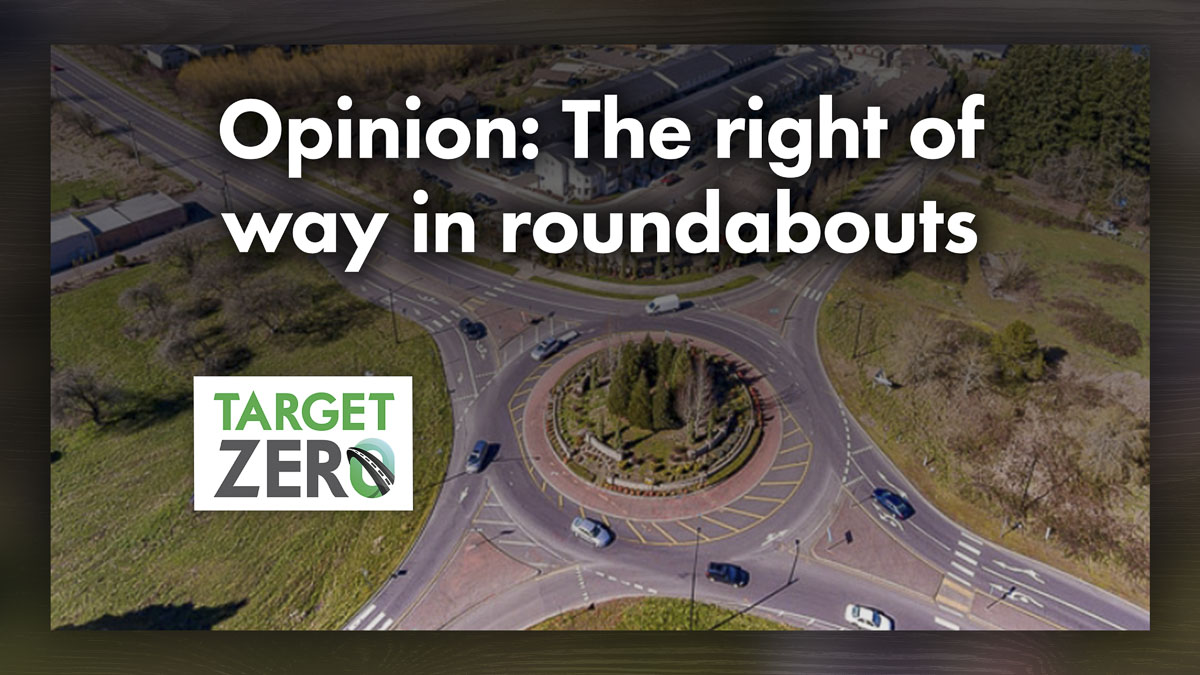
Target Zero Manager Doug Dahl answers the question of who has the right-of-way when two cars enter a roundabout at the same time at different speeds
Doug Dahl
The Wise Drive
Q: Who has the right-of-way when two cars enter a roundabout at the same time at different speeds; the slower one on the right, or the one to the left who enters at high speed and has to brake for the one on the right?
A: Imagine you’re in the grocery store. You’re working your way down the list and your next item is milk, at the back wall. You turn down an aisle and catch up to a shopper inching down the row while agonizing over cereal options. Meanwhile, a string of shoppers approach from the opposite direction, eliminating any possibility of passing the breakfast bumbler. What do you do?

Unless you’re a sociopath or prone to conflict, you’re going to slow down to the speed of the shopper in front of you. It’s your only real option. Let’s say that this particular grocery store, in the name of efficiency, decided to post right-of-way rules for shoppers, and rule number one was, “slower shoppers must yield the right-of-way to faster shoppers.” Well, now you have the rules on your side, but it’s still functionally impossible to exercise your right-of-way. That slow shopper can’t do anything to yield to you.
We’re in the same situation with your roundabout example. It wouldn’t matter if the slower vehicle had a requirement to yield to the faster one (it doesn’t); there’s nowhere to pull over and get out of the way, short of exiting at the next turn. The reality of the situation demands that the faster driver slow down for the vehicle in front of them.
But are there any laws that might apply here? If I were arguing on behalf of the faster driver I’d be hard-pressed to find any support. The closest possibility might be the law that requires slow drivers to pull over if they’re delaying five or more vehicles, but it only applies to two-lane roads with sufficient area for a safe turn-out, so that’s not going to work.
We know (hopefully we all know) that drivers entering a roundabout are required to yield to vehicles already in the roundabout. But once you’re in there, I can’t find any rule saying who yields to who. However, there are other laws we could find relevant. First, there’s the one that requires drivers to “drive at an appropriate reduced speed” when entering an intersection. Roundabouts are designed for speeds of 15 to 25 mph, so the slower driver is doing the right thing by the law.
Then there’s tailgating, or what the law calls following too closely, which states that drivers “shall not follow another vehicle more closely than is reasonable and prudent.” At some point the faster driver would be closer than what’s prudent and would have to slow down to comply with the law (and to be a responsible driver).
Finally, we have a fundamental principle in traffic law often referred to as “due care” which I’d loosely paraphrase as: even if you’re following all the other rules, you still must do what you can to avoid a crash. If you’re ever unclear about what the law is in a driving situation, do the thing that minimizes the risk of a crash.
In theory, when two cars enter a roundabout at about the same time and at roughly the same speed, neither would have to yield to the other because there would be enough room between them. Of course, when you have the situation you described that won’t work. In that case, both reality and traffic laws put the burden of responsibility to yield on the faster driver.
Also read:
- Opinion: Half the road, full stop – Understanding pedestrian right-of-way
 Doug Dahl explains how Washington’s law requires drivers to stop when a pedestrian is within one lane of their half of the road, not just when directly in front.
 - Opinion: What is the cost of a bridge?
 John Ley argues the I-5 Bridge replacement’s soaring cost stems from costly extras like light rail, noting other states deliver larger, toll-free bridges for much less.
 - Letter: Vancouver Mayor Anne McEnerny-Ogle makes several serious and incorrect engineering statements
 Bob Ortblad critiques engineering claims by Vancouver Mayor Anne McEnerny-Ogle, highlighting cost and safety advantages of an immersed tunnel for the I-5 crossing.
 - Washington’s studded tire deadline is March 31
 Drivers must remove studded tires by March 31 or face a $137 fine, with WSDOT urging early action due to busy service centers and no planned deadline extension.
 - VIDEO: WA diesel hits record $6.53, crushing truckers and school budgets
 With diesel nearing $6.53 per gallon in Washington, trucking businesses and school districts now confront sharply higher fuel expenses affecting budgets and workers.
 wpDiscuz
