



Joe Cortright asks why does Oregon’s massive new highway bill make no provision for the rising cost of the state’s most expensive highway project and why are officials continuing to delay release of new, higher cost estimates that they’ve been promising for the past year and half?
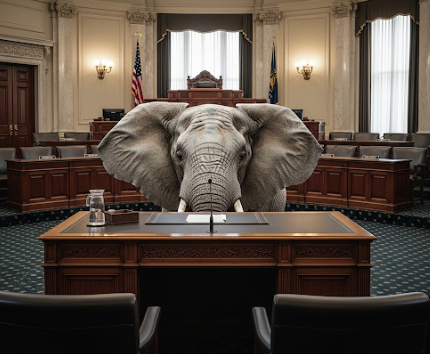
There’s a $9 billion elephant in the Oregon State Capitol’s Hearing Room A, where the Joint Transportation Committee meets twice a week. Legislators are trying to work out a multi-billion dollar package that will supposedly fix the fiscal wreck that is the Oregon Department of Transportation, but their calculations leave out virtually certain cost overruns on the massive Interstate 5 Bridge replacement project.
It makes a mockery of the idea that legislators and ODOT are getting a handle on “accountability” when they’re utterly failing to include the most expensive highway project in state history in their financial calculations.
What’s likely to happen is that by the end of June, the Legislature, facing a statutory adjournment deadline, will rush to pass a bill with virtually no public testimony. Then, a few weeks or months after the bill is signed into law, the Oregon Department of Transportation will suddenly report that the state faces an additional liability in the form of a $9 billion dollar or more price tag for the Interstate Bridge replacement project.
That massive transportation package that is supposedly in the works in Salem leaves out any mention of the single largest, most expensive highway project in Oregon: The Interstate Bridge replacement project.
Since the start of 2024, ODOT has been delaying releasing new cost estimates that are certain to push the cost of the project well above the $7.5 billion estimated years ago.
ODOT failed to make any mention of the rising cost of the IBR in its presentations to the Joint Transportation Committee roadshow in 2024 that traveled the state to talk about budget needs.
What’s likely to happen is that the 2025 Legislature will vote to pass a 20 cent a gallon gas tax hike, higher vehicle registration fees and a roughly $250 million annual tax on the sale of new and used cars, only to find that it has a multi-billion dollar additional liability to pay for its share of cost increases and revenue shortfalls on the I-5 bridge.
Two key pieces of the IBR financing haven’t fallen into place: It will be 2028 before we know whether the federal government will contribute a hoped-for $1 billion for the light rail portion of the project. In addition, it won’t be until next year that we have an independent, investment grade toll revenue forecast that tells us actually how much we can expect to raise from bridge tolls (and what those tolls will have to be).
Make no mistake, Oregon is fully responsible for half of the cost of this project — whatever it ends up costing. If federal grants fall short, or toll revenues don’t materialize, or costs increase, Oregon will be obligated to pay those costs.
The Oregon Legislature appointed a “Joint I-5 Bridge Committee” when it convened in January. The Committee has never met during this session of the Legislature. There’s simply a big empty space on the webpage for the committee under “Meetings”
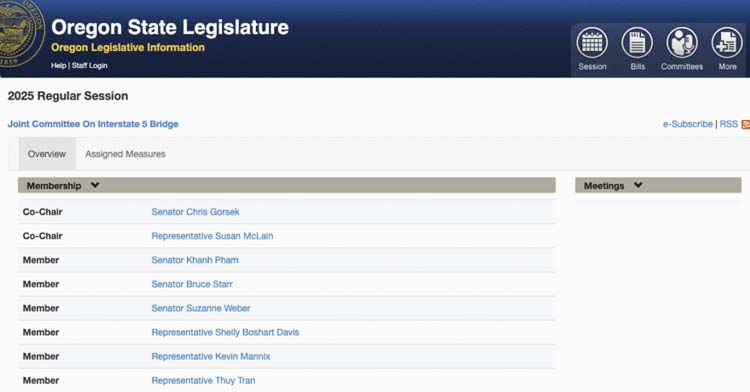
Likewise, during the Legislative interim, when the Joint Transportation Committee did a series of “roadshow” hearings around the state, ODOT said nothing about additional liability for increasing costs for the proposed project. At these hearings, ODOT presentation materials made no mention of the project, its cost or funding in a presentation entitled “ODOT Transportation Funding Review” or in Portland.
Delayed cost estimates
The Interstate Bridge replacement project has repeatedly delayed releasing updated cost estimates, signaling a likely substantial increase from its last public figure of $7.5 billion. Despite acknowledging since January 2024 that costs were rising, the IBR team has repeatedly pushed back the release of a new, comprehensive estimate.
Chronology of delayed cost estimates for the I-5 Bridge replacement:
- January 2024: IBR Director Greg Johnson acknowledges rising costs and states a new overall program estimate would be reissued “later this summer.”
- Summer 2024 (expected): New estimate does not materialize.
- June 13, 2024 (Community Advisory Committee meeting): Project Director Greg Johnson confirms costs are still rising, but the “rigorous and up-to-date number” won’t be available until “around this time next year” (summer 2025).
- Summer 2025 (expected): New estimate is again delayed.
- April 21, 2025 (Community Advisory Group/Executive Advisory Group): Greg Johnson informs advisory groups that a new estimate won’t be ready until “right around September” due to ongoing “cost validation process” and market variables.
- May 8, 2025 (Oregon Transportation Commission): IBR Assistant Director Ray Mabey indicates the new cost estimate will take even longer, pushing the release to late 2025.
These continuous delays suggest that the IBR staff are holding back unfavorable news about the project’s escalating price tag, which will likely top $9 billion.
This column was first published by the City Observatory.
Also read:
- Final Supplemental Environmental Impact Statement published for Interstate Bridge Replacement Program
 Federal agencies published the final environmental impact statement for the Interstate Bridge replacement project.
 - Speed cameras designed to bring added safety to work zones
 WSP issued 65,000 infractions in first year, with 59,000 being penalty-free first offenses as program expands statewide.
 - Marie Gluesenkamp Perez seeks federal assistance in combating sea lion predation of salmon & steelhead fishing stock
 Congresswoman pushes for expanded lethal removal authority as sea lions devour Columbia River fish stocks.
 - Opinion: The high cost of hiding – Why IBR’s delayed revenue study is a $15 billion warning sign
 IBR delays critical toll revenue analysis until June 2027, hiding financial details until after project approval.
 - Opinion: The high cost of hiding – Why IBR’s delayed revenue study is a $15 billion warning sign
 IBR delays critical toll revenue analysis until June 2027, hiding financial details until after project approval.
