



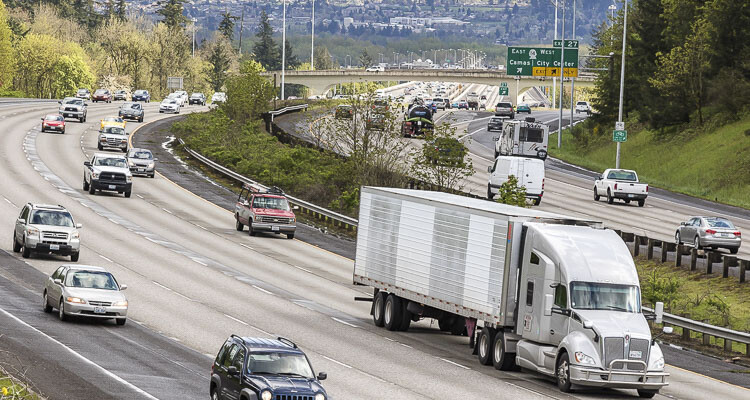
Charles Prestrud says that even though motorists are paying taxes on CO2 emissions, they won’t see any benefit when it comes to highway maintenance or completion of needed improvements
Charles Prestrud
Washington Policy Center
An editorial in the July 5th Wall Street Journal suggests that Washington State is imitating California. They don’t mean that in a good way. Their point is that Washington residents shouldn’t be surprised that the state’s new tax on carbon-based fuels has made our gas prices the highest in the U.S. Several years ago California enacted a similar cap-and-trade tax on carbon fuels and their gas prices are nearly as high as ours.

My colleague Todd Myers has shown that Washington’s carbon tax has increased the price of gas by about 44 cents per gallon, and that is on top of Washington’s 49.4 cent per gallon gas tax, which was already one of the highest in the U.S. It’s easy to blame the oil companies for high prices but their profit margins are slim compared to the taxes the state is raking in.
The Wall Street Journal editorial hit the nail on the head, but the high price of gas is only half the story. Washington is also following California’s lead in another way that isn’t good, which is the deteriorating condition of our highways. Anyone who has driven on I-5 through Seattle will have noticed this, and it’s confirmed by the Reason Foundation’s Annual Highway Report which ranks Washington State’s highways 46th out of the fifty states, just one notch above California. The dire need for highway system repair and repaving has not escaped the attention of WSDOT. WSDOT Secretary Roger Millar has gone so far as to say “the system is on a glide-path to failure”. WSDOT has estimated that an additional $350 million per year is needed to bring the state highway system up to a state of good repair, but they have no plan to accomplish that.
You might think the hundreds of millions of dollars the State is collecting from the tax on CO2 emissions ought to go a long way toward funding high priority maintenance work. However, when the State Legislature adopted the carbon tax they specifically prohibited using the revenue for fixing state highways. Instead, the revenue is doled out to a smorgasbord of “green” programs the effectiveness of which remains to be seen. Meanwhile the backlog of deferred maintenance continues to grow.
So, even though motorists are paying taxes on CO2 emissions every time they go to the gas station, they won’t see any benefit when it comes to highway maintenance or completion of needed improvements.
Charles Prestrud is the director of the Coles Center for Transportation at the Washington Policy Center.
Also read:
- Opinion: Half the road, full stop – Understanding pedestrian right-of-way
 Doug Dahl explains how Washington’s law requires drivers to stop when a pedestrian is within one lane of their half of the road, not just when directly in front.
 - Opinion: What is the cost of a bridge?
 John Ley argues the I-5 Bridge replacement’s soaring cost stems from costly extras like light rail, noting other states deliver larger, toll-free bridges for much less.
 - Letter: Vancouver Mayor Anne McEnerny-Ogle makes several serious and incorrect engineering statements
 Bob Ortblad critiques engineering claims by Vancouver Mayor Anne McEnerny-Ogle, highlighting cost and safety advantages of an immersed tunnel for the I-5 crossing.
 - Washington’s studded tire deadline is March 31
 Drivers must remove studded tires by March 31 or face a $137 fine, with WSDOT urging early action due to busy service centers and no planned deadline extension.
 - VIDEO: WA diesel hits record $6.53, crushing truckers and school budgets
 With diesel nearing $6.53 per gallon in Washington, trucking businesses and school districts now confront sharply higher fuel expenses affecting budgets and workers.
 wpDiscuz
