



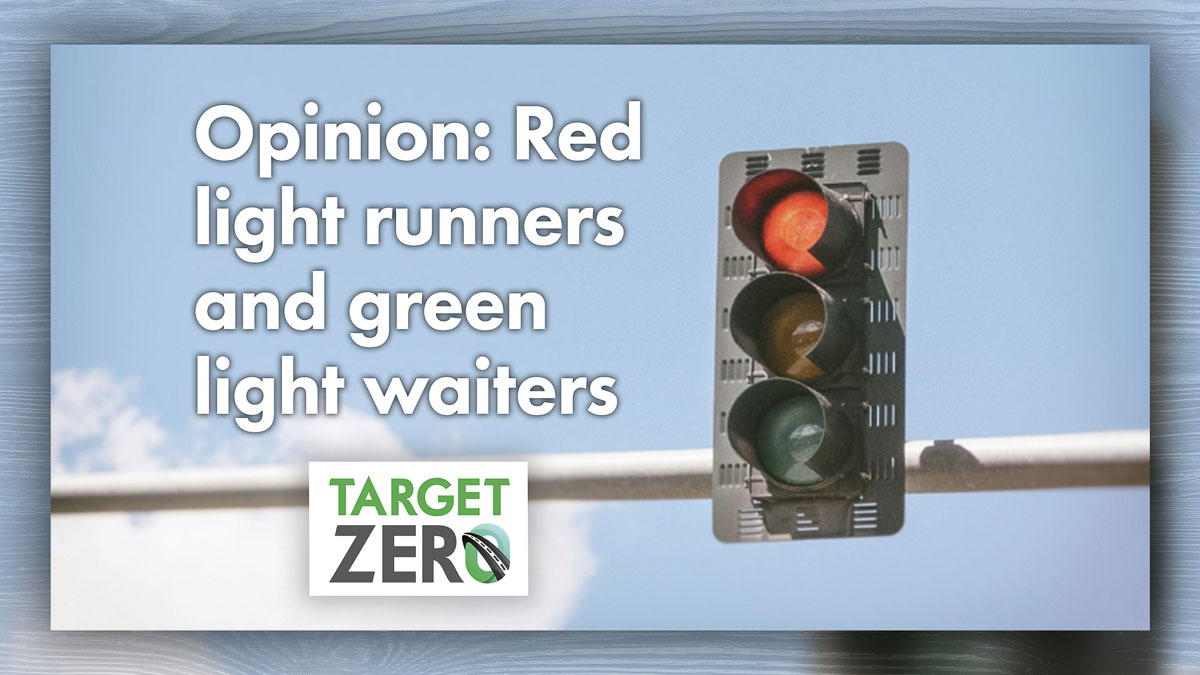
Target Zero Manager Doug Dahl discusses the appropriate actions of drivers at intersections
Doug Dahl
The Wise Drive
Q: We are helping our nephew learn to drive. On a recent drive, he was first at a green light, and did not look to see if anyone was running the red light for the cross street before he proceeded. His uncle maintains a crash would be the fault of the red-light runner, and I say the law requires you to make sure the intersection is clear before you proceed, so the person proceeding through without first making sure it is clear could be at fault.
A: I should not get involved in a family dispute, but I’m going to anyway. Collisions between two vehicles sometimes happen because of the actions of both drivers, so it’s not uncommon for both drivers to share some responsibility for the crash. In this case though, I’m siding with the uncle, and I’m basing that on what the law requires for each driver.

When trying to solve a conflict, it’s good to start with what we agree on. The law states that a driver facing a red light is required to stop. No argument there. For any driver that’s not on board with that, please shred your driver license and get a bus pass.
For the other driver, it’s wise to make sure the intersection is clear before proceeding, but the law on traffic signals doesn’t include that as a requirement. Once stopped at a red light, drivers are to remain until “an indication to proceed is shown.” When the light turns green, they can proceed. It doesn’t have a part about checking to make sure the intersection is clear in the way you’re describing, but does require turning drivers to yield to other vehicles lawfully in the intersection (think oncoming traffic that also has a green light.) That wouldn’t include the red-light runner, as it’s not lawfully in the intersection.
I understand why you might believe that the law requires a driver to make sure the intersection is clear before proceeding. The law for vehicles at an intersection with a stop sign does require drivers to “yield the right-of-way to any vehicle in the intersection or approaching on another roadway so closely as to constitute an immediate hazard”.
There is a law that states that it is “the duty of all persons to use due care”, so I’ll ask, “Is waiting for the light to turn green before proceeding sufficient due care, or does due care requires a driver to also confirm that the cross-traffic with a red light has actually stopped?” That’d be up for a judge to decide, but if there was an officer investigating the crash and they had only one ticket left in their ticket book, I’m confident they’d give it to the red-light runner. (And it’s been years since police have had actual ticket books. Now I suppose it’d be if they only had enough printer paper for one ticket.)
To add to the debate, I’ll argue that the real question isn’t who’s at fault (well, if the crash actually happened that would be an important question) but in this theoretical scenario it’s, “Could the crash have been avoided?” It feels good to be right, but I’d much rather avoid getting in a crash because I took a second to check for someone else violating the law than have an officer (and possibly paramedic) give me sympathy for being hit by a red-light runner. Knowing the other driver got the ticket isn’t really much of a comfort when your car is totaled or you’re in the back of an ambulance.
The Wise Drive is hosted by Doug Dahl, a Target Zero manager for the Washington Traffic Safety Commission.


Also read:
- Opinion: Half the road, full stop – Understanding pedestrian right-of-way
 Doug Dahl explains how Washington’s law requires drivers to stop when a pedestrian is within one lane of their half of the road, not just when directly in front.
 - Opinion: The state’s RFK-proofing bill comes with a cost
 Mandates like HB 2242 can lead to higher premiums as insurance companies absorb costs for new preventive services, affecting affordability statewide.
 - Opinion: What is the cost of a bridge?
 John Ley argues the I-5 Bridge replacement’s soaring cost stems from costly extras like light rail, noting other states deliver larger, toll-free bridges for much less.
 - POLL: Do you agree with giving a state commission the power to remove an elected sheriff?
 A new poll asks if a state commission—not voters—should have the power to remove an elected sheriff, following concerns raised by Clark County Sheriff John Horch.
 - Opinion: Defending Democracy by denying it?
 Washington voters are blocked from weighing in on new income taxes as state lawmakers and officials bypass public input, drawing criticism from Northwest voices.
