



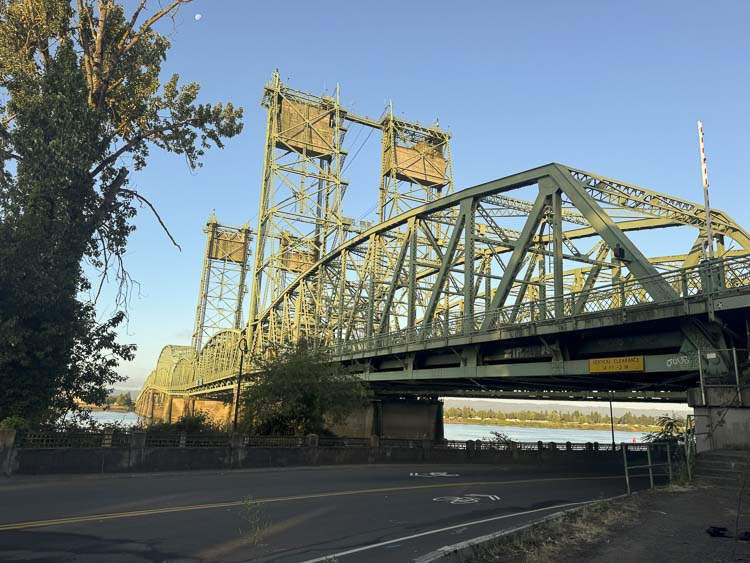
Clark County Today Editor Ken Vance provides an update on the latest discussion surrounding the I-5 Bridge replacement project
Ken Vance, editor
Clark County Today
The narrative surrounding the Interstate 5 Bridge replacement project is getting interesting. In fact, it’s becoming more than just interesting for those of us who have intensely spent so many years following the proposed project. Folks like myself are actually becoming more and more optimistic by the day that common sense will be injected into the discussion very soon.

I have never written in opposition to replacing the I-5 Bridge. I acknowledge it needs to be done at some point. However, I don’t believe there is as much urgency as some others believe there is. I also believe citizens want transportation corridor options, including a third or even a fourth bridge, and I don’t believe the majority of citizens want another transit option (light rail). I am also not in favor of a project that does not reduce congestion, and this one will have no significant impact on our traffic congestion issues.
Prior to the last presidential election, I had started to lose hope that any sanity would ever come to this project, the current price tag is estimated to be between $5 and $7.5 billion. We’ve been waiting for quite some time for that estimate to be updated. Interstate Bridge Replacement Program (IBR) officials have promised an updated estimate later this year. Many opponents of the IBR’s proposal expect that price tag to increase to at least $9-10 billion.
There is no evidence that this project has gotten on the radar of President Donald Trump. Attempts have been made to make sure transportation officials in Washington, DC are aware of the absurdities involved in this project with the hope that someone at the federal level will intervene before it’s too late. It is my hope that the likelihood of that happening will increase once the new price tag is announced later this year.
You might be aware that President Trump recently has brought common sense and fiscal responsibility to other transportation projects. As reported by The Center Square Washington, the Trump administration has terminated approximately $4 billion in unspent federal funding for California’s High-Speed Rail project. The California High Speed Rail Authority is suing the Trump administration over the cancellation of federal funding.
The nearly $2.1 billion in federal funding so far for the I-5 Bridge replacement project comes primarily from two major grant programs: the $600 million Mega Grant Program and the $1.5 billion Bridge Investment Program. The project also received a $30 million Reconnecting Communities grant.
Sam Stites, a member of the IBR Communications Team, told The Center Square Washington earlier this week that the IBR Program is a separate endeavor from the California High-Speed Rail, with its own dedicated funding streams and planning process involving the states of Oregon and Washington and the federal government.
“The grant agreements required to access the $2.1 billion in federal funds already awarded to the Program through the Mega Grant and Bridge Investment Program (BIP) Grant were both fully executed and signed earlier this year by ODOT/WSDOT and the Federal Highway Administration,” Stites emailed The Center Square.
ODOT is the Oregon Department of Transportation, and WSDOT is the Washington State Department of Transportation.
“A portion of the funds from these grants have already been obligated, with future obligations occurring for the remaining funds once we reach the construction phase,” Stites explained. “The IBR Program currently expects to receive an amended record of decision in early 2026 from the Federal Highway Administration and Federal Transit Administration, which provides federal approval to move to construction,’’ Stites said.
“The combined $2.1 billion from these grants is critical for the project, and we will continue to work with our federal partners and congressional delegation about our ability to access these funds, and to seek clarity on federal changes as they’re announced,” he said.
However, earlier this year, Vancouver Mayor Anne McEnerny-Ogle appeared to reveal a crack in her confidence for the project in comments made to Oregon Public Broadcasting.
“The contracts haven’t been written, the checks haven’t been signed. So, until that happens, we don’t have a bridge right now. We’re working as if we will, hoping to get a record of decision Sept. 8, 2025 and put a shovel in the dirt the next day,” Mayor McEnerny-Ogle said, referring to early construction preparation. “Until all of those documents are signed, we don’t have a bridge.”
The mayor recently shared that every day the project is delayed, it adds $1 million to the cost. Yet the IBR staff members now admit their timeline for the Record of Decision is delayed until “early 2026.” This adds at least $100 million or more to the cost, due to the project team’s delays. The tolling component has been delayed a year. How many other delays are the responsibility of the project team? How much added costs are actually attributed to the management and oversight of the program?
And, it’s also worth noting that the issue of the height (178 feet) of the proposed bridge replacement is unacceptable to the U.S. Coast Guard. That issue has yet to be resolved and is certainly one of significance.
Also, the C-TRAN Board of Directors continue to wrestle over their decision as to whether or not that agency will agree to participate in funding the maintenance and operations (O&M) of TriMet’s 1.83-mile extension into Vancouver. That light rail extension accounts for about $2 billion of the overall price tag for the project. More importantly, Portland’s TriMet is demanding Clark County taxpayers cover $7 million each year for their light rail O&M costs.
Most recently, because the Oregon legislature refused to bail out TriMet financially with a significant statewide jobs tax increase, TriMet has announced significant cuts in their service. This includes up to 18 percent of MAX light rail service.
Clark County residents would be wise to avoid financial entanglements with a financially ailing TriMet. Citizens have spoken loud and clear at multiple C-TRAN Board meetings they do not want to pay for light rail.
Also read:
- POLL: Do you support extending light rail beyond the waterfront to connect with C-TRAN at Library Square?
 Readers can weigh in on Anne McEnerny-Ogle’s proposal to extend light rail beyond the waterfront to Library Square for improved C-TRAN connections.
 - Opinion: Passing a cyclist – Law, myth and a little patience
 Most drivers can’t legally pass cyclists in-lane due to vehicle width versus road measurements.
 - Vancouver mayor counters IBR’s proposal for the only light rail stop to be at the waterfront
 Vancouver’s mayor wants light rail extended beyond the waterfront to connect with C-TRAN buses at Library Square.
 - Letter: ‘This is the worst thing that ever happened to the region’
 A Hayden Island resident Sam Churchill is criticized in a letter calling the $14 billion Interstate Bridge Replacement project a “boondoggle” that destroys local businesses.
 - Opinion: Half the road, full stop – Understanding pedestrian right-of-way
 Doug Dahl explains how Washington’s law requires drivers to stop when a pedestrian is within one lane of their half of the road, not just when directly in front.
 wpDiscuz
