



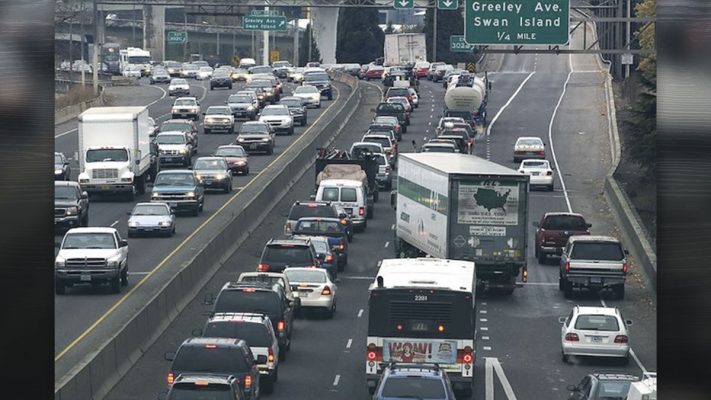
A key part of the strategy calls for prioritizing multimodal transportation over roads and promoting development patterns that make it easier to live without a car
Randall O’Toole
The Anti Planner
Oregon’s strategy for saving energy is doomed to failure, say comments on the draft strategy written by the Antiplanner. A key part of the strategy calls for prioritizing multimodal transportation over roads and promoting development patterns that make it easier to live without a car. This strategy has never worked, the comments point out, and if Oregon is going to have an energy strategy it should adopt one that will actually work rather than one that is designed to fail.
The Portland area has been following this policy since the late 1970s, when it cancelled a proposed freeway and used the funds to instead build the region’s first light-rail line. The Antiplanner’s comments use the latest American community survey data to show that this policy failed to increase transit ridership, bicycling, and walking.
In 1980, 9.6 percent of Portland-area workers took transit to work while 64.6 percent drove alone, 17.7 percent carpooled, and 4.9 percent walked or bicycled to work. In 2019, after building 60 miles of light-rail lines and nearly 400 miles of bikeways and bike lanes, transit’s share of commuting had fallen to 7.7 percent, driving alone had increased to 68.4 percent, and walking and cycling had increased only slightly to 5.7 percent (but had fallen from their 2014 peak of 6.4 percent).
The trend that actually reduced auto commuting was one neither anticipated nor promoted by Portland-area planners: people working at home. This was already increasing before the pandemic from 1.9 percent of workers in 1980 to 8.0 percent in 2019, but the pandemic caused it to zoom to 20.7 percent in 2024.
This reduced the share of people driving alone to 61.3 percent, but it had an even greater impact on transit, walking, and cycling, with transit falling to 4.0 percent and walking and cycling to 4.2 percent in 2024.
In terms of numbers, remote working increased by 171 percent between 2019 and 2024. This reduced the number of auto commuters by 6 percent but it reduced transit commuters by 46 percent and bicycle and pedestrian commuters by 22 percent. Clearly, Portland-area residents were not doing what planners wanted them to do, especially since people working at home tend to drive as many miles as when they drove to work, they just drive them at different times of the day.
The Antiplanner’s comments also pointed out that cars use a lot more energy and emit a lot more greenhouse gases in congestion, something that is not taken into consideration in state or local transportation planning models. The Texas Transportation Institute estimates that Portland-area congestion wasted 35.1 million gallons of fuel in 2019, six times more than the 5.7 million gallons wasted in 1982. This increase represents 282,000 tons of additional greenhouse gas emissions in 2019.
Electric-powered light rail, meanwhile, saved around 42,000 to 45,000 tons of emissions, assuming people riding the trains would have otherwise ridden buses or driven cars. If the money spent on light rail had instead been spent on policies that cost-effectively reduced the region’s congestion, it could have saved six to eight times as much greenhouse gases.
The comments further challenge the claim that new development patterns would lead people to drive less. Most studies that found that people living in dense apartments drove less failed to account for self-selection. Even to the extent that such people do drive a little less, they drive in more congested conditions, which means the greenhouse gas emissions per person can be greater than people living in car-friendly suburbs.
The comments also note that the Department of Energy estimates that multifamily housing uses more energy per square foot than single-family housing. It also uses more in construction because of the need for more concrete and steel.
Instead of linking the state energy plan to a policy that is already proven to fail, the comments suggest the state expand its existing, but limited, program to encourage people to drive more fuel-efficient cars. The existing program has a limited amount of money giving people credits or rebates on electric cars and electric vehicle chargers.
The Antiplanner’s comments conclude that expanding this program to promote all fuel-efficient autos, including petroleum-powered vehicles that get, say, 40 miles per gallon or better, would save energy and reduce emissions at a far lower cost than prioritizing multimodal transportation and emphasizing developments that supposedly discourage driving.
Oregon’s draft energy strategy is now available for download. Comments on the strategy are welcome at Oregon’s public comment portal through September 22.
The Antiplanner is a forester and economist with more than fifty years of experience critiquing government land-use and transportation plans.
Also read:
- Overnight closure planned on westbound SR 14 Camas Slough Bridge Tuesday
 WSDOT crews will close westbound SR 14 at Exit 14 in Camas to collect bridge deck samples and plan future repairs; detours will be in effect.
 - Opinion: Stay in your lane – seriously, it’s the law
 Drivers must choose the nearest lane when turning in Washington, and left turns bring added risk. Even with signals, every driver must help prevent crashes by following law.
 - POLL: After hearing state leaders describe the I-5 Bridge as vulnerable in an earthquake, what is your reaction?
 State and local leaders describe the I-5 Bridge as structurally at risk but recommend drivers continue crossing it while complex replacement plans unfold.
 - WA and OR scale back I-5 Bridge ambitions as cost balloons
 A $14.4 billion price tag prompts Washington and Oregon leaders to delay portions of the I-5 bridge project and prioritize just the main spans.
 - Letter: ‘Now we have Engineer Bob telling us the I-5 Bridge needs replacing because it is built on shifting sand with wooden structures’
 Amboy resident Thomas Schenk critiques Democrat leadership, tax policies, and the addition of light rail to the I-5 Bridge, while urging Republican voters to participate more in midterm elections.
 wpDiscuz
