



The Interstate Bridge Replacement Program plans to charge tolls to cross the Columbia River on both I-5 and I-205
Dr. Eric Fruits, Ph.D.
Cascade Policy Institute
In about 18 months, Portland-area drivers will be paying the first of many tolls if the Oregon Department of Transportation has its way. By the end of 2024, ODOT plans to toll both the Abernethy Bridge and the Tualatin River Bridges on I-205. Tolls could be as high as $2.20 each way on each bridge, or $8.80 round-trip across both bridges. That’s just the first phase.
By the end of 2025, ODOT expects to impose tolls along the entire lengths of both I-5 and I-205 from Wilsonville to the Washington state border. After that, the Interstate Bridge Replacement Program plans to charge tolls to cross the Columbia River on both I-5 and I-205.
If you’re catching a flight at PDX, shopping at Bridgeport Village, tailgating at a Ducks game, or just trying to get to work, ODOT’s tolls will drain your bank account. For months, ODOT has been dodging the question of how much of a toll its tolling scheme will take on the region’s economy. But, the days of dodging are over.
Under federal law, states must get permission from the Federal Highway Administration (FHWA) to charge tolls on Interstate highways. One of the steps is publishing an Environmental Assessment that details the potential environmental and economic impacts of a federally funded project. Last month, ODOT published its Environment Assessment of the Abernethy and Tualatin River bridge tolls. It’s a real eye-opener.
ODOT estimates the average household will pay $575 a year just for its first phase of tolls. That’s $575 that Oregonians won’t be able to spend on other things, with restaurants and retail establishments the hardest hit. Imagine putting years into building your restaurant or store, only to find that road tolls have driven away your customers and forced you out of business. You don’t have to imagine—because ODOT estimates that its tolls will cause more than 750 people to lose their jobs and reduce wages by about $3 million a year.
The transportation department projects that it will collect $132 million a year in tolls: $93 million a year from households and $39 million a year from freight carriers. At the same time, ODOT estimates that reduced traffic on I-205 will produce only $105 million in economic benefits from reduced congestion, environmental improvements, and economic activity. That means Oregonians will be $27 million worse off every year these tolls are collected.
This is not how congestion pricing is supposed to work. Done correctly, congestion pricing makes us better off because the value of the time we save is worth more than the toll we pay. Somehow, ODOT got way off track and concocted a tolling scheme that charges outrageous tolls, doesn’t generate sufficient time savings, impoverishes families, and drives out employers.
There is hope, however. Legislators should support and pass Senate Bill 933, which prohibits the Oregon Transportation Commission from establishing tolls on I-205 or I-5. The bill has bipartisan sponsorship and is awaiting a hearing in the Joint Committee on Transportation.
If the legislature won’t act, then we the people can. IP-4 is an initiative petition that requires county voter approval before a toll is imposed anywhere within the county. If this measure makes it on the ballot and is passed by voters, then the I-205 and I-5 tolls would require voter approval in Multnomah, Washington, and Clackamas counties.
Lastly, federal law allows anyone to comment on an Environmental Assessment. If the FHWA receives sufficient comments that demonstrate the negative impacts of ODOT’s tolling plan, then the agency may not approve the tolling plan. Send your comments to is: I205TollEA@odot.oregon.gov. The deadline for providing comment is 4 p.m. on April 21, 2023.
If we do nothing, tolls soon will be coming to Oregon roads. We can do something, though, and we need to do it within the next few months.
Eric Fruits, Ph.D. is Vice President of Research at Cascade Policy Institute, Oregon’s free market public policy research organization. A version of this article was published by The Portland Tribune on March 15, 2023.
This report was first published by the Cascade Policy Institute.
Also read:
- Opinion: Portland’s War on Cars Part 4 – A smarter automobile strategy to end gridlock
 O’Toole argues fuel wasted in Portland-area congestion has sextupled since 1982, generating 250,000 tons of extra greenhouse gases annually.
 - Opinion: Transit ridership trends are dismal but regional plans are oblivious
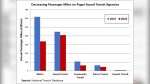 Puget Sound transit passenger-miles fell 31% from 2015 to 2024 despite a half-million-resident population increase.
 - Interstate Bridge Replacement Program seeks qualified firms for bridge replacement contract
 The CRBR project is backed by $5.7 billion from state funds, federal grants, and future tolling.
 - Opinion: Bankrupt – A $3.5 billion Rose Quarter Freeway widening project
 Joe Cortright argues ODOT’s Rose Quarter project has grown from a $450M approval to a $3.5B estimate, with a $2B funding gap.
 - Opinion: Portland’s War on Cars 3 – Ending the war on automobiles
 O’Toole argues Portland should add toll lanes, fix safety hazards, and redesign TriMet routes to end its anti-auto policies.
 wpDiscuz